Insurance and your child

Protecting the lives of your family, for the lifetime of your family

There is nothing more devastating to a parent than to have a son or daughter predecease them. We expect to raise our children to go out into the world, so witnessing their departure from it prematurely is not something a parent expects to be dealing with. It’s called a death out-of-order for good reason, as it does not fit the natural order of things.

Even so, the suggestion to obtain life insurance on a child can be unsettling to a parent. After all, the primary purpose of insurance is to replace lost income. The child doesn’t support the family; the parent does. To some, insuring a child may seem like a gamble for a payout upon a tragic and unlikely event.

However, the reality is that a child’s death can have significant consequences for the entire family. Insurance can provide the time, space and resources for people to heal. And in the more likely scenario where misfortune does not occur, it can then be a valuable tool to give your children a financial head start in life.

Financial cushion for recovery

Beyond the initial shock and expense of dealing with the loss, parents will need time to grieve. While many employers provide bereavement leave, it may not be enough for many parents to adequately recover.

With insurance acting as an income bridge, parents could choose to spend more time away from work until they are truly ready to return. Or for parents who run their own business, insurance could be used to sustain operations in their absence, for example to fund employee overtime, hire temporary staff or otherwise provide a cash infusion while activity slows.

And while this extended time is a welcome reprieve, it does not in fact heal all wounds.

Both parents and siblings of the departed child will have their own ways of coping. Some may be comfortable leaning on one another or confiding in friends, while others may need more. Insurance can help with the cost of professional counselling, allowing each family member to take whatever time they need and to use whatever process suits them best.

Types of insurance to choose from

Once a parent sees how insurance can help them manage such traumatic circumstances, the next consideration is whether to use a term or permanent policy. Term insurance is intended to last for a specified number of years, whereas permanent insurance is expected to be held for life. In either case, the insurer’s premium cost is based largely on the low risk of death of a young child, which in turn helps make it affordable for parents.

Generally, the least expensive option is for a parent to add a child term rider when they purchase their own insurance policy. Most insurers offer this coverage on a child up to a certain age, usually 25, at which time it is normally then convertible into permanent coverage.

Alternatively, the parents could choose permanent coverage right away, commonly a term-to-100 or whole life policy. Of the two, term-to-100 is lower cost, but whole life is often preferred as it can generate annual dividends that build its cash surrender value over the years. What’s more, that growth is tax-sheltered.

Tax-sheltered savings for education and more

Far and away, the greater likelihood is that a child progresses through their youth to become a thriving young adult. In that case, parents may wonder whether those past insurance premiums are a lost cost. The answer is that the financial cushion discussed above is only part of the case to be made for obtaining the insurance.

Built on that foundation, insurance can be an effective tool for a child’s own future financial needs. A familiar strategy is to use the tax-sheltered cash surrender value of a whole life policy to complement a Registered Education Savings Plan (RESP) for post-secondary education.

As policyholder, a parent could withdraw part of the cash value, arrange a policy loan with the insurer, or pledge the policy as collateral for a loan from a separate lender. An appealing part of the withdrawal option is that there is no interest charge in comparison to the loan options. On the other hand, if a large withdrawal is taken, it may be partially taxable. Even here though, there is a way to get some relief.

An income tax rule allows a parent to transfer a policy on a child’s life to that child on a tax-free basis. If the child then makes a withdrawal while over age 18, it is the child who will bear the tax, if any. Assuming that the child is a student with minimal income at the time, it is likely that there will be little or no tax to pay. It is also worth noting that money coming out of an insurance policy may be used for any purpose, not just for education.

For a child’s own future family

As children move further into adulthood, they will take on greater responsibilities, including having their own families. Like their parents, these new adults will have financial obligations to those families.

Insurance established in those early years and transferred to the child can now be used as a safety net for the new family. Of course, the amount of coverage needed will be larger than the original amount on the policy, so additional coverage may be sought.

But what if the son or daughter becomes disabled through an accident or develops a severe medical condition? How would that affect the policy? Fortunately, the insurance established in those early years may continue, even if there is a later diagnosis that makes the person uninsurable thereafter. As well, many insurers offer a guaranteed insurability rider to their policies, allowing future increases in the amount of insurance (within limits) without having to prove medical eligibility.

As these examples show, life insurance is not merely on a child’s life, but can be for a child’s life. It is a way for parents to preserve and pass on family values, both in financial sense and in sharing their beliefs.
Canadian dividends provide investors tax-efficiency

Home bias with a rational rationale

Investors are often comforted by investing in what is familiar. For Canadians, that may include investing a greater share of their portfolio in Canadian securities.

Whether or not it is intentional, this home bias can provide benefits beyond comfort, by also rewarding the investor from a tax perspective.

WHAT – Focus on non-registered investments

In a registered account like a Registered Retirement Savings Plan (RRSP), there is no tax distinction among the types of income. No tax applies to the income earned within the plan, then all withdrawals are fully taxable.

It’s different with non-registered accounts, where the method and amount of tax varies according to the type of income. In these accounts, Canadian dividends are tax-preferred, especially for those at low to middle income.

WHY – Corporation adds a taxpayer level

The recipient of any income is responsible for paying tax. If all income was earned directly by individuals, or natural persons, then things would be straightforward.

However, there are also artificial persons—or corporations—which may first earn and pay tax on income before passing it on to real people. The way it is passed on by the corporation is by paying dividends to its owner/shareholders, in this case the portfolio investors.

HOW – Integration mitigates double-taxation

With both individuals and corporations being required to pay tax on the income they receive, there is a risk of double-taxation. This is further complicated by the way each is taxed: corporations are taxed at a flat rate, and individuals pay tax at graduated rates that get progressively higher as income rises.

To reconcile this two-stage taxation, our system has a set of rules that integrates personal and corporate taxes. It’s known as the integration model and it has two main components:

1. Gross-up

A dividend received by a shareholder from a Canadian corporation is increased by an arithmetic factor designed to add back the taxes paid by the corporation. By doing so, it’s as if the investor earned the income that was really earned by the corporation. This ‘taxable’ dividend is what is used to calculate the investor’s initial tax liability – but wait…

2. Dividend tax credit

Another arithmetic factor is then applied to reduce the individual’s tax liability by the estimated tax that the corporation has already paid. The government has only collected part of its revenue from the corporation, so in effect the investor is topping that up.

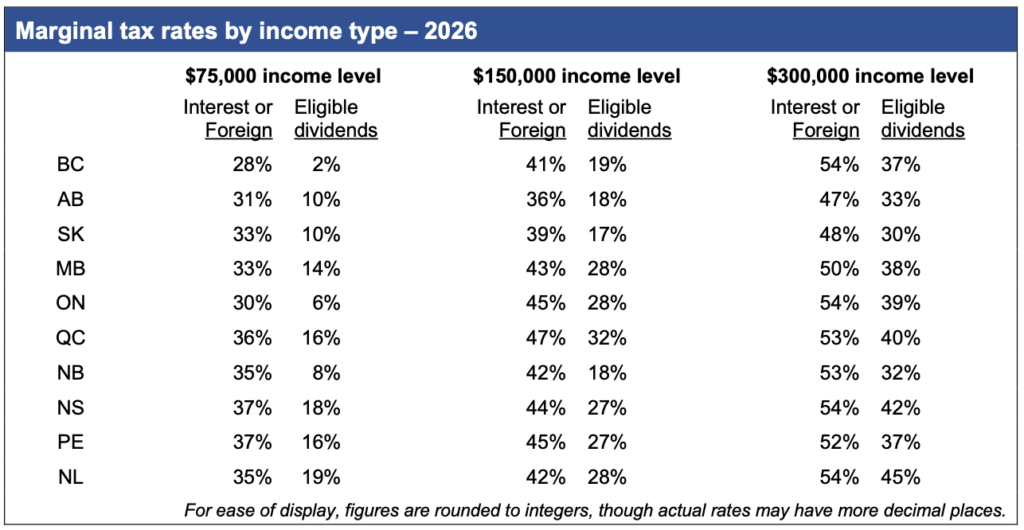
For investors in low to middle income brackets, this can result in much less tax than would apply to interest income or foreign dividends. And at very low income, the credit may exceed the tax as calculated above, allowing the excess credit to be applied against tax otherwise due on the person’s other income. The combined effect of the gross-up and dividend tax credit are shown in the table on the next page.

History – Two types of Canadian dividends

For decades, one set of factors for gross-up and tax credits applied to all Canadian-source dividends. But since 2006, dividends from a corporation that has paid its taxes at the general corporate rate have been entitled to more favourable ‘eligible’ gross-up and tax credit rates. This better recognizes the revenue the government has already collected from Canadian public corporations, and in turn provides relief to investors on taxation of the associated dividends received in their portfolios.

By contrast, where a corporation has used the small business rate, the ‘ineligible’ gross-up and tax credit rates apply. These are mostly owner-operator businesses, so not the type of dividends normally earned in an investment portfolio.

Governments adjust the gross-up and dividend tax credit figures occasionally, to maintain alignment with any changes in their corporate tax rates.

Illustration – Eligible dividends in a non-registered account

This following table shows the combined federal-provincial marginal rates for a dollar of income, without breaking over bracket thresholds. Figures are rounded to integers for ease of relative comparison of the income types, though actual rates may have more decimal places.

WHY NOT – Foreign dividends

Comparatively, dividends from foreign corporations are fully taxable to Canadian investors. A foreign corporation will have paid tax to its own government. As Canada receives none of that revenue, there is no reason for it to give a credit on foreign dividends paid to Canadian residents.

Estate freezing in an economic downturn?

A tax planning prompt for business owners[1]

Just a handful of years back, the COVID-19 pandemic caused tremendous disruption and pain in both the personal sphere and in business activity. Fastforward half a decade on and we’re grappling with recession fears in the midst of a tariff war initiated by our southern neighbour. In such times, owners of closely-held small businesses can be especially vulnerable, with both their primary income source and invested capital at risk.

The stops and starts of multiple waves – of virus on one hand and trade threats on the other – can wreak havoc and sew uncertainty. Ironically though, this kind of economic rollercoaster can open a window of tax opportunity for business owners who may have been hemming-and-hawing about succession. Whether pandemic, trade war or any adverse economic condition, a dip in business value may present a ripe opportunity to proceed with an estate freeze.

Tax exposure on succession

Think Think of an entrepreneur who established a business corporation years ago, and now wants to bring adult children into ownership. The problem is that a direct share transfer would be a disposition. The capital gain is calculated as the difference between the fair market value and adjusted cost base (ACB). That could result in a hefty tax bill for the parent, with a 1/2 income inclusion in the year that capital gains are realized.

Whether the parent intends to make a gift or to have the children buy their way in, quite often the children don’t have the cash at present anyway. That means the parent will have to use other cash to pay that tax bill. A more likely reality for many business owners is that the bulk of their wealth is tied up in the business, so there is little if any readily available cash.

Thus, the prospect of paying that tax could be paralyzing. Business growth would continue to accrue to the parent as current full owner, carrying with it the associated growing tax liability.

Enter the estate freeze

An estate freeze offers a more tax-efficient way to go about it. Future business growth is transferred to the successors, and the past growth is frozen in a way that ensures that no tax is incurred by the current owner in the present.

A familiar scenario is for the parent to exchange their common shares for preferred shares with the same value. These new ‘freeze’ shares won’t increase in value but will usually carry voting control and dividend rights. Often, it’s possible to increase the ACB on the shares using the lifetime capital gains exemption (LCGE), which stands at $1.275M in 2026. Whether or not the LCGE is used in this way, no tax arises at the time of the exchange.

Tax is deferred until the parent disposes of these freeze shares. Sometimes the shares are redeemed by the corporation over a course of years, providing cash to the parent and spreading tax recognition. Otherwise, there’s a deemed disposition at the parent’s death, or on the later death of a spouse if the shares are rolled over to the spouse on that first death.

A new class of ‘growth’ shares is issued to the children for nominal cost. Alternatively, a trust may be set up to hold these shares for the children as beneficiaries, with legal control left in the hands of the parent as one of the trustees. No tax arises on this part of the plan either.

Future growth has been pushed down a generation, allowing for years or decades of deferral before future gains are exposed to tax.

Why freeze on a dip? Or re-freeze?

Apart from the terrible health crisis of COVID-19, it also had a negative impact on the financial value of many businesses. But with that downturn came opportunity. While there was no guarantee when and how much a given business may recover, those who executed a freeze at a depressed value were able to push a greater amount of future growth to their next generation.

Consider as well the LCGE, this time looking at the successors. The exemption applies on a per-person basis, allowing for a multiplication of its total benefit based on the number of new shareholders. And if the value falls so far that the parent is not able to use the full LCGE on the share exchange, the parent could choose to take some of the growth shares and thereby also participate in the upswing.

What about those who undertook a freeze years ago at a much higher value before the economic downturn (pandemic or otherwise) ate away at the business value? In that case, a thaw and re-freeze might be in order, effectively resetting at the current depressed value, again in anticipation of the recovery of the business itself.

As to determining the appropriate value, it needs to stand up to scrutiny should the Canada Revenue Agency inquire, so the best approach is to have a professional valuation.

Implications for life insurance

Upon a freeze, the parent’s taxable gain becomes both known and capped. This is an ideal application for life insurance on that parent, or a joint last-to-die policy on the parent-couple. Of course, less insurance is needed with a freeze at a lower value, but that’s only half the story.

The successor children will now expect to reap a greater proportion of the gain. Allowing that the amount of the gain is unknown (unlike for the parent) and that the LCGE may reduce the tax, this is a still a good time to open the insurance dialogue. If the child’s entrepreneurial drive matches the parent’s, greater growth may yet be ahead, and the insurance put in place today will feel like a bargain in hindsight when the child considers their own estate freeze down the line.

[1] A version of this article appeared in Advocis Forum.