Interest equivalency

A tax tool for comparing interest to other investment returns

Rate of return on a portfolio is often front and centre in an investor’s mind. Understandable as this is, ultimately it’s about how much of those returns the investor will keep. The difference between the two is tax, which in turn depends on the type of income earned and the investor’s tax bracket.

This article deals with an individual earning income in a non-registered account, also known as an open account or cash account. With a range of variables in play, it can be difficult to follow the steps from initial return through tax calculation to spendable after-tax cash. A useful tool to help connect the arithmetic is interest equivalency.

Interest – Taking into consideration the tax trade-off

Interest is appealing for the part of a portfolio where certainty is the prime concern. For example, the issuer of a guaranteed investment certificate (GIC), agrees to pay a set amount of interest for the period of the contract.

This certainly provides valuable comfort to the investor, but an important trade-off from a tax perspective is that interest faces the full tax rate at any given income bracket.

Preferred taxation – Capital gains & Canadian dividends

Compared to interest, Canadian dividends and capital gains receive favourable tax treatment. They come at it from different routes, with the benefits emphasized at different income levels. Canadian dividends provide the best after-tax yield at low to mid brackets, giving way to capital gains at higher and top brackets.

Capital gains

There are two features that lead to the favourable tax experience from capital gains:

    1. Deferral – While a security is held, no tax arises on changes in its price. This is also true if the investor holds a mutual fund that fluctuates according to price movement of its underlying securities. But a redemption/sale is a taxable event, and if the value has increased then the investor will realize a capital gain at that time.
    2. Reduced inclusion rate – When there is a disposition, capital gains are said to be realized in that year, but only a portion of the capital gain is taxable. The “taxable capital gain” is derived by applying the income inclusion rate, which has ranged between 1/2 and 3/4 since 1971, but has been stable at 1/2 since 2000. The 2024 Federal Budget increased it to 2/3, while still allowing the 1/2 rate on the first $250,000 of an individual’s annual capital gains. (For trusts and corporations, the 2/3 rate applies to all capital gains.) The 1/2 rate is used in the examples to follow, on the assumption that the investor is an individual with less than $250,000 of annual capital gains.

The first feature allows tax-deferred growth. It is the second that is used in the interest equivalency calculation.

Canadian dividends

Like interest, Canadian dividends are taxed in the year earned, but the tax is calculated in two steps:

    1. Gross-up – The ‘gross-up’ factor adds back the corporate tax, so the investor’s bracket can be used to calculate the tax as if the investor had earned the income that was really earned by the corporation.
    2. Tax credit – The investor then gets a tax credit for the tax that the corporation has already paid.

This two-step process protects against double-taxation. The government’s revenue is split between the corporate tax and the personal tax, which is why an investor pays less on a dividend compared to the full rate for interest. 

How interest equivalency works

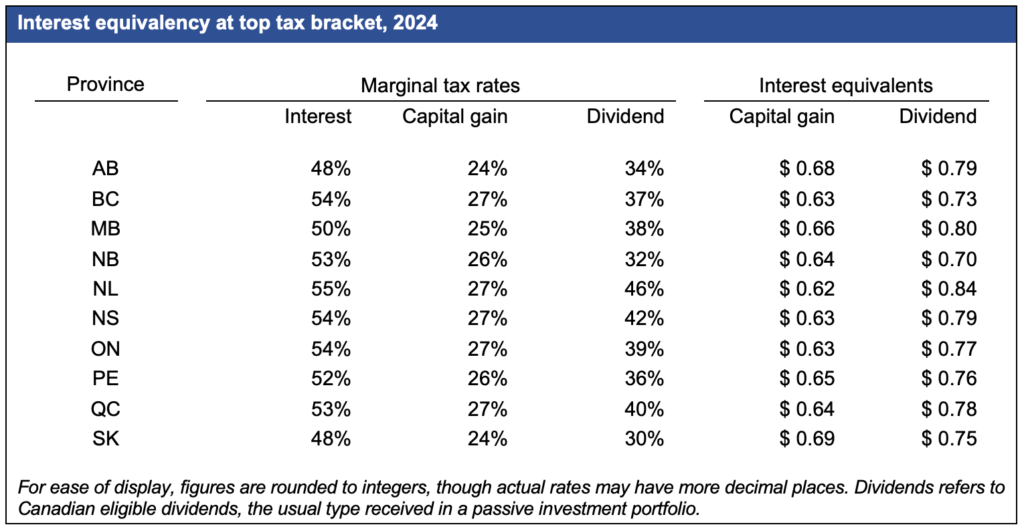
Interest equivalency shows what amount of preferred income will give an investor the same after-tax spendable cash as a dollar of interest. Alternatively, it can be expressed as the higher amount of interest that equates to a dollar of preferred income. Either way, the result is expressed in dollars and cents.

Formula

Interest equivalency is shown in the following table at top tax bracket for each province, but it can be calculated at any income level by applying the following formula that uses marginal tax rates (MTR):

Interest equivalency  =  ( 1 – MTRinterest ) ÷ ( 1 – MTRpreferred )
Proof

It may be easier to see how this works by looking at an example, here using Alberta in the first row of the table:

 

Informing yourself with this tool

To be clear, interest equivalency is a tool used to compare investment returns; it is not a suggestion against interest returns in a portfolio. All income types have their respective features, benefits and risks. The tool can help advisors and investors understand, compare and discuss investment options and recommendations in a portfolio.

Paying small business corporation dividends – Federal budget may be a call to action

One of the surprises in this year’s Federal Budget was the announced increase in the small business deduction for corporations.  Or in more common language, the small business tax rate is coming down.

This will be welcome news to small business owners who will benefit from being able to reinvest more of their after-tax dollars within their corporations.  While this is a win in the context of required reinvestment for business purposes, the effect is not so clear where it is a discretionary decision to forego dividends and invest to earn passive income.

And beyond that, this development could cause a reconsideration of existing investment accounts held at the corporate level.  Continuing to hold these funds in the corporation could result in the shareholder paying up to 2% more if dividends are delayed beyond this year.

Small business tax adjustments

The small business rate on the first $500,000 per year of qualifying active business income of a Canadian-controlled private corporation (CCPC) is going down from 11% to 9%.  The reduction will be implemented in half-percentage point in stages from 2016 to 2019.

In turn, corporate income that has benefited from the small business rate is treated as a non-eligible Canadian dividend when paid out to the shareholder.  To maintain balance for the integration of corporate and personal taxes, the gross-up and dividend tax credit (DTC) for non-eligible dividends will also be adjusted. (See table.)

These are changes at the federal level.  However, as the same gross-up is applied when calculating the shareholder’s provincial tax on the dividend, one would expect provinces to adjust their dividend credit rates accordingly.

Federal small business tax adjustments

                                                      2015        2016        2017        2018        2019

Small business rate              11%      10.5%        10%        9.5%          9%

Gross-up                                 18%         17%        17%         16%        15%

DTC                                            11%      10.5%       10%         9.5%         9%


Implications for dividend policies

In a given year, a shareholder (as director) may declare a dividend out of retained earnings, or continue to retain such funds in the corporation.  All else being equal (so the saying goes), the shareholder portion of income tax is deferred by retaining those funds corporately.  However, all else is not equal as we come into 2016 and roll through the next three years.

Consider a corporation that earns income in the current year, paying the 11% small business rate (focused on federal portion only).  On dividend of those funds in the current year, the DTC will be an equivalent of 11%.  However, if the dividend is delayed one year to 2016, the DTC will be the reduced 10.5%, meaning corporation and shareholder bear an extra 0.5% tax.  And of course that becomes as much as 2% if one delays to 2019.

This adds a wrinkle to the dividend/retention decision this year and in the next three years, though of course it is for the particular business owner to decide whether it is material. An obvious tradeoff arises if current dividends push the shareholder up through marginal tax brackets.

With respect to existing corporate investment accounts, the need for a decision is arguably more pressing.  This is retained money that has already paid its corporate tax, and has essentially been waiting to be subject to personal tax on dividend to shareholder.  As the corporate investments are likely part of eventual retirement, an early withdrawal may be undesirable, even in the face of this additional tax cost.   On the other hand, the reduction of the gross-up from 18% to eventually 15% will mean that later dividends will have less of a clawback effect on income tested benefits.

A thorough review will be necessary to determine the net effect on a given business owner.  And to repeat, it remains that person’s prerogative whether this is sufficiently material to take action.

Tax on dividends rising – Changes for small business owners

Small business owners will generally be paying a little more on the dividends they extract from their corporations beginning in 2014.  

In the 2013 federal budget, the government expressed its concern that individuals were being over-compensated by receiving dividends from a corporation than if the individual had earned that income personally.  Changes were proposed, and now enacted, in an effort to bring the system of integrating corporate and personal taxes back into alignment. 

To be more precise, these changes target corporate income that has made use of the small business deduction.  Previous changes had already addressed corporate income that had been subject to the full corporate tax rates – the so-called eligible dividend regime introduced in 2006 and rolled-out over the following six years.

Ineligible dividends in 2014, and on

In our income tax system we have two main types of taxpayers: individuals and corporations. Despite that taxes are levied at the corporate level, ultimately those taxes are borne by individuals.  The dividend gross-up/tax-credit procedure accounts for previously paid corporate taxes when the shareholder/individual calculates personal taxes due.  

Since the introduction of the eligible dividend regime in 2006, the federal gross-up and tax credit rates on ineligible dividends had remained unchanged.  Beginning in 2014, the gross-up will change from 25% to 18%, and the federal tax credit will go from 2/3 to 13/18.  The provinces use the federal gross-up, so have been prompted to adjust their respective tax credit rates.  

Based on enacted and announced changes (and subject to potential change in upcoming 2014 budgets), this table shows the effective tax rate shareholders face at top bracket in each province:

Top bracket rates – Ineligible dividends
(Combined federal-provincial)

Province     2013      2014

BC            33.7%    38.0%
AB            27.7%    29.4%
SK            33.3%    34.2%
MB           39.1%    40.8%
ON*          32.6%    36.5%
QC            38.5%    39.8%
NB            33.0%    36.0%
NS            36.2%    39.1%
PE            38.6%    38.7%
NL           30.0%    31.0%

The other side of the story

In fairness to the tax authorities, these changes are not arbitrary.  They are designed to integrate with the actual small business rate that will have been used in calculating the original corporate income.   

In theory, an individual taxpayer should be indifferent about earning income personally, or through a corporation that then distributes to the individual.  This should hold true whether the distribution is in the form of salary to that person as an employee, or as a dividend to that person as shareholder/owner. 

In practice though, things had gotten a bit out of kilter, leading to a preference toward dividends in most provinces in recent years.  The effect of the changes will be to narrow the distinction between salary and dividends, and in some cases to slightly swing the pendulum past perfect integration and toward salary.  

Bearing in mind that these are not the only considerations in deciding on the salary/dividend mix, here is the starting point those owner/managers can use for that analysis:  

Tax savings or cost of using dividends
(A positive figure favours dividends)

Province    2013    2014

BC            1.0%    -0.6%
AB            1.2%    -0.3%
SK            2.0%     1.2%
MB            0.6%    -0.9%
ON*          3.4%     0.1%
QC            -0.3%   -1.3%
NB            1.6%     0.9%
NS            4.2%     2.1%
PE            1.4%     1.3%
NL           1.8%     0.9%

* Ontario is expressed at the top federal bracket rate, rather than the significantly higher Ontario rate of $500,000+.