Donating securities ‘in-kind’ to charity

Tax-optimizing your philanthropy

When it comes to charitable donations, the most likely type of donation that comes to mind for most of is cash. However, there are a variety of ways to support your favourite charitable causes, one of which is to donate publicly traded securities in-kind.

The Canada Revenue Agency (CRA) defines a publicly traded security to include a share, debt obligation or right listed on a designated stock exchange, a share of the capital stock of a mutual fund corporation, a unit of a mutual fund trust, an interest in a related segregated fund trust or a prescribed debt obligation. 

When such securities are donated in-kind from a non-registered account, a tax receipt is issued for their fair market value (FMV) on the donation date. As with cash donations, a tax credit can then be claimed to reduce your income tax bill. In addition, in-kind donations can cost you less, and there is no reduction in what the charity receives.   

How the donation tax credit works

When you make charitable donations, both the federal and provincial governments allow you to claim a credit against the income tax you owe. The tax credit is based on the total dollar value of all donations in the year, no matter how many individual donations you make. The value of the credit varies by province, with the credit rate ranging from 20% to 25% on your first $200 of annual donations, and 40% to 54% on the amount over $200.

You can claim donations up to 75% of your net income in a year. Donations not claimed in the current year can be carried forward to be used in any of the next five years. This assures that a large single donation can be fully utilized, even if it exceeds the net income threshold. As well, this gives you flexibility if it is more beneficial to forego claiming the entire credit in the current year, and instead strategically spread it across multiple years.

For more on the principles of the donation tax credit, see the article “Four tax strategies to get more bang for your charitable donation buck”.

Donating cash or selling appreciated securities?

Most people make periodic charitable donations in cash, but that may not be optimal when you own securities that have appreciated in value. Cash is worth what you have in your hands, but appreciated securities carry a waiting tax bill. That appreciation is known as a capital gain, and while there is no tax on unrealized gains during the time one is holding investments, tax does apply in a year when there is a disposition/realization. The current income inclusion rate brings 1/2 of the capital gain into income, which is what is used in the examples in this article.

Let’s say you want to contribute to a local charity’s capital fund, and you have equal balances in your chequing account and your (appreciated) securities account. If you write a cheque, you still have your securities, but with their pending tax liability. If you sell the securities to make the donation, there is less money available for the donation due to the tax, which means that either the charity gets less, or you need to top up the donation from your chequing account.

One way or another, you or the charity will bear the brunt of the tax in these two scenarios. The question is whether there is a way for you to keep your fully spendable chequing balance, while making the maximum donation to the charity using your securities? This is where in-kind donations come in. 

Donating securities in-kind to eliminate tax on capital gains

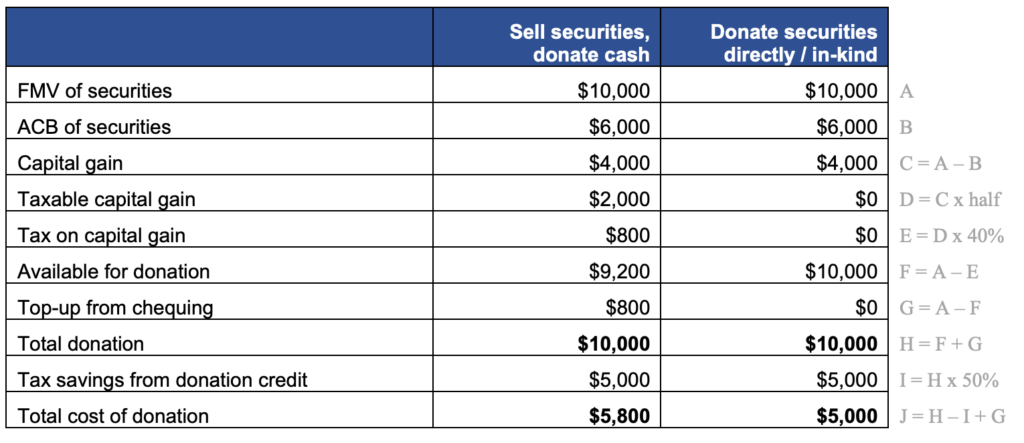
Typically, when there is a change of ownership of a security, a disposition is deemed to occur, and a capital gain or capital loss is triggered. However, when a security is transferred directly to a registered charity as a donation, the tax on any capital gain is reduced to zero. We can illustrate this with the following example:

  • Donor is in a 40% combined federal-provincial tax bracket in a province with a top donation credit rate of 50% 
  • $10,000 donation, using a security with $10,000 FMV and $6,000 adjusted cost base (ACB)
  • There has already been $200 in charitable donations made elsewhere this year
Donating securities in-kind to trigger a capital loss

The donation of appreciated securities is attractive, as we have just outlined. However, donating depreciated securities can also be a viable option, especially when it comes to your year-end tax planning. 

When you donate depreciated securities, you trigger a capital loss that will be applied against capital gains realized in that same tax year. You can then carry back any remaining capital loss to offset capital gains in the three previous tax years or carry those losses forward indefinitely. So not only will you receive a tax credit for the FMV of the donated securities, you will also be reducing your tax bill if you have realized capital gains elsewhere.
Canadian dividends provide investors tax-efficiency

Home bias with a rational rationale

Investors are often comforted by investing in what is familiar. For Canadians, that may include investing a greater share of their portfolio in Canadian securities.

Whether or not it is intentional, this home bias can provide benefits beyond comfort, by also rewarding the investor from a tax perspective.

WHAT – Focus on non-registered investments

In a registered account like a Registered Retirement Savings Plan (RRSP), there is no tax distinction among the types of income. No tax applies to the income earned within the plan, then all withdrawals are fully taxable.

It’s different with non-registered accounts, where the method and amount of tax varies according to the type of income. In these accounts, Canadian dividends are tax-preferred, especially for those at low to middle income.

WHY – Corporation adds a taxpayer level

The recipient of any income is responsible for paying tax. If all income was earned directly by individuals, or natural persons, then things would be straightforward.

However, there are also artificial persons—or corporations—which may first earn and pay tax on income before passing it on to real people. The way it is passed on by the corporation is by paying dividends to its owner/shareholders, in this case the portfolio investors.

HOW – Integration mitigates double-taxation

With both individuals and corporations being required to pay tax on the income they receive, there is a risk of double-taxation. This is further complicated by the way each is taxed: corporations are taxed at a flat rate, and individuals pay tax at graduated rates that get progressively higher as income rises.

To reconcile this two-stage taxation, our system has a set of rules that integrates personal and corporate taxes. It’s known as the integration model and it has two main components:

1. Gross-up

A dividend received by a shareholder from a Canadian corporation is increased by an arithmetic factor designed to add back the taxes paid by the corporation. By doing so, it’s as if the investor earned the income that was really earned by the corporation. This ‘taxable’ dividend is what is used to calculate the investor’s initial tax liability – but wait…

2. Dividend tax credit

Another arithmetic factor is then applied to reduce the individual’s tax liability by the estimated tax that the corporation has already paid. The government has only collected part of its revenue from the corporation, so in effect the investor is topping that up.

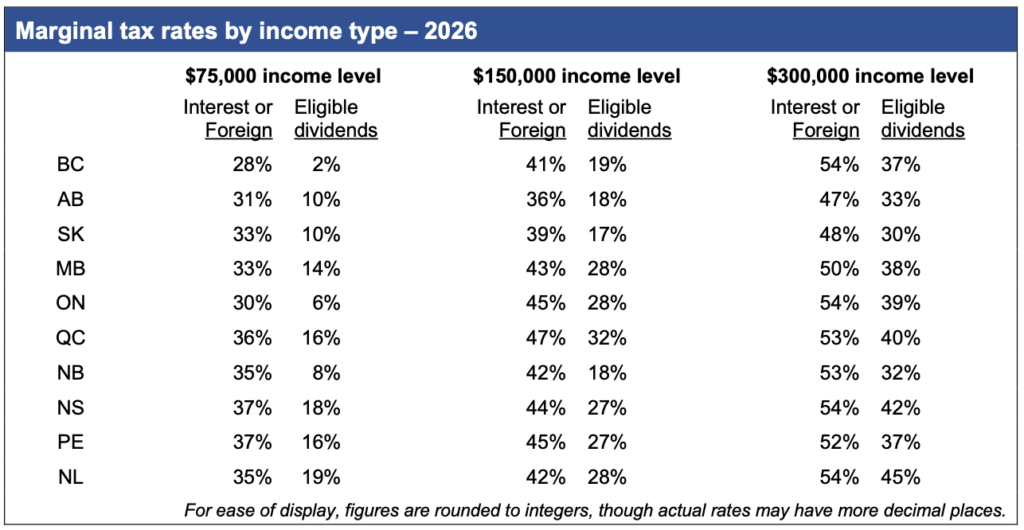
For investors in low to middle income brackets, this can result in much less tax than would apply to interest income or foreign dividends. And at very low income, the credit may exceed the tax as calculated above, allowing the excess credit to be applied against tax otherwise due on the person’s other income. The combined effect of the gross-up and dividend tax credit are shown in the table on the next page.

History – Two types of Canadian dividends

For decades, one set of factors for gross-up and tax credits applied to all Canadian-source dividends. But since 2006, dividends from a corporation that has paid its taxes at the general corporate rate have been entitled to more favourable ‘eligible’ gross-up and tax credit rates. This better recognizes the revenue the government has already collected from Canadian public corporations, and in turn provides relief to investors on taxation of the associated dividends received in their portfolios.

By contrast, where a corporation has used the small business rate, the ‘ineligible’ gross-up and tax credit rates apply. These are mostly owner-operator businesses, so not the type of dividends normally earned in an investment portfolio.

Governments adjust the gross-up and dividend tax credit figures occasionally, to maintain alignment with any changes in their corporate tax rates.

Illustration – Eligible dividends in a non-registered account

This following table shows the combined federal-provincial marginal rates for a dollar of income, without breaking over bracket thresholds. Figures are rounded to integers for ease of relative comparison of the income types, though actual rates may have more decimal places.

WHY NOT – Foreign dividends

Comparatively, dividends from foreign corporations are fully taxable to Canadian investors. A foreign corporation will have paid tax to its own government. As Canada receives none of that revenue, there is no reason for it to give a credit on foreign dividends paid to Canadian residents.

Spouse and family income splitting

Navigating income attribution rules, including prescribed rate loans

Income splitting has been around for as long as the tax system itself. It’s a shift of income recognition from a high-rate taxpayer to someone at a lower tax rate. Most often it will involve a spouse/common-law partner (CLP), and can also work with children though less often when they are of minor age.

Importantly, income splitting is not illegal. It is however constrained by tax rules that scrutinize gifts and preferential loans between closely connected people. That being so, it’s sensible to review and understand the rules that could undo a planned action, prior to launching into the effort.

The motivation for income splitting

The premise of a progressive tax system is that those more financially capable are asked to bear a larger share of tax. For income tax, a higher rate of tax is imposed on income above each bracket threshold.

Presently there are five federal tax brackets, with rates progressing from 15% up to 33%. Each province has a similar structure, though the rates and number of brackets vary. When combined with federal rates, the top individual marginal tax rate is near or above 50%. Comparatively, the lowest combined rates are roughly in the 20-25% range, and may be close to zero once personal tax credits are applied.

Successful income splitting could cut that portion of a given family’s tax bill in half or better.

Attribution with a spouse/common-law partner

Attribution rules include both general and specific Income Tax Act provisions designed to plug holes where tax may leak. The base rule between an individual and a spouse/CLP is that any income, loss, capital gain or capital loss on loaned or transferred property will be attributed back to the transferor.

The rules don’t affect or change the legality of the transfer, including the legal right to the associated income or gain. Instead, they simply cause the transferor to pay the tax at his/her marginal tax rate.

The rules apply to direct transfers, as well as to indirect transfers and more complex scenarios, including:

    • Transfer to a trust or corporation in which the recipient has a beneficial interest
    • Loans without interest, or at interest below the prescribed rate (discussed further below)
    • Loans through an intermediary to mask underlying routing of funds back to the recipient
    • Third party loans advanced to the recipient, contingent on the guarantee of the high bracket person
    • Re-advancing loans paying off an original loan from the same person to whom attribution applied
    • Non-monetary loans, such as a loan of real estate or personal property
    • Claiming an advantageous split of commingled funds, without any record of respective contributions
    • Pre-relationship transfer or loan, with attribution beginning once a spouse/CLP relationship begins
    • Substituted property acquired with proceeds of sale of original property that was subject to attribution

Attribution with a related minor child

Where a transfer or loan is made to a related minor child, attribution applies on income up to the year the child reaches age 18. Notably, there is no attribution of capital gains or capital losses, whether realized before or after the child reaches age 18, presenting a significant splitting opportunity. For these purposes, child includes a grandchild, sibling, niece or nephew of the individual or of a spouse/CLP.

Strategies that can avoid the attribution rules

The attribution rules can be circumvented with informed planning. The strategies described below refer to a spouse/CLP, but they work just as well when splitting with a child.

Prescribed rate loan

While a transfer to a spouse/CLP by way of gift is a problem, a properly documented and serviced loan that complies with the prescribed interest rate rules will escape attribution. The investment income will be taxed to the lower income borrowing spouse, less a deduction for the interest paid. On the other side, the lending spouse will have to include the interest in income.

While a formal written loan agreement is not mandatory, it’s prudent to have one to buttress the bona fides of the arrangement, should it be questioned in future by tax authorities. Apart from that,

    • Interest payments must actually be made from borrower to lender, paid during the calendar year or no later than 30 days after year-end (January 30th, not ‘end of January’).
    • The lending spouse cannot be the source of the interest for the borrowing spouse, meaning it cannot be simply capitalized to the loan or be part of a revolving loan arrangement.
    • The rate must be commercially reasonable, and be no less than the rate prescribed by tax regulations. That rate is set quarterly, calculated as the average yield of Government of Canada 3-month T-Bills auctioned in the first month of the preceding quarter, rounded up to the next whole percentage.
    • The prescribed rate is 3% in the first quarter of 2026.
    • Failure to comply with any of these rules makes the loan forever offside thereafter.

What makes this strategy particularly appealing is that the loan may remain outstanding indefinitely at the original interest rate, even if the prescribed rate rises in future. And if the prescribed rate falls, the current loan could be paid out, and a new loan established at the lowered prescribed rate.

Fair market value exchange

If a low bracket spouse gives an asset of fair market value (FMV) in exchange, attribution will not apply. However, if the FMV falls short, full attribution still applies. In other words, there is no pro-rata treatment, so the transfer from the high bracket spouse should be no more than the available asset’s FMV.

Examples may be an automobile, antiques or jewelry, as long as the ownership interest did not originate with the high bracket spouse, such as an earlier gift. An interest in a cottage or principal residence may also be possible, but those are more complicated due to land transfer tax (in some provinces), as well as tax on disposition and required tax elections to be made when filing tax returns for that year.

Income-on-income (also known as second/later generation income)

It is only the income on the original gift that is attributable. When that income is reinvested by the receiving spouse, the ongoing income-on-income is taxed to him/her. To prove this distinction if there is an audit (given that the onus is on the taxpayer), it may help to move income on the original investment into a separate account where it can be clearly tracked.

Business income

Generally, the attribution rules are intended to capture passive income from property. If the receiving spouse uses the transferred funds to generate business income, then attribution will not apply.