Disability needs planning using trusts

Aligning trust features with individual circumstances

Disability planning can be challenging to manage, even when focused on the health and medical issues alone. Extend that to navigating financial supports and tax benefits, and understandably it can feel overwhelming. Trusts1 can ease both the financial pressure and mental stress this can bring on, whether planning for oneself, a spouse2, a child, a sibling, or extended relations.

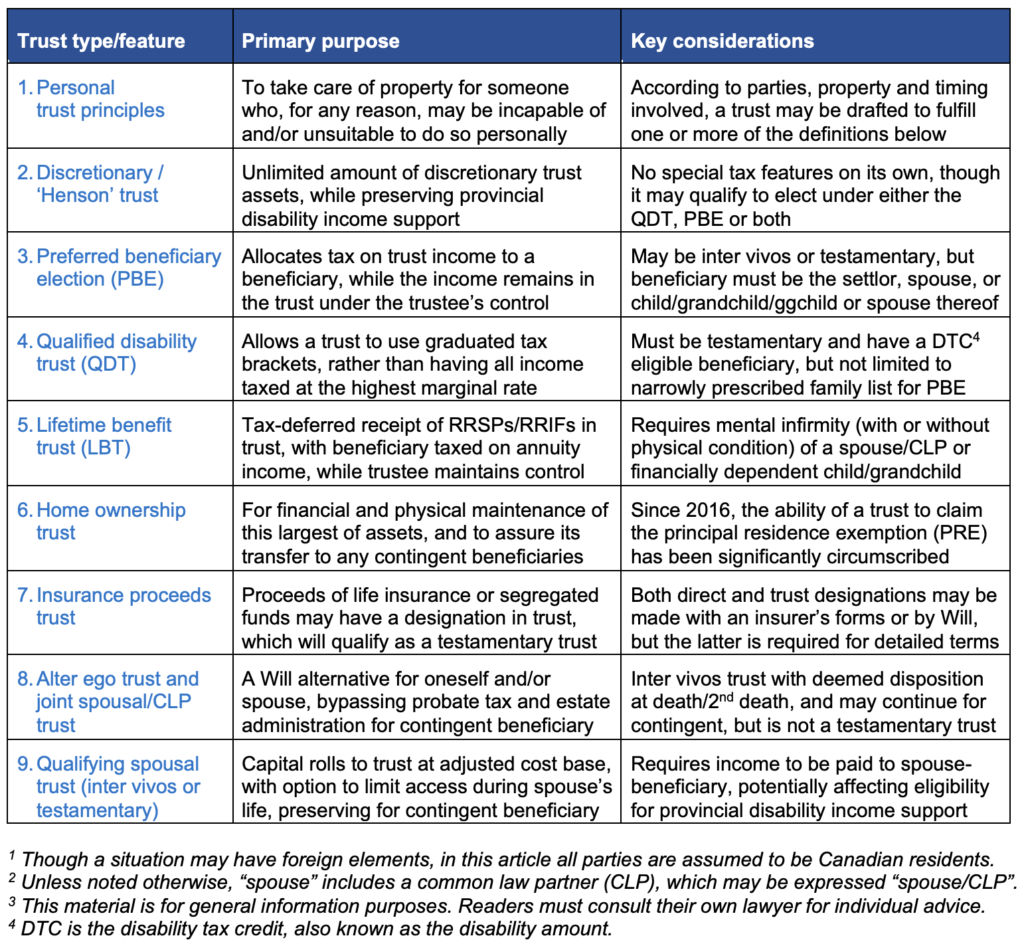
The table below highlights the type and features of trusts that can assist those with disabilities, with more detailed discussion in the following pages. In addition, for current tax and financial figures, please see the companion article Disability income support and tax benefits.3


1.    Personal trust principles

At its core, a trust separates legal ownership of property from beneficial ownership. The original property owner (the settlor) wishes to provide for someone (the beneficiary) who may be incapable of, or unsuitable to be managing property personally. By creating/settling the trust, the settlor chooses a person (the trustee) whom the settlor trusts in both the generic sense of confidence and in the formal position of having legal control.

For the disability trust types and features discussed below, the drafting must adhere to the appropriate regulation or administrative guidance. Even so, there can be trade-offs among these options, so legal advice is a must.

2.    Discretionary / ‘Henson’ trust

Provincial disability income support programs require that applicants provide initial and ongoing financial disclosure. The specifics vary by province, but generally these programs are intended as a safety net for vulnerable people who do not have, or have exhausted, personal resources in managing their lives. Thus, if an individual’s assets or annual income exceed prescribed figures, benefits may be reduced or eliminated altogether.

A discretionary trust can help shield against inclusion of some assets and income sources in this determination. This is sometimes called a ‘Henson’ trust, a reference to the 1980s Ontario case that ruled on the issue. Though technically only applicable to the Ontario program (now the Ontario Disability Support Plan, or ODSP), most provinces abide by similar principles, but with some variation so it is prudent to verify with provincial officials.

The defining (and really the only) feature is that the trustee has absolute discretion as to the amount and timing of trust distributions. As the beneficiary cannot compel payment, those assets will not be counted when determining eligibility or amount of support. Distributions to the beneficiary are subject to the program’s usual income rules.

Helpful as this can be, other factors aside from public support may influence when, how and even whether to use such a trust, depending on available assets and other income sources, and implications for access to tax benefits.

Ontario Inheritance trust

Up to $100,000 that is received as beneficiary of an estate or life insurance policy may be transferred into a non-discretionary trust. It is treated as income in the month received, but an exempt asset thereafter if transferred into trust within six months. Annual trust income does not affect ODSP if added to trust capital (up to the prescribed $100,000 level), but distributions to the beneficiary are subject to the program’s usual income rules.

Manitoba EIA trust

Manitoba has a “trust property exemption”, under its Employment and Income Assistance (EIA) Regulation. It allows up to $200,000 to be contributed to either/both an EIA trust and a registered disability savings plan (RDSP) without affecting support eligibility. Recent legislation passed in 2021 came in force in 2023, but the associated regulation did not come in force at the same time. Consult a Manitoba lawyer for current status.

RDSPs generally

A RDSP is not a personal trust, but as it was mentioned above in discussing Manitoba, it bears noting that all provinces exempt it as an asset. As well, distributions are treated as exempt income (partial in NB, PE and QC).

3.    Preferred beneficiary election (PBE)

The preferred beneficiary election (PBE) allows for tax on income earned in a trust (inter vivos or testamentary) to be allocated to certain beneficiaries, while the income itself remains in the trust. The trust must have one or more preferred beneficiaries, and may also have other non-preferred beneficiaries. A preferred beneficiary is a person:

    • Of any age who qualifies for the DTC, or
    • Who is 18 or older, and a dependant of another individual due to mental or physical impairment, and whose annual income (not including any allocation under the PBE) is no more than the maximum basic personal tax credit amount

In addition, the beneficiary must be one of the following:

    • Settlor of the trust
    • Spouse/CLP or former spouse/CLP, of the settlor
    • A child, grandchild, or great grandchild of the settlor, or
    • Spouse/CLP of a child, grandchild, or great grandchild of the settlor

The trust will pay no tax up to the basic personal exemption and can apply graduated bracket rates above that. Despite using the beneficiary’s credits and brackets, the election does not affect provincial disability income support.

Legal requirement for a joint election

To obtain this treatment, the preferred beneficiary and the trust must make an annual joint election that is filed with the trust’s T3 Tax Return. If the beneficiary is legally incapable of making the election, it may be made by the person’s attorney for property if one was appointed before the beneficiary was found to be incapable, failing which it will be necessary to commence a court application to appoint a guardian of property for the beneficiary.

4.    Qualified disability trust (QDT)

Since 2015, most testamentary trusts are taxed at the highest marginal tax rate in the province, as has long been the case for inter vivos trusts. However, if a testamentary trust has a ‘qualifying beneficiary’ (one who is eligible for the DTC), it may be able to use graduated tax brackets as a qualified disability trust (QDT).

Like the PBE, the trust and beneficiary must make an annual joint election, and if the beneficiary is incapable then an attorney or guardian for property may do so. Note that while a qualifying beneficiary can only make this election with one trust in a year, the trust may have other beneficiaries in addition to the qualifying beneficiary. Be aware that if a capital distribution is made to anyone other than the qualifying beneficiary, QDT status will be lost and the trust will be taxed at the highest bracket rate that year, with the added risk of reassessment of past years’ T3 returns.

There was initial concern when the QDT was introduced that use of the PBE may be limited thereafter, but either or both elections may be made in a year if the respective conditions of each provision are met.

5.    Lifetime benefit trust

A person’s assets are deemed disposed on death, including causing the value of registered retirement savings plans (RRSPs) and registered retirement income funds (RRIFs) to be taxed in the deceased’s final year. This inclusion can be deferred to a spouse/CLP or financially dependent child/grandchild who is a plan beneficiary. However, if that person has a disability, concerns may arise as to how the money might be managed after receipt.

With this in mind, the RRSP/RRIF holder could instead direct the proceeds to a lifetime benefit trust (LBT), of which the intended recipient is the lifetime beneficiary. Preferably this will be done using a Will, so the trustee can be given detailed instructions, as needed. Whether designated on a plan or by Will, this is only available for mental infirmity, not for strictly physical conditions. On the other hand, the condition need not be so severe that the person qualifies for the DTC, though if the DTC is being claimed then that can bolster the assertion of mental infirmity.

There is no tax when the LBT receives the RRSP/RRIF. The trustee must use those funds to acquire a qualifying trust annuity (QTA), which will make periodic payments to the LBT. By default, the trust is taxed at top bracket, but the annual annuity income may be attributed to the beneficiary, to make optimal use of tax credits and graduated brackets. The trust then pays the beneficiary’s tax, and the net income remains under the trustee’s control.

The trustee must use the trust money for the comfort, care and maintenance of the beneficiary, who has a lifetime interest. This is to distinguish from any contingent beneficiary/ies the RRSP/RRIF holder has designated to receive any undistributed balance in the LBT and any commuted value of the QTA upon death of the lifetime beneficiary. This provides comfort and certainty that the remainder cannot be redirected by the lifetime beneficiary’s Will (or by intestacy in the absence of a Will), and that it will also bypass any probate tax.

Despite attribution to the lifetime beneficiary, the annuity payments to the LBT will not be considered the beneficiary’s own income, and so will not affect provincial disability income support. However, distributions from the LBT to the beneficiary may affect the amount of those benefits, subject to the program’s usual income rules.

6.    Home ownership trust

Apart from assuring sufficient financial support for living needs, top priorities for the parent of a disabled child are a caring social network and a stable home environment. Indeed, the two go hand-in-hand, with the parent being the main provider. But as a parent ages, this becomes increasingly difficult to handle, and there can be even greater uncertainty after the parent’s death, even with diligent planning.

For the range of reasons already outlined, it may not be practical or desirable for a disabled person to directly own the home they live in. Consider further that a parent with other children will likely want to share his/her estate among them, even if a larger share may be earmarked for the child with a disability. This presents an especially large obstacle when the home (or the money needed for its purchase) constitutes the bulk of the expected estate.

So, whether it’s an only child or one of many, a trust may be a prudent alternative for home ownership. It could be an inter vivos trust created while the parent is alive and continuing after death (see Alter ego and joint spousal/CLP trust below), or a property owned by the parent at death could pass through the Will to a testamentary trust. 

Principal residence exemption (PRE)

Without getting into all the criteria for the PRE, it generally protects against taxation of capital gains on disposition of a residence that a person owns and ordinarily inhabits. This can include a trust owning a residence inhabited by a beneficiary, though the availability of the PRE to trusts has been significantly circumscribed since 2016, now limited to the following trusts:

    • A qualifying spousal/CLP trust, alter ego trust or joint spousal/CLP trust
    • An ‘orphan trust’, being for a minor child of a deceased parent, or
    • A qualified disability trust (QDT), but only if the trust was settled by a parent or spouse

If there are multiple beneficiaries of a QDT, and the trust claims the PRE on behalf of the DTC-qualified beneficiary in a year, this can affect future PRE claims of other beneficiaries on properties owned during overlapping years.

7.    Insurance proceeds trust

For a parent preparing for what will happen after their own death, insurance and/or segregated funds may be intended as a principal source to provide for a child (minor or adult) with disability needs.

Generally, beneficiaries may be designated by an insurer’s forms, or by making a written declaration, including by Will. The declaration must comply with, and explicitly refer to, the relevant provincial Insurance Act provision to assure that the policy/plan proceeds do not form part of the estate for creditor or probate purposes. (This should be verified with a local lawyer, particularly in Saskatchewan where some courts have held otherwise on certain facts.)

If the beneficiary is a minor or is otherwise unable to give legal consent, the proceeds must be paid to a trustee for the beneficiary. As with a direct designation, a trust designation may be made by way of the insurer’s forms or by written declaration, again including a Will. Either way, it will be considered a testamentary trust for tax purposes.

Insurers will generally only allow brief terms for trust designations, whereas a Will may contain as much detail as desired. As will be evident from the foregoing discussion, a clear identification of powers and rights is critical to be able to make use of desired trust types and features. To achieve this, a properly drafted Will is recommended.

8.    Alter ego trust and joint spousal/CLP trust

A person who is at least 65 can settle an alter ego trust of which he/she is the beneficiary, or joint spousal/CLP trust where both spouse/CLPs are beneficiaries. In the latter case, one or both may be settlors. Property is transferred into the trust tax-deferred at adjusted cost base (ACB), and future trust income is attributed to the settlor. Only the settlor or spouse may receive the income or capital of the trust while they are living, and contingent beneficiaries may be named to receive the remainder on death for an alter ego trust, or on 2nd death for joint spousal/CLP trust.

The main purpose of such trusts is as a Will alternative, as the contingent beneficiary designation allows for the bypass of any probate tax, and streamlines distribution outside of the formal estate. They may also be used with knowledge or anticipation of the settlor or spouse/CLP’s future disability or incapacity.

For parents of a disabled child, the contingent beneficiary designation may be part of the plan to provide for that child after the 2ndparent’s death. In deciding whether, when and how much to settle into such a trust, parents should be cognizant that this an inter vivos trust, so will not meet the requirements of a QDT which is required to be testamentary, but may qualify for the PBE.

9.    Qualifying spousal/CLP trust (inter vivos or testamentary)

Like an alter ego trust or joint spousal/CLP trust, property can roll into a qualifying spousal/CLP trust at ACB, but in this case the spouse/CLP is the only beneficiary. Only that spouse/CLP may obtain the income (though taxation may be attributed to the settlor) or capital of the trust during his/her lifetime, and contingent beneficiaries may be named to receive the remainder at death.

Though this type of trust can be created inter vivos (at any age), it is more commonly established in a deceased’s Will to create a testamentary trust that provides for a surviving spouse/CLP. The ACB rollover in this case defers the tax that would otherwise apply due to the deemed disposition on death. There are a range of reasons for creating such a trust rather than making an outright transfer to the spouse as an estate beneficiary (which may also be by ACB rollover). For example, this may be useful in a second marriage situation, allowing continued use of assets by a surviving spouse/CLP, with ultimate distribution of capital going to children of a first marriage.

When testamentary, this trust may be an effective tool to care for a disabled surviving spouse/CLP, and after that person’s death to be part of the support for a disabled child. For either of those beneficiaries, it can qualify for the QDT and PBE, and may also be able to serve as a house ownership trust, including the ability to claim the PRE.
Disability income support and tax benefits – 2026

Public assistance, tax relief and coordinated private planning

People with physical and mental disabilities often face serious financial challenges due to earning limitations and direct out-of-pocket costs. Fortunately, government support is available, as summarized below. Unless noted otherwise, all figures are for programs and federal tax credits for the 2026 tax year, rounded to the nearest dollar. 

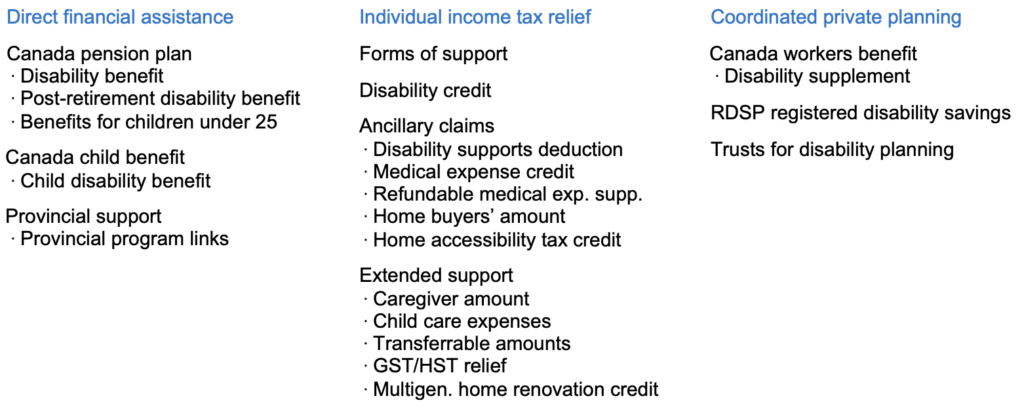
With support delivered in multiple ways, from both provincial and federal sources, it can be difficult to determine what, how and how much may be available. To help you navigate, the material in this document is broken into three major topics below. Hyperlinks to official sources are included in the subtopic descriptions, with full text of those links in the appendix:

Direct financial assistance

Canada pension plan

The Canada pension plan (CPP) is a social insurance plan providing income replacement to contributors and their families in the event of retirement, disability or death. It is run by the government, but funded by mandatory employee and employer premiums.

CPP disability benefit [1]

The CPP disability benefit is available to people under age 65 not receiving a CPP retirement pension who have made recent CPP premium payments while working. Generally, this means contributions in four of the last six years, or contributions for at least 25 years, including three of the last six years.

The disability must be both:

    • severe (a person is incapable of regularly pursuing any substantially gainful occupation); and
    • prolonged (long-term and of indefinite duration or is likely to result in death).

The monthly disability benefit is a basic amount, plus an addition based on the person’s past CPP premiums. Currently, the base is $610, with the maximum at $1,741. When the person turns 65, the CPP disability benefit is automatically changed to a CPP retirement pension.

CPP post-retirement disability benefit [2]

A person 60 to 65 with a CPP retirement pension for more than 15 months is not eligible for the CPP disability benefit. Instead, if the definition for disability and minimum contribution requirements are met, the post-retirement disability benefit (PRDB) is paid as a $598 flat rate. The application is the same as for the CPP disability benefit.

Benefits for children under 25 [3]

The CPP children’s benefits provide monthly payments to the dependent children of disabled or deceased CPP contributors. The disabled contributor’s child’s benefit, currently $308, is for a child of a person receiving a CPP disability benefit. Though related to the disabled contributor’s own claim, this is a separate application form and process. It is taxable to the child, even if received by a parent or guardian on the child’s behalf. The child must be under age 18, or under 25 if attending a qualifying post-secondary educational institution. For a part-time post-secondary student under 25, the benefit is halved.

Canada child benefit

The Canada child benefit (CCB) is a tax-free payment made to eligible families by the federal government to help with the cost of raising children under 18 years of age. The maximum amounts are progressively reduced as adjusted family net income (FNI) exceeds indexed annual thresholds.

    • For July 2025 to June 2026, the monthly maximum is $666 for children under 6, and $562 for a child between 6 and 17, reduced as 2024 FNI exceeds $37,487
    • For July 2026 to June 2027, the monthly maximums by those age categories are $680 and $574 respectively, reduced as 2025 FNI exceeds $38, 237

The CCB may include the child disability benefit (CDB) and related provincial/territorial programs.

Child disability benefit (CDB)  [4]

The CDB is available to families with children qualifying for the disability credit (see below). Amounts for 2023 are:

    • For July 2025 to June 2026, the monthly maximum is $284, reduced as 2024 FNI exceeds $81,222
    • For July 2026 to June 2027, the monthly maximum is $290, reduced as 2025 FNI exceeds $82,847

To qualify, Form T2201 must be completed by a qualified health professional and submitted to the Canada Revenue Agency (CRA) for approval. The payment is then delivered as part of the monthly CCB payment.

Provincial support programs

Some provinces have standalone disability support programs, while others recognize disability as a special qualification within the broader social support system. Generally, a licensed health professional using provincially prescribed criteria and forms must certify the disability. Provincial approaches vary in terms of service offerings, cost reimbursements, rates for family size and composition, and direct financial assistance.

Entitlement is reduced or eliminated where earnings or assets exceed regulated thresholds, though some provinces will disregard assets held in a discretionary trust for the disabled person (ie., Henson trust, discussed below). To determine provincial resources, consult these program links: [5]

Alberta – Assured Income for the Severely Handicapped (AISH)

British Columbia – Disability assistance

ManitobaEmployment and Income Assistance for Persons with Disabilities

New Brunswick – Family Income Security Act – Extended Benefits Program

Newfoundland and LabradorPersons with Disabilities & Income Support, Rates

Nova ScotiaDisability Support Program

Ontario – Ontario Disability Support Program (ODSP)

Prince Edward Island – AccessAbility Supports

Quebec – Ministère du Travail, de l’Emploi et de la Solidarité sociale (general)

SaskatchewanSaskatchewan Assured Income for Disability (SAID)

Individual income tax relief

Forms of support [6]

Tax measures commonly available to assist persons with disabilities fall into three categories:

    1. Deductions
      Qualifying items reduce the taxable income upon which relevant federal and provincial tax rates are applied.
    2. Non-refundable tax credits
      Once a person’s tax liability is calculated, credits are applied to reduce that liability but cannot take it below zero. The qualifying amount is multiplied by the applicable federal or provincial rate (usually the lowest bracket rate) to calculate the credit value. In 2025, the newly elected Liberal party reduced the lowest bracket rate from 15% to 14%, but allowed for the 15% rate to continue for tax credit purposes for tax years from 2025 to 2030.
    3. Refundable tax credits
      The value of these credits is determined similarly to non-refundable credits, with the qualifying amount multiplied by the applicable federal or provincial rate. The resulting value is first applied to reduce the individual’s tax due, and if there is any left over after the tax liability has been reduced to zero, the remainder is paid to the taxpayer.

The following is an outline of the key items and their potential dollar values (often income-dependent), though it does not cover all possibilities. For a comprehensive view, including detailed qualification criteria, consult Guide RC4064 Disability-Related Information. [7]

Disability tax credit (DTC) [8]

This is a non-refundable credit, available both federally and provincially. Using tax form T2201, the disability must be certified by a qualified medical practitioner as being both severe (i.e., blindness, conditions requiring life-sustaining therapy, a marked restriction in speaking or hearing, walking, feeding, dressing, elimination or a marked restriction in everyday mental functions) and prolonged (lasting, or expected to last, continuously for at least 12 months).

The basic federal amount is $10,341. A supplement worth as much as $6,032 may be available for children under age 18, though the value is reduced if certain child and attendant care expenses are claimed for the child.

When multiplied by the credit rate, the maximum value for the DTC is $1,551 and for the supplement $905, for as much as $2,456 total.

Ancillary claims

Disability supports deduction [9]

A disabled person may deduct qualifying out-of-pocket expenses incurred to work, go to school or conduct grant-supported research. The person may not deduct amounts already claimed under the medical expense credit (whether claimed personally or on the person’s behalf as a dependant), or amounts already reimbursed by health insurance plans or through other non-taxable payments. Generally, the deduction cannot exceed the person’s earned income for the year, calculated using CRA Form T929.

Medical expense credit [10]

A person may claim eligible medical expenses, whether incurred in Canada or elsewhere, that will be paid in a 12-month period that ends on any day in the taxation/calendar year.

Special rules apply to attendant care expenses, according to whether the care was received at home or in a facility. This is a non-refundable tax credit, equal to expenses that exceed the lesser of $2,890 (indexed annually) and 3% of the disabled person’s net income. Each province uses a similar rule of lesser-of a prescribed dollar amount and 3% of net income, though applied differently in Quebec as a credit on qualifying expense amounts over 3% of family net income.

Eligible expenditures can be claimed either under this medical expense credit calculation or as a disability support deduction, but not both. Accordingly, run a test calculation to determine which of the two yields the best net tax result.

Refundable medical expense supplement [11]

This is a refundable credit designed to assist people with low incomes who claim either the disability supports deduction or the medical expense credit. Subject to a clawback where family net income exceeds $33,960, this federal credit can be worth as much as $1,534.

Home buyers’ amount [12]

A credit amount of $10,000 (value $1,500 as a non-refundable tax credit) is available for first-time purchasers of a qualifying home. You do not have to be a first-time buyer if you are eligible for the DTC or you bought the home for the benefit of a related person who is eligible for the DTC. However, the purchase must be to allow the person with the disability to live in a home that is more accessible or better suited to his or her needs.

Home accessibility tax credit [13]

This non-refundable credit is worth up to $3,000, based on a $20,000 amount. It is for eligible home renovations if they allow a person to gain access to or be more mobile or functional within the home, or if the renovations reduce the risk of harm within the home. The eligible person must be 65 or older, or be eligible for the DTC. The credit may be claimed by that person, or by a homeowner who supports the eligible dependent person if certain criteria are met.

Extended support

Caregiver amount

The Caregiver amount is a non-refundable tax credit that may be available to a person who supports a person with a physical or mental impairment. The amount and value of the credit are determined based on the dependant the taxpayer is supporting.

For care of a dependent spouse/common-law partner (CLP) the spouse/CLP amount is increased by $2,740. For a minor child or grandchild, the amount for an eligible dependant is similarly increased by $2,740. In either case, the value of the credit is $411. Depending on the dependent’s net income, the amount on which the credit is calculated can be up to $8,773, worth up to $1,316. [14]

If you are caring for your or your spouse/CLP’s dependent relatives (parent, sibling, adult child or certain specified relatives) 18 years of age or older with infirmities, the amount is $8,773, worth up to $1,316. [15]

Child care expenses [16]

Childcare expenses may be deductible if incurred so that a parent may earn income, run a business, attend school or conduct certain research activities. The calculation of this credit can be complicated, even without disability issues to consider. For present purposes, be aware that there are provisions to guard against concurrent claims being made for the disability amount or the medical expense credit.

Transferrable amounts [17]

A person may be able to claim certain amounts, notably the disability credit and the medical expense credit, transferred from a spouse, common-law partner or dependant.

GST/HST relief [18]

Many goods and services used by persons with disabilities are not subject to GST or HST, whether by exemption or rebate. Here’s a list of what’s qualified:

    • most health care services;
    • personal care and supervision programs while a primary caregiver is working;
    • prepared meal delivery programs;
    • public sector recreational programs designed for persons with disabilities; and
    • medical devices, supplies and specially-equipped vehicles.
Multigenerational home renovation tax credit [19]

Effective for 2023 and following years, this refundable credit is available for renovations that create a secondary dwelling unit to permit an eligible person (a senior or a person with a disability) to live with a qualifying relation. It is calculated on the lesser of eligible expenses incurred and $50,000, making it worth up to $7,500. The credit can be claimed by either the eligible person or a qualifying relation. One qualifying renovation is permitted to be claimed in respect of an eligible person over their lifetime, as compared to the home accessibility credit (discussed above) which may be claimed annually.

Coordinated private planning

To optimize access and use of government financial and tax supports, individuals and families must manage their income and assets. This includes family estate planning, up-to-date wills, informed beneficiary designations, executing powers of attorney, and establishing trusts where appropriate.

Canada workers benefit

The Canada workers benefit (CWB) is a refundable tax credit designed to assist low-income working individuals and families. There is a basic amount that can be claimed if family working income is more than $3,000, and a disability supplement. It is worth up to $1,665 for individuals (reduced as individual adjusted net income exceeds $27,392) or $2,869 for families (reduced as AFNI exceeds $31,251).

Disability supplement [20]

A person eligible to claim the DTC may be able to claim the disability supplement on top of the CWB basic amount. It can be claimed if individual working income is more than $1,150. It is worth up to $860 for either individuals or families, and may be reduced as individual adjusted net income exceeds $38,495, or AFNI exceeds $50,377.

Registered Disability Savings Plan (RDSP) [21]

An RDSP may be established for a person under 59 who qualifies for the disability tax credit. The maximum lifetime contribution is $200,000, complemented by government support of up to $20,000 in free Canada disability savings bond (CDSB) money and $70,000 in matching Canada disability savings grant (CDSG) money. The CDSG and CBSB are available until the year the disabled beneficiary turns 49.

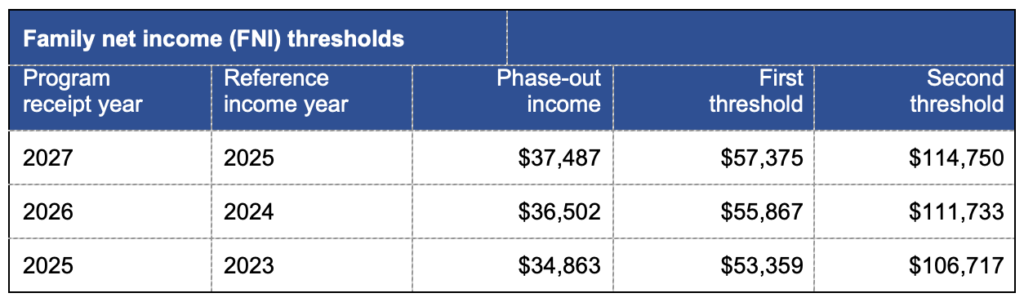
The government support is subject to the beneficiary’s adjusted family net income (AFNI), or the parents’ AFNI if the person is under age 18. As an example using the government’s most recently published data,

    • If 2025 AFNI is less than $114,750, a $1,500 contribution in the year will attract $3,500 of CDSG.
    • If 2025 AFNI is less than $34,863, the government will contribute $1,000 of CDSB, regardless of personal contributions.

Contributions will most commonly be made directly from after-tax funds, but may also be by transfer from a RESP or through a beneficiary designation from a parent’s RRSP/RRIF. Amounts from such plans roll over tax-free but do not qualify for CDSG matching, and will be taxable on eventual withdrawal (except for the personal RESP contributions, which are after-tax amounts). All contributed amounts grow tax-free, and are eventually paid out to, or for, the disabled beneficiary. Taxable amounts are reported by the beneficiary, which generally means very little tax is paid.

All provinces disregard RDSP assets when determining entitlement to provincial disability income support. Most provinces also exempt any income taken from RDSPs when calculating the amount of such support, but the exemption is only partial in New Brunswick, Prince Edward Island and Québec.


Verify this annually. The rdsp.com website has hyperlinks to each province’s regulations for assets and income test.  https://www.rdsp.com/tutorial/provincial-resources/

Trusts for disability planning

A trust separates legal ownership of property from beneficial ownership, allowing a trustee to manage the needs of someone who may be incapable of, or unsuitable to be managing property personally. An application mentioned above is a discretionary ‘Henson’ trust that can help preserve income from a provincial disability support program. As well, some trust may be entitled to preferred tax treatment when a/the beneficiary has a disability. Sometimes maximizing public support and optimizing taxes are complementary, and other times there may be trade-offs.

For an in-depth discussion of this topic, please see the companion article Disability needs planning using trusts.

Appendix – Hyperlinks to official sources

    1. https://www.canada.ca/en/services/benefits/publicpensions/cpp/cpp-disability-benefit.html
    2. https://www.canada.ca/en/services/benefits/publicpensions/cpp/cpp-post-retirement.html
    3. https://www.canada.ca/en/services/benefits/publicpensions/cpp/cpp-childrens-benefit.html
    4. https://www.canada.ca/en/revenue-agency/services/child-family-benefits/child-disability-benefit.html
    5. Provincial support programs
    6. https://www.canada.ca/en/financial-consumer-agency/services/financial-toolkit/taxes/taxes-3.html
    7. https://www.canada.ca/content/dam/cra-arc/formspubs/pub/rc4064/rc4064-21e.pdf
    8. https://www.canada.ca/en/revenue-agency/services/tax/individuals/segments/tax-credits-deductions-persons-disabilities/disability-tax-credit.html
    9. https://www.canada.ca/en/revenue-agency/services/tax/individuals/topics/about-your-tax-return/tax-return/completing-a-tax-return/deductions-credits-expenses/line-21500-disability-supports-deduction.html
    10. https://www.canada.ca/en/revenue-agency/services/tax/individuals/topics/about-your-tax-return/tax-return/completing-a-tax-return/deductions-credits-expenses/lines-33099-33199-eligible-medical-expenses-you-claim-on-your-tax-return.html
    11. https://www.canada.ca/en/revenue-agency/services/tax/individuals/topics/about-your-tax-return/tax-return/completing-a-tax-return/deductions-credits-expenses/line-45200-refundable-medical-expense-supplement.html
    12. https://www.canada.ca/en/revenue-agency/services/tax/individuals/topics/about-your-tax-return/tax-return/completing-a-tax-return/deductions-credits-expenses/line-31270-home-buyers-amount.html
    13. https://www.canada.ca/en/revenue-agency/services/tax/individuals/topics/about-your-tax-return/tax-return/completing-a-tax-return/deductions-credits-expenses/line-31285-home-accessibility-expenses.html
    14. https://www.canada.ca/en/revenue-agency/services/tax/individuals/topics/about-your-tax-return/tax-return/completing-a-tax-return/deductions-credits-expenses/line-30425-caregiver-spouse-dependant.html
    15. https://www.canada.ca/en/revenue-agency/services/tax/individuals/topics/about-your-tax-return/tax-return/completing-a-tax-return/deductions-credits-expenses/line-30450-caregiver-infirm-dependant.html
    16. https://www.canada.ca/en/revenue-agency/services/tax/individuals/topics/about-your-tax-return/tax-return/completing-a-tax-return/deductions-credits-expenses/line-21400-child-care-expenses.html
    17. https://www.canada.ca/en/revenue-agency/services/tax/individuals/topics/about-your-tax-return/tax-return/completing-a-tax-return/deductions-credits-expenses/line-32600-amounts-transferred-your-spouse-common-law-partner/you-claim-transfer-certain-amounts-your-spouse-common-law-partner.html
    18. https://www.canada.ca/en/revenue-agency/services/tax/individuals/segments/tax-credits-deductions-persons-disabilities/gst-hst-information.html
    19. https://budget.gc.ca/2022/report-rapport/chap1-en.html#m9
    20. https://www.canada.ca/content/dam/cra-arc/formspubs/pbg/5000-s6/5000-s6-23e.pdf
    21. https://www.canada.ca/en/revenue-agency/services/tax/individuals/topics/registered-disability-savings-plan-rdsp.html

RDSP – Registered Disability Savings Plan

Tax-sheltering disability savings, with a government boost

The Registered Disability Savings Plan (RDSP) is a long-term savings tool for a person who is eligible for the disability tax credit (DTC). It has three main financial benefits:

    1. Government money added to personal contributions
    2. Tax-sheltered growth of personal and government money in the plan
    3. Tax eventually borne by the plan beneficiary, not the contributors

Who qualifies to use a RDSP?

A RDSP may be opened by a person up to age 59 who qualifies for the disability tax credit, and is a Canadian resident with a valid Social Insurance Number (SIN). If the application is made (on the beneficiary’s behalf) by someone other than the DTC-qualified person, that applicant must also have a valid SIN. If at a later time the beneficiary no longer qualifies for the DTC, the plan may remain open but no further contributions are allowed.

There can only be one RDSP for a given beneficiary, and only one beneficiary for each RDSP.

How do you set one up?

Application is made to a RDSP issuer, which is a financial institution registered with the government to open plans, receive government bonds and grants, and invest funds as directed by the plan holder.

The plan holder will generally be a parent or guardian if the beneficiary is a minor. An adult beneficiary must be his/her own holder, unless he/she is not contractually competent, in which case it may be a parent, spouse or common law partner, qualifying family member or designated legal representative.

Allowable contributions and their tax treatment

The lifetime contribution limit is $200,000, but there is no annual limit. However, there are annual limits to the amount of government assistance (see CDSB and CDSG below), which could influence contribution timing.

Contributions are after-tax, meaning there is no tax deduction when contributing. Government assistance is not taxable when credited to a plan. While in the plan, there is no tax on income earned on either personal or government contributions.

RRSP rollovers

RDSP contributions may also be by a tax-deferred rollover from a deceased’s registered retirement savings plan (RRSP) or registered retirement income fund (RRIF). The beneficiary must be a child or grandchild who was, at the time of the deceased’s death, financially dependent on the deceased for support by reason of an impairment in physical or mental functions. These contributions are included in the $200,000 lifetime contribution limit but do not attract any matching grants, and will be included in the taxable portion of future RDSP withdrawals.

RESP rollovers

Funds in a registered education savings plan (RESP) may also be rolled over to a RDSP on a tax-deferred basis. The same person must be the beneficiary of the RESP and RDSP. This is an option under RESP rules, where an accumulated income payment (AIP) would otherwise be taxed currently. As with RRSP/RRIFs, such contributions are included in the $200,000 lifetime contribution limit but do not attract any matching grants, and will be included in the taxable portion of future RDSP withdrawals.

Government assistance: CDSB and CDSG

Though a RDSP may receive personal contributions up to age 59, government assistance through the Canada Disability Savings Bond (CDSB/bonds) and Canada Disability Savings Grants (CDSG/grants) are only available up to the beneficiary’s age 49.

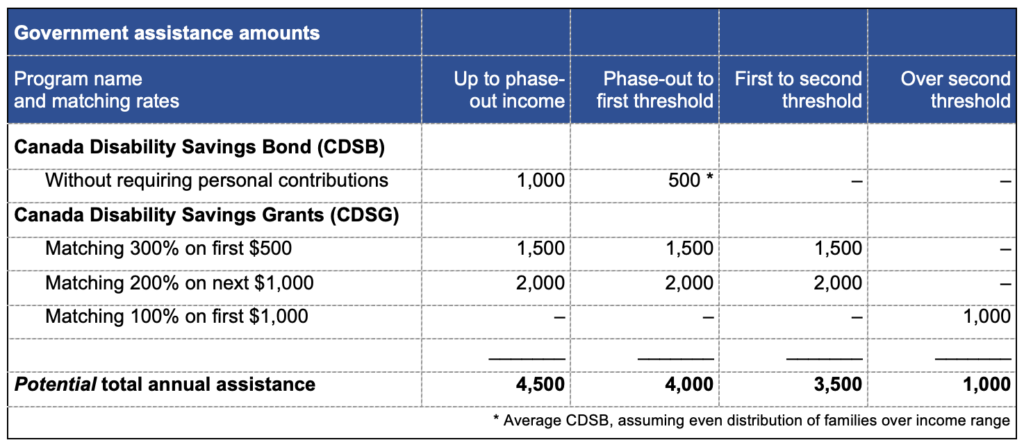
The CDSB makes an annual payment to a RDSP, regardless of personal contributions. It can be up to $1,000 annually, with a lifetime limit of $20,000. If the beneficiary qualified for a RDSP in years before the plan was opened, a one-time catch-up up to $10,000 is allowed for unclaimed bond money over the preceding 10 years.

The CDSG matches personal contributions. It can be as much as a 300% match, to a maximum of $3,500 annually, with a lifetime limit of $70,000. Like bonds, up to 10 years of catch-up is allowed, but the maximum that can be received in any one year is $10,500 (or 3X maximum), so it may take a few years to collect all the matching grants.

The amount available under these programs is determined according to family net income (FNI) thresholds two years preceding the program year, as shown in the table below. When a beneficiary is under 19, FNI is the combined net income of the beneficiary’s parents. Thereafter, it is the beneficiary’s own net income (even if continuing to live with parents), or if the beneficiary is cohabiting with a spouse or common-law partner then that couple’s combined net income.

There are three FNI thresholds used to determine the annual assistance amount:

  • Phase-out income – The income level above which the annual amount of CDSB payable begins to decrease.
  • First threshold – The income level that, when reached or exceeded, the annual amount of CDSB payable is nil.
  • Second threshold – The income level that, when below or equal to, the matching grant will be 300% of the first $500 in contributions and 200% of the next $1,000 in contributions. When income is above this level, the matching grant will be 100% of the first $1,000 in contributions.

Effect on other public support

Having a RDSP will not affect eligibility for federal programs such as the Canada Child Benefit, GST/HST credit, Old Age Security or Employment Insurance, nor limit access to provincial disability support programs.

Withdrawing funds from the plan

Withdrawals are formally called disability assistance payments (DAPs), and may be taken periodically, or as annual recurring payments. Recurring payments are called lifetime disability assistance payments (LDAPs). LDAP payments must begin by the end of the calendar year that the beneficiary turns 60.

When a withdrawal is taken and CDSB and CDSG have been received in the preceding 10 years, a portion of those bonds and grants may be repayable. Repayment may also apply if the beneficiary is no longer qualified for the DTC and takes a withdrawal while under age 60.

There is no repayment of grant or bond money if the beneficiary has turned 60, if the last bond and grant money was received more than 10 years ago, or if reduced life expectancy is five years or less.

When assistance is paid to the beneficiary – who does not have to be a Canadian resident at the time – each payment is a proportion of personal contributions, investment earnings, CDSB and CDSG. The beneficiary is taxed on the payment except for the portion that represents the return of personal contributions.