Disability public assistance – Ontario ODSP

Ontario Disability Support Program

Living with a disability can pose personal and emotional challenges. As well, there are often direct financial costs and economic challenges, both for the individual and surrounding family.

For Ontarians, the Ontario Disability Support Program (ODSP) is the anchor program assisting individuals and their families managing with disability needs. While it has many components, at its core ODSP delivers financial assistance for essential living expenses, provides a number of health care benefits, and offers help in finding employment and advancing a person’s career.

Here is an overview of the key features of ODSP.

Your rights and your responsibility

As an Ontarian 18 years or older with a disability, you have the right to apply for ODSP support. A caseworker reviewing your application is guided by policy directives intended to assure consistent service across the province, balanced with the discretion to cater to individual needs and circumstances.

At the same time, be aware that as a large public program, ODSP has plenty of administrative structure and financial oversight, with practical implications for the path that lies ahead for you. This includes detailed initial financial disclosure, regular caseworker reviews, and your continuing obligation to report and make first use of your own financial resources, supplemented by this public support program.

What is a “disability” for ODSP purposes?

The disability must be a substantial mental or physical impairment that is continuous or recurring, lasting for a year or longer. It has to be shown that it substantially affects your ability to work, to care for yourself or to participate in the community. This must be verified by a health care professional.

For those who meet the criteria for certain other government programs – the most familiar being the Canada Pension Plan (CPP) disability pension – no further medical evidence of disability is required. However, you must still apply and meet ODSP financial eligibility requirements in order to receive income support.

Two components of income support: Basic needs & shelter allowance

There are two core components of ODSP:

    • Basic needs income support – To help cover food, clothing and necessary personal items
    • Shelter allowance – To help cover rent/mortgage, utilities and other direct housing carrying costs

Note in both cases that it is “to help cover”, which is not an assurance of full coverage.

To show financial need, your household basic living expenses must be more than your income and assets. As ODSP income support is meant to supplement other income, you must seek out any financial resources you or your family may be entitled to receive. This is determined in consultation with a caseworker.

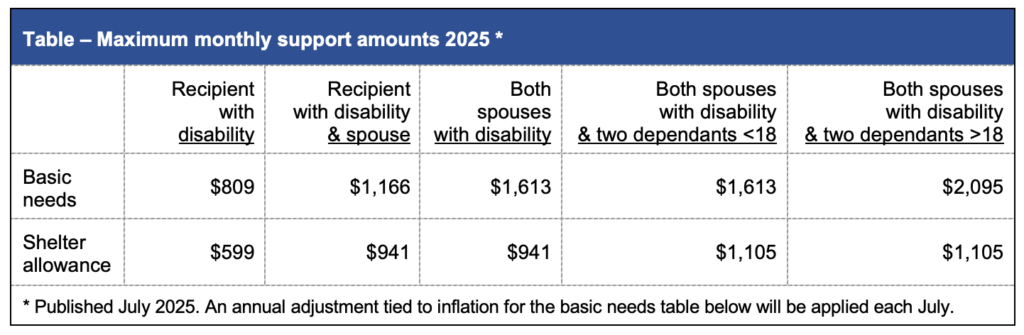
Once available resources are ascertained, attention turns to the number and age of those in the family, and whether your spouse has a disability. With so many variables, a full review is generally necessary to estimate the income support amount in a particular case. For general reference, the table on the following page shows the maximum support amounts available, using some examples of who might be in the household.
Working income affecting income support

You are entitled and encouraged to work. In fact, ODSP Employment Supports offers many resources to help with training, tools, assistive devices and even business start-up mentoring.

If you are indeed working, once your monthly income exceeds $200, 50% of your earnings is deducted from your income support payment. For this purpose, monthly earnings is the net you receive after mandatory payroll deductions like income tax, CPP and employment insurance premiums. The reduction may be offset by the $100 ‘Work-Related Benefit’ paid for each month you are working.

Treatment of income generally

Beyond employment, again all available income sources must be disclosed, including spousal support, business profits, Old Age Security, CPP benefits, and potentially even loans you receive. As with work income, these will reduce ODSP income support.

However, some sources are exempt from that reduction, such as child tax benefits, child support payments and amounts drawn from a registered disability savings plan (RDSP).

Receiving gifts

Each family member in the ODSP recipient’s household may receive up to $10,000 in gifts annually, with any excess treated as income. This dollar limit excludes gifts that go toward a disability related device or service, or into an exempt asset. (See “Asset limits” below.)

Health care benefits

Once you are entitled to income support, there are a number of health care benefits that come with that.

ODSP recipients are eligible for prescription drugs listed in the Ontario Drug Benefit Formulary. For adults there are basic dental services, and children under 18 are automatically enrolled in Healthy Smiles Ontario. If you don’t have eye care under the Ontario Health Insurance Plan (OHIP), ODSP covers routine eye examinations, major examinations for those with a medical condition or infection, and periodic eyeglass prescriptions and repairs.

Asset limits, and loss of income support

You will not be entitled to income support if the value of your assets exceeds a certain level. The limit is $40,000 for a single person or $50,000 for a couple, plus $500 for each dependant other than a spouse. This includes cash, banking and investment accounts, registered retirement savings plans (RRSPs) and tax-free saving accounts (TFSAs), secondary/rental properties and even valuable collectibles (eg., stamps, hockey cards).

Fortunately, there are many items that are exempt. This list includes the home you live in, personal clothing and furniture, your primary vehicle, and funds in registered education savings plans (RESPs) and RDSPs. Also excluded are amounts in life insurance cash values and trusts from gifts/inheritances, together totaling up to $100,000.

Preserving ODSP with a discretionary ‘Henson’ trust

That mentioned $100,000 limit for trust-held funds and insurance may not be adequate where there are significantly more assets that would otherwise be available to the ODSP recipient. In that case, in order to better preserve ODSP support, a more sophisticated trust arrangement might be considered.

A fully discretionary trust allows a trustee alone to decide the amount and timing of payments to a trust beneficiary who has a disability. Because the beneficiary has no legal right to force the trustee’s hand, ODSP does not include any such property in asset limits. This is commonly known as a “Henson trust” for the 1989 Ontario case that challenged the predecessor Ontario support program.

Even though the trust capital is not considered an asset for ODSP purposes, payments from the trust may be considered income that could affect ODSP support. Payments will generally be considered exempt as income, for example, if used for:

  • approved disability related items, services, education or training expenses that are not reimbursable
  • the purchase of a principal residence or an exempt vehicle;
  • first and last month’s rent necessary to secure accommodation; or
  • any purpose up to $10,000 maximum in a 12-month period.

The use of a trust in this way should not be taken lightly, as it places a very high degree of power and responsibility in the trustee. A qualified trust lawyer familiar with disability issues can advise on whether and how to proceed, taking a view of the totality of circumstances.

5undamentals – RDSP – Registered Disability Savings Plan

Published version: Linkedin

Discuss these 5 fundamentals with your advisor to learn how they apply to you, and whether there are further details, qualifications or exceptions to consider.

1. What is a Registered Disability Savings Plan (RDSP)?

Purpose – The RDSP is a long-term savings plan for persons with disabilities and their families. It offers 3 main financial benefits: 1) Government money added to your contributions 2) Tax-sheltered growth of all money in the plan, and 3) Tax eventually borne by the plan beneficiary, not contributors.

Qualifying criteria

  • Disability tax credit (DTC) – Application for the DTC is made by or on behalf of an individual using CRA Form T2201. A medical professional must certify that the applicant has a severe and prolonged impairment, providing details of its nature and describing the effects on the person.
  • Age limit – A plan may be opened any time before the end of the year the person turns 59, and may remain open for the life of the beneficiary, though some events may cause earlier closure.
  • Canadian resident – The beneficiary must be a Canadian resident when the plan is opened and when any contribution is made. A holder (who is not the beneficiary) need not be a Canadian resident to open a plan, but both holder and beneficiary must have a valid social insurance number at that time.

Effect on other public support

  • Federal – Neither RDSP assets nor RDSP withdrawals affect eligibility for federal programs such as the Canada Child Benefit, the G/HST credit, Old Age Security or Employment Insurance.
  • Provinces & territories – RDSP assets are exempt in determining eligibility for social support programs for persons with disabilities. Similarly, RDSP withdrawals are not generally treated as income that affects the amount of support from such programs, though some jurisdictions have a maximum RDSP withdrawal threshold, beyond which benefits may be reduced.
2. Parties to the arrangement

Parties – The holder enters into a contract with an issuer to save for the future of a beneficiary.

Beneficiary – There can be only be one RDSP for a given beneficiary, and only one beneficiary for each RDSP. Once personal funds are contributed into a RDSP, they belong to the beneficiary, not the holder. Government assistance and earnings also accrue to the beneficiary, but may sometimes be repayable.

Holder – The holder opens the RDSP, names a beneficiary, and makes decisions on the plan, including whether to allow others to contribute. As to who may be a holder, it depends on the age and contractual competency of the beneficiary.

  • Minor beneficiary – A parent, or a ‘legal representative’, being a guardian, curator or agency authorized by provincial/territorial law. Age of majority is either 18 or 19, by province/territory.
  • Adult beneficiary who is contractually competent – The beneficiary.
  • Adult beneficiary who is NOT contractually competent – A legal representative.
  • Adult beneficiary whose contractual competence is uncertain – A qualifying family member (QFM), generally being a parent, spouse or common law partner (CLP).

Issuer – Financial institution offering RDSP based on a specimen plan submitted and approved by Canada Revenue Agency (CRA); certifies accuracy of applicant information; administers contributions, rollovers and transfers; applies for, receives and deposits CDSG & CDSB; invests funds as directed by holder; provides statement of accounts; makes payments from RDSP to eligible beneficiaries; and is ultimately responsible for maintaining tax-registered status.

3. Contributions and tax treatment

Contribution limits

  • Lifetime limit – The lifetime contribution limit is $200,000.
  • Annual limit – There is no annual limit, but there are annual limits to the amount of government assistance that may be received (see below), which could influence your contribution timing.

Qualified investments – RDSPs may generally invest in the same kinds of deposits and marketable securities allowed for RRSPs and other registered plans.

Tax treatment

  • Coming in – RDSP contributions are after-tax, meaning there is no tax deduction for placing funds into a plan. Government assistance is not taxable when credited to a plan.
  • Within – While in the plan, there is no tax on income or growth, whether on your contributions or on any government assistance.
  • Coming out – When taken out, all income and government assistance are taxable to the plan beneficiary. The later withdrawal of the portion that is your own contributions is not taxable.

Rollover contributions – Under qualifying conditions, funds held in education and retirement savings plans may roll tax-deferred into a RDSP. These rollover amounts count toward the $200,000 lifetime contribution limit, but do not attract CDSG and will be taxable on withdrawal.

  • Registered education savings plan (RESP) – One of three criteria must be met, two dealing with plans that have been in place for many years or decades, and the third applying where the beneficiary cannot attend post-secondary school for DTC related reasons. In all cases, only an otherwise accumulated income payment (AIP) of the RESP earnings may be rolled over.
  • RRSP, RRIF, RPP, PRPP, SPP – These plan types may be rolled over from a parent/grandparent on whom the beneficiary was financially dependent at the time of the former’s death.
4. Government assistance

Family income – Amount of assistance depends on family income. Up to the calendar year when the beneficiary turns 18, it is the family income of the beneficiary’s primary caregiver. Starting the calendar year the beneficiary turns 19, it is the beneficiary’s own family income, which includes the income of a spouse/CLP. [The following income figures are for 2020 entitlements, based on 2019 family income.]

Canada Disability Savings Bond (CDSB) – The CDSB makes an annual payment to a RDSP, regardless of personal contributions. Up to family income of $31,711 it is $1,000, which is then phased-out to zero when family income reaches $48,535. The lifetime bond limit is $20,000.

Canada Disability Savings Grants (CDSG) – The CDSG matches personal contributions at a 1:1, 2:1 or 3:1 rate. If family income is below $97,069, the matching rate is 300% of the first $500 in contributions and 200% of the next $1,000 in contributions. If family income is above this threshold, the rate is 100% of the first $1,000 in contributions. That’s as much as $3,500 in one year, with a lifetime limit of $70,000.

Carryforward and usage timeline – You can carry forward up to 10 years of unused grant and bond entitlements to claim in future years, as long as you meet eligibility requirements in those future years. The annual usage maximum for carried forward CDSG is $10,500, and $11,000 for CDSB. All grants and bonds must be claimed by the end of the year the beneficiary turns 49.

10-year repayment rule – Grant and bond money received in the preceding 10 years may have be returned to the government upon certain events. These include intentional termination of the plan, ceasing to qualify for the DTC, and death of the beneficiary. Consult your issuer to explain all triggering events, and the availability of relief and/or deferral depending on the circumstances.

Provincial assistance – Provinces may also enact programs to assist RDSPs and their beneficiaries.

5. Payments out of the plan

Three payment types – Funds come out of a RDSP by either: 1) Repayment of CDSB, CDSG or provincial support to the respective government 2) Transfer/payment of the holdings to a RDSP for the same beneficiary with another issuer 3) Assistance payment to the beneficiary. Our focus is on the last of these, assistance payments.

Assistance payments – The regulations on drawing funds out of a RDSP are complex, with there being two types of payments to a beneficiary – DAP and LDAP – governed by a variety of rules as to the amount, timing and composition of those payments.

  • Disability assistance payment (DAP) – A DAP is a RDSP withdrawal at the holder’s request, as made from time to time, payable to the beneficiary or their estate.
  • Lifetime disability assistance payment (LDAP) – A LDAP is a recurring annual (or more frequent) RDSP withdrawal paid to the beneficiary. Once begun, the LDAP series must continue until the beneficiary is deceased or the funds in the plan are exhausted.
  • Composition of DAP or LDAP – Each payment is a proportion of each of personal contributions, earnings, CDSB, CDSG and provincial support. The beneficiary/recipient of the payment is taxed on all components, except for the non-taxable return of personal contributions. The beneficiary does not have to be a Canadian resident to receive a DAP or LDAP.
  • Minimums and maximums – The allowable amount for a DAP or LDAP depends on many variables, including 1) Age, specifically 59-under or 60-plus 2) Whether government support exceeds personal contributions 3) CDSB & CDSG receipts in the preceding decade 4) If the beneficiary’s life expectancy is less than 5 years, and 5) Formulas prescribed by regulations.

Death of beneficiary – Upon the beneficiary’s death, all CDSB, CDSG and provincial support paid in the preceding 10 years must be repaid to the respective government. It is not possible for a RDSP beneficiary to directly name a beneficiary to receive the plan upon his/her death, so the remaining RDSP assets will be a taxable receipt for the beneficiary’s estate, except the non-taxable return of personal contributions. The plan must then be closed no later than December 31 of the calendar year following the year of death.

Using the preferred beneficiary election with new qualified disability trusts

At issue

Testamentary trusts may come into being at and as a result of a person’s death.  Commonly this is done using a Will, less often using an insurance or RRSP/RRIF beneficiary designation, and occasionally as a result of a court order.  

For decades the tax benefit of such trusts has been their entitlement to use graduated tax brackets, as opposed to top bracket treatment for inter vivos trusts.  As of 2016, testamentary trusts no longer have this preference, except for the first 36 months of an estate and for certain trusts for disabled beneficiaries.  In the former case of an estate, there are limited opportunities to engage in meaningful tax planning. 

On the other hand, trustees can and must act strategically on behalf of disabled beneficiaries.  In the first place, there is a positive obligation to file an election to preserve those graduated brackets, and only one trust can be so-elected.  This can complicate how a parent approaches trust drafting in isolation, let alone where multiple contributors may be contemplated.  

As well, trustees need to be certain how existing trust tax rules for disabled beneficiaries may be affected.  At the head of that list is the continuing use of the preferred beneficiary election.

Income Tax Act (ITA) Canada – 104(14) — Preferred beneficiary election

The term “preferred beneficiary” is a defined term in the ITA, and for present purposes includes someone who has a mental or physical impairment that entitles the person to claim the disability tax credit.

Section 104(14) sets forth that: “Where a trust and a preferred beneficiary under the trust … elect in respect of the particular year … such part of the accumulating income of the trust … shall be included in computing the income of the preferred beneficiary for the beneficiary’s taxation year”.

The effect of the election is that some or all of the trust income is allocated to the beneficiary.  Tax is calculated based on the beneficiary’s graduated rates, and the trust pays that tax.  The net income remains in the trust under the care and control of the trustee.  

ITA 122(3) — Qualified disability trust (QDT)

As noted, testamentary trust usage of graduated tax brackets is now very limited.  However, where the QDT definition is met, a trust remains entitled to use graduated brackets to calculate its taxable income.  To qualify, a joint election must be filed by the trust and a beneficiary of the trust who, by reason of mental or physical impairment, is entitled to claim the disability tax credit. 

Importantly, the electing beneficiary cannot “jointly elect with any other trust, for a taxation year of the other trust that ends in the beneficiary year, to be a qualified disability trust.”  To the point, there may be only one QDT for a given person in any taxation year.

2015-0605111E5 (E) — Qualified Disability Trusts – Preferred beneficiary election

The taxpayer described a hypothetical situation in which an individual with a disability has four grandparents and each grandparent establishes under his/her will a trust for the individual.  It is acknowledged that only one of the trusts could be a QDT for the 2016 and subsequent tax years.  The inquiry goes on to ask whether the trustees of the additional three testamentary trusts created for the benefit of the same individual can make a preferred beneficiary election for each additional trust.  

In response, the CRA author confirms that there have been no changes to the preferred beneficiary election rules as a result of the changes to the rules applicable to testamentary trusts, including the introduction of the QDT.  

Both the QDT and preferred beneficiary election are elective provisions, and those elections are not mutually exclusive.  As such, the trustees together with the disabled beneficiary can choose which joint election will be made, if any, and it is indeed possible for a trust that has made a joint election to be a QDT to also make a preferred beneficiary election.  

Practice points

  1. As of 2016, most testamentary trusts cannot use graduated tax brackets, but the new qualified disability trust preserves that treatment for disabled beneficiaries.
  2. For existing trusts, additional tax filing obligations are required to assure QDT treatment, which fortunately may be coordinated with the preferred beneficiary election.
  3. For families in the preparatory stages, they should confirm with legal counsel that appropriate powers and permissions have been explicitly drafted into trusts and other planning documents.