Donating RRSP/RRIF to charity

Re-directing final tax dollars to your chosen causes

As a regular supporter of your favourite charity, you’re pleased that your annual donations help keep the lights on. Ideally though, you’d also like to contribute in a way that sustains the organization over the longer-term.

One way to do this – without reducing what you need to live on – is to direct some or all of the remaining value of your RRSP or RRIF on death to your chosen charity. Not only will that make for a substantial gift in and of itself, but you’ll also be pleased to know that it comes
‘at the expense’ of some of the tax that would otherwise have been paid at your death. 

Indeed, after the tax break, the donation may only cost you half of what the charity receives. 

Tax imposed on registered plans at death

For many Canadians, registered retirement savings plans (RRSPs) are the primary tool used to accumulate retirement savings. Contributions are tax-deductible, with income and growth tax-sheltered while in the plan. 

Commonly on retirement, an RRSP is converted into a registered retirement income fund (RRIF), which continues to enjoy tax-sheltered income and growth. Withdrawals from the plan are taxable income, but usually spread over multiple years at graduated tax bracket rates. 

Still, the entire value of a RRSP/RRIF is eventually taxable. 

On death, the remaining balance is treated as income that year, though that can be deferred by rolling over to a registered plan of a spouse or financially dependent child or grandchild. Otherwise, the full amount is taxed in a single year, pushing up through those graduated brackets toward the top bracket, which is within a couple percentage points of 50% or more, varying by province. 

Tax relief on charitable donations

When someone donates to charity, the person may claim a credit to reduce annual taxes. The tax credit is at the lowest bracket rate on the first $200 of donations claimed in a year, being 15% federally, and ranging by province from about 5% to 20% depending on where the donor resides. 

Above $200 of annual donations claimed, the tax credit jumps to a higher rate. The high rate applied against federal tax is the 4th bracket 29% rate, or the top/5th bracket rate of 33% if income is over that level. Those brackets are $181,440 and $258,482 in 2026. For provincial tax, Quebec and BC use the federal approach, with the other provinces applying a single high credit rate that is near or equal to their top bracket rate. This puts the combined federal-provincial credit rate near or above 50%, varying by province.

The maximum annual donation that can be claimed is equal to 75% of a taxpayer’s net income. That limit is increased to 100% in the year of death, and if the donation is larger than that final year’s net income, the excess can be used to recover tax from the preceding year’s tax bill, also based on up to 100% of net income

Donating registered plans to charity at death

The owner of a RRSP/RRIF may designate one or more beneficiaries to receive the proceeds of a plan upon the person’s death. The plan administrator will provide a form to make that direct designation, or alternatively most provinces allow for a person’s Will to direct the proceeds of such a plan. (Note that direct designations are not available to Quebec residents, whether on the plan directly or by Will.)

A named beneficiary may be another person, or it may be an organization, such as a charity. When a charity is named, by either method, the donation is deemed to have been made immediately before the person’s death. This then qualifies the donation for that 100% threshold for both the year of death, and excess carryback to the preceding year.

Spousal flexibility

A spouse could be designated as primary beneficiary, with the charity named as contingent beneficiary. This assures that a living survivor would continue to have full use of the couple’s savings on a first death through the usual tax-deferred rollover. Meanwhile that contingent designation serves as a backup plan if the survivor forgets to name the charity as beneficiary after the first spouse’s death, or if there is an unfortunate common disaster. 

Note that once a RRSP/RRIF has rolled to a spouse, the original owner’s instructions will have no further control over the proceeds. When carried out by beneficiary designation, the past plan ceases to exist, as does any contingent designation. When the transfer to the spouse is as successor annuitant on a RRIF, the plan and contingent designation may remain intact, but the surviving spouse has full legal control over the plan, including the right to change any designation.

Providing a legacy through the Will

Sometimes a person may be uncertain whether their estate will have enough liquidity to fund desired legacies, or even to commence administration of the estate. For example, some provinces require that the probate fee/tax is paid before the executor is granted legal authority to deal with estate property. Potentially a RRSP/RRIF could be made available for this purpose, either by foregoing the naming of a beneficiary for the plan, or by making a direct designation to the estate (on the plan or by Will).

Once the estate liquidity need has been satisfied, the net remaining funds could then be paid as a legacy to the charity. So long as the donation occurs within 36 months of the date of death, it may be claimed in the estate year when it is made or in an earlier estate year (in either case up to 75% of net income), or in the year of death or preceding year (once again, up to the 100% threshold).

Probate and estate creditors

The trade-off in allowing the RRSP/RRIF to come into the estate is that it will be subject to probate fee/tax in provinces where such applies, and estate creditor/claimants may latch onto those plan proceeds. 

Comparatively, a direct beneficiary designation (other than to the estate) bypasses probate and creditors. This bypass generally applies even when the Will is the instrument used to make the designation, though this should be verified with the drafting lawyer, as probate has been levied in some provinces based on the facts in a few court cases.

Illustrating donation of RRSP/RRIF on death

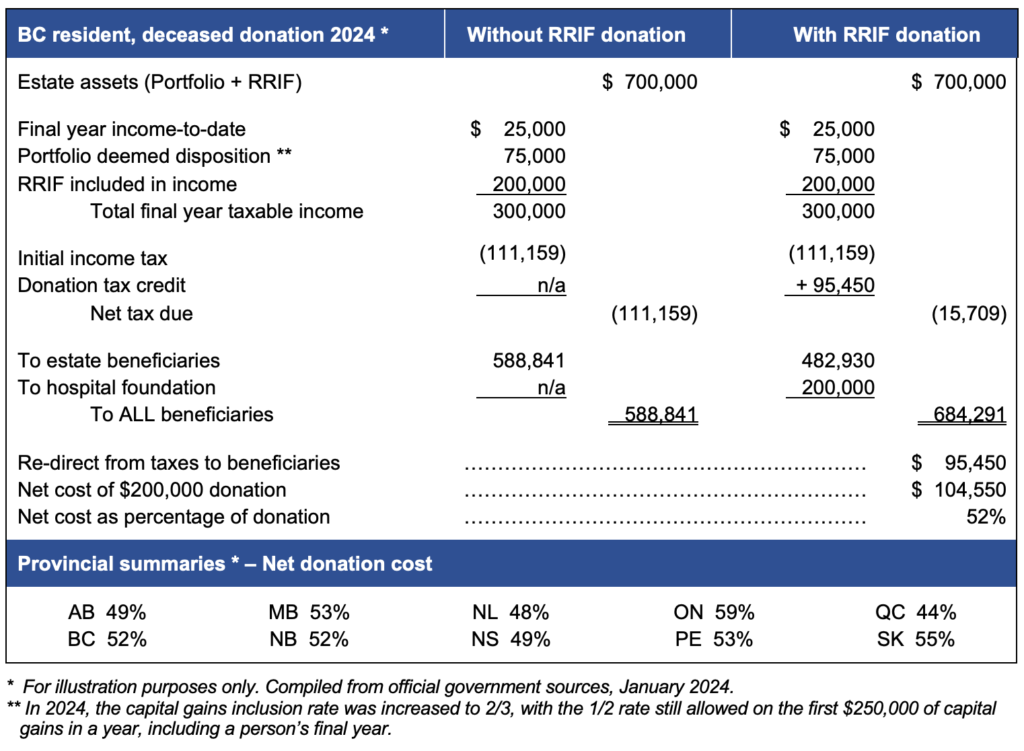
To illustrate how this can work, meet Greg who lives in British Columbia. He wants to give back to the local hospital that provided such compassionate support when his spouse Jean went through palliative care. He confirms the legal name of the hospital foundation, and names it as beneficiary on his RRIF administrator’s form. 

Greg understands this will reduce how much will go to their children – all financially secure adults – but expects it will also reduce the estate tax bill, making it an efficient way to donate. On his death, Greg was living in long-term care, which consumed his $25,000 income to-date that year. On death, there was a $500,000 non-registered portfolio with a $150,000 capital gain (resulting in a taxable capital gain of $75,000, based on the 1/2 inclusion rate), and a $200,000 RRIF.

Commuting a registered pension plan

The why, when and how to your decision

Whether you are headed into retirement or changing jobs at an earlier stage of your life, one of the largest financial decisions you face when you leave an employer is what to do with your retirement savings.

If you have been saving in your own registered retirement savings plan (RRSP), there’s not much more to say as it already belongs to you. Even when it is a group RRSP arranged through your workplace, generally the accumulated amount is yours to keep, though you’ll likely have to transfer to other investment choices.

If instead your work has a registered pension plan (RPP), there’s more involved.

Distinguishing registered pension plan types

You may be allowed to stay in your employer’s RPP, move to a new employer’s plan, or transfer into a locked-in retirement account. Depending on the type of RPP, that last option can be relatively straightforward, or it can be a multi-part process to arrive at the pension value, including potential immediate tax fallout.

Pensions come in two main varieties: defined contribution (DC) plans and defined benefit (DB) plans. Some plans are hybrid arrangements that have elements of both.

Defined contribution plans

Under a DC plan (also called a ‘money purchase plan’), the employer’s obligation is the amount to be contributed.

The employer as the pension sponsor must contribute a certain amount to the plan each year. Sometimes there may also be employee contributions. You will be able to choose among the investment options within the plan, with all income and growth tax-sheltered. The accumulated value is what is available to provide your retirement pension, which by default is paid as an annual annuity.

If you leave prior to retirement, the plan may be transferred dollar-for-dollar into a locked-in retirement account, where your investments may continue to grow tax-sheltered. The main feature of being ‘locked-in’ is that there is a maximum amount you can draw from it each year, which is intended to limit depletion so that it is sustainable through your retirement years.

Defined benefit plans

By contrast, under a DB plan the employer’s obligation is the pension benefit to be paid in future.

The employer must provide a retirement pension as determined by a formula. An actuary calculates the employer’s required contributions, based on the number of plan members and their respective rights. Those contribution amounts are adjusted from time to time according to past investment experience and future economic expectations.

You will be entitled to a retirement pension according to a formula in the plan (more on that below). If you leave before retirement and want to take your funds with you, once again an actuary is needed to determine the value. That’s where the complications really set in.

The remainder of this article focuses on commutation of a DB plan, first in terms of valuation and tax effects, and then on to how to approach this decision based on your particular needs. 

Between you & your employer: Gross commuted value

A DB plan annual retirement pension is determined by multiplying a base income times a credit rate times years of employment. The base income and credit rate are negotiated between employer and employees. The base could be (for example) the average of your last five years of employment income, or better yet your best three years’ income. The credit rate generally ranges from 1% to 2% per year of employment.

If you leave prior to retirement, an actuary has to determine the value of your entitlement in the accumulating pension fund. On the face of it, it’s that annual pension discussed above multiplied by a present value (PV) factor. The PV factor is essentially an interest rate, but one requiring numerous inputs to derive, the main ones being current age, assumed commencement date (less any reduction for starting early), continuation provisions (e.g., to spouse), any guarantee period and any annual indexation.

The result is the lump sum current amount that would be required to pay the projected annual pension to you over your expected lifetime. For the sake of the calculation, it is assumed that the lump sum will be invested at long-term interest rates. Accordingly, commuted values tend to be higher when prevailing interest rates are low, and lower when interest rates are high.

Between you & the CRA: Maximum tax-free transfer to a locked-in plan

The commuted value from the actuary’s report should not be confused with the amount that can be transferred into a locked-in retirement account.

In structure, the tax rule is similar to the commuted value calculation above. In tax terms, it multiplies your “lifetime retirement benefits” by a PV factor. In this case though, the PV factor is less generous than the commuted-value PV factor outlined above. For example, it doesn’t account for any indexing or early retirement benefits. As a result, the tax transfer value is often less than the commuted pension value. In a sense (though not literally), you might think of the tax calculation as what you would have accumulated under the RRSP rules, and therefore that’s the amount that you are allowed to transfer into a locked-in retirement account.

The excess amount will be taxable in the current year. While this is obviously not a pleasant prospect, it is applying tax to the more generous terms of the DB RPP, but you still get to keep the after-tax amount. The impact of this may be deferred if you have unused RRSP contribution room and choose to make a corresponding contribution.

Considerations before deciding to commute

Apart from the value of the commuted plan and tax transfer, here are some surrounding issues to review before committing to a course of action:

    1. Investment of the commuted value may ultimately deliver a larger retirement income, but this should be balanced against downside investment risk. Some people like to make investment decisions, while others shy away. A conversation with your financial advisor can help you decide.
    2. Are you comfortable leaving behind indexing and guarantees that may have been part of the original pension?
    3. Do you want to be able to adjust income from year to year, or ever make a lump-sum withdrawal? As locked-in plans put a cap on annual withdrawals, a commuted pension may be needed for this kind of flexibility.
    4. Some pension plans allow continued health and dental coverage (at least for some period of time), which can relieve your budgetary costs in retirement.
    5. On the other hand, if you have health concerns that may affect your life expectancy, you may prefer to take the commuted pension as a sure thing to be able to pass on the remaining value to your beneficiaries, especially if you have no spouse.
    6. Spousal pension income splitting is available under age 65 from a registered pension plan, but generally only from age 65 for an individual life income fund. Does this affect your income plans?
    7. Beyond a spouse, you may wish to leave a legacy to family or charity. Managing a commuted pension amount may provide an avenue for that kind of planning.

RRSP-TFSA concepts & coordination

Your decision depends on many factors

Since its introduction in 2009, the TFSA has proven to be a powerful tool that opens up countless possibilities for improving our finances. However, when it comes to retirement savings, the RRSP should be the default choice for most of us.

Here are some important considerations to help you decide what’s best for you.

Tax treatment IN – Tax treatment OUT

The key difference between these plans is what happens on front and back end:

    • RRSP deposits are pre-tax, income within is sheltered, and withdrawals are taxable
    • TFSA deposits are after-tax, income within is sheltered, but withdrawals are not taxed

If you’re depositing to an individual RRSP, any associated refund must also go into your RRSP to keep it intact as ‘pre-tax’. For workplace group RRSPs, your employer does this for you through withholding tax.

Base comparison

If your income is taxed at the same rate when contributing to and withdrawing from the investment, your spendable cash will be the same either way.

Using $100 at a 40% tax rate and a 10% return (to allow for simple arithmetic):

However, if the withdrawal tax rate is reduced to 30%, the tax on the $110 in the RRSP will be reduced from $44 to $33, netting $77. On the other hand, if the withdrawal tax rate is 50%, the tax will be $55, netting to $55.

So, if you expect your tax rate to be lower when you will be taking withdrawals from this investment, choose RRSP. But if you expect a higher rate later on, choose TFSA.

‘Same rate’ – Marginal or average?

To assist in comparing rates, keep in mind we have a progressive tax system. That means higher income is taxed at a higher rate. An RRSP contribution gives you a tax deduction at your top marginal tax rate.

On withdrawal in your later years, the appropriate comparison is average rate, which is total tax divided by income. As average rate is mathematically lower than marginal rate, RRSP is usually the default choice.

What’s your own expected average rate?

In truth, your RRSP (in the form of a RRIF or annuity draw) will not be your only retirement income. You will have Canada Pension Plan and Old Age Security, and may have a pension, all together forming your foundation income. Thus, the average rate on your RRIF/annuity will be higher than your overall average.

And if you expect your retirement income to exceed the OAS clawback level, that will raise your effective marginal tax rate – that’s when it’s time to run the numbers through a financial planning spreadsheet!

Default choice, but with flexibility

To repeat, the point here is that RRSP is the default choice, but it could be displaced. Think of it in terms of proportionally allocating savings between them, not an either-or decision. Consider these factors:

Favouring RRSP

Most people live on a lower income in retirement. Spousal pension income splitting can reduce seniors’ household tax rate. The pension credit can reduce tax on $2,000 of RRIF/annuity income.

Favouring TFSA

Savings timeframe is shorter term, not retirement. Contributor is at low bracket at saving age. There are already significant RRSP assets. A large inheritance/winfall is confidently expected