Donating securities ‘in-kind’ to charity

Tax-optimizing your philanthropy

When it comes to charitable donations, the most likely type of donation that comes to mind for most of is cash. However, there are a variety of ways to support your favourite charitable causes, one of which is to donate publicly traded securities in-kind.

The Canada Revenue Agency (CRA) defines a publicly traded security to include a share, debt obligation or right listed on a designated stock exchange, a share of the capital stock of a mutual fund corporation, a unit of a mutual fund trust, an interest in a related segregated fund trust or a prescribed debt obligation. 

When such securities are donated in-kind from a non-registered account, a tax receipt is issued for their fair market value (FMV) on the donation date. As with cash donations, a tax credit can then be claimed to reduce your income tax bill. In addition, in-kind donations can cost you less, and there is no reduction in what the charity receives.   

How the donation tax credit works

When you make charitable donations, both the federal and provincial governments allow you to claim a credit against the income tax you owe. The tax credit is based on the total dollar value of all donations in the year, no matter how many individual donations you make. The value of the credit varies by province, with the credit rate ranging from 20% to 25% on your first $200 of annual donations, and 40% to 54% on the amount over $200.

You can claim donations up to 75% of your net income in a year. Donations not claimed in the current year can be carried forward to be used in any of the next five years. This assures that a large single donation can be fully utilized, even if it exceeds the net income threshold. As well, this gives you flexibility if it is more beneficial to forego claiming the entire credit in the current year, and instead strategically spread it across multiple years.

For more on the principles of the donation tax credit, see the article “Four tax strategies to get more bang for your charitable donation buck”.

Donating cash or selling appreciated securities?

Most people make periodic charitable donations in cash, but that may not be optimal when you own securities that have appreciated in value. Cash is worth what you have in your hands, but appreciated securities carry a waiting tax bill. That appreciation is known as a capital gain, and while there is no tax on unrealized gains during the time one is holding investments, tax does apply in a year when there is a disposition/realization. The current income inclusion rate brings 1/2 of the capital gain into income, which is what is used in the examples in this article.

Let’s say you want to contribute to a local charity’s capital fund, and you have equal balances in your chequing account and your (appreciated) securities account. If you write a cheque, you still have your securities, but with their pending tax liability. If you sell the securities to make the donation, there is less money available for the donation due to the tax, which means that either the charity gets less, or you need to top up the donation from your chequing account.

One way or another, you or the charity will bear the brunt of the tax in these two scenarios. The question is whether there is a way for you to keep your fully spendable chequing balance, while making the maximum donation to the charity using your securities? This is where in-kind donations come in. 

Donating securities in-kind to eliminate tax on capital gains

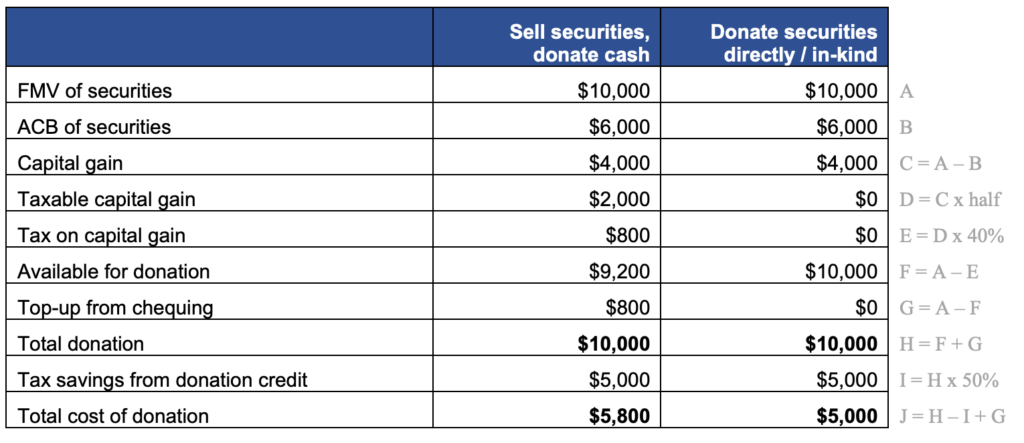
Typically, when there is a change of ownership of a security, a disposition is deemed to occur, and a capital gain or capital loss is triggered. However, when a security is transferred directly to a registered charity as a donation, the tax on any capital gain is reduced to zero. We can illustrate this with the following example:

  • Donor is in a 40% combined federal-provincial tax bracket in a province with a top donation credit rate of 50% 
  • $10,000 donation, using a security with $10,000 FMV and $6,000 adjusted cost base (ACB)
  • There has already been $200 in charitable donations made elsewhere this year
Donating securities in-kind to trigger a capital loss

The donation of appreciated securities is attractive, as we have just outlined. However, donating depreciated securities can also be a viable option, especially when it comes to your year-end tax planning. 

When you donate depreciated securities, you trigger a capital loss that will be applied against capital gains realized in that same tax year. You can then carry back any remaining capital loss to offset capital gains in the three previous tax years or carry those losses forward indefinitely. So not only will you receive a tax credit for the FMV of the donated securities, you will also be reducing your tax bill if you have realized capital gains elsewhere.

Interest equivalency

A tax tool for comparing interest to other investment returns

Rate of return on a portfolio is often front and centre in an investor’s mind. Understandable as this is, ultimately it’s about how much of those returns the investor will keep. The difference between the two is tax, which in turn depends on the type of income earned and the investor’s tax bracket.

This article deals with an individual earning income in a non-registered account, also known as an open account or cash account. With a range of variables in play, it can be difficult to follow the steps from initial return through tax calculation to spendable after-tax cash. A useful tool to help connect the arithmetic is interest equivalency.

Interest – Taking into consideration the tax trade-off

Interest is appealing for the part of a portfolio where certainty is the prime concern. For example, the issuer of a guaranteed investment certificate (GIC), agrees to pay a set amount of interest for the period of the contract.

This certainly provides valuable comfort to the investor, but an important trade-off from a tax perspective is that interest faces the full tax rate at any given income bracket.

Preferred taxation – Capital gains & Canadian dividends

Compared to interest, Canadian dividends and capital gains receive favourable tax treatment. They come at it from different routes, with the benefits emphasized at different income levels. Canadian dividends provide the best after-tax yield at low to mid brackets, giving way to capital gains at higher and top brackets.

Capital gains

There are two features that lead to the favourable tax experience from capital gains:

    1. Deferral – While a security is held, no tax arises on changes in its price. This is also true if the investor holds a mutual fund that fluctuates according to price movement of its underlying securities. But a redemption/sale is a taxable event, and if the value has increased then the investor will realize a capital gain at that time.
    2. Reduced inclusion rate – When there is a disposition, capital gains are said to be realized in that year, but only a portion of the capital gain is taxable. The “taxable capital gain” is derived by applying the income inclusion rate, which has ranged between 1/2 and 3/4 since 1971, but has been stable at 1/2 since 2000. The 2024 Federal Budget increased it to 2/3, while still allowing the 1/2 rate on the first $250,000 of an individual’s annual capital gains. (For trusts and corporations, the 2/3 rate applies to all capital gains.) The 1/2 rate is used in the examples to follow, on the assumption that the investor is an individual with less than $250,000 of annual capital gains.

The first feature allows tax-deferred growth. It is the second that is used in the interest equivalency calculation.

Canadian dividends

Like interest, Canadian dividends are taxed in the year earned, but the tax is calculated in two steps:

    1. Gross-up – The ‘gross-up’ factor adds back the corporate tax, so the investor’s bracket can be used to calculate the tax as if the investor had earned the income that was really earned by the corporation.
    2. Tax credit – The investor then gets a tax credit for the tax that the corporation has already paid.

This two-step process protects against double-taxation. The government’s revenue is split between the corporate tax and the personal tax, which is why an investor pays less on a dividend compared to the full rate for interest. 

How interest equivalency works

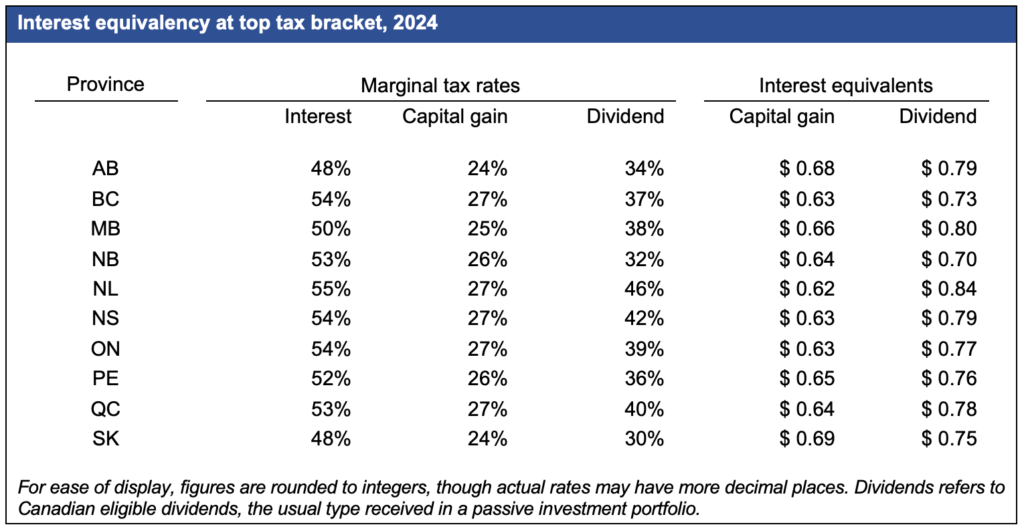
Interest equivalency shows what amount of preferred income will give an investor the same after-tax spendable cash as a dollar of interest. Alternatively, it can be expressed as the higher amount of interest that equates to a dollar of preferred income. Either way, the result is expressed in dollars and cents.

Formula

Interest equivalency is shown in the following table at top tax bracket for each province, but it can be calculated at any income level by applying the following formula that uses marginal tax rates (MTR):

Interest equivalency  =  ( 1 – MTRinterest ) ÷ ( 1 – MTRpreferred )

Proof

It may be easier to see how this works by looking at an example, here using Alberta in the first row of the table:


Informing yourself with this tool

To be clear, interest equivalency is a tool used to compare investment returns; it is not a suggestion against interest returns in a portfolio. All income types have their respective features, benefits and risks. The tool can help advisors and investors understand, compare and discuss investment options and recommendations in a portfolio.

A tax strategy about nothing

What Seinfeld can teach us about the value of staying the course

Like a lot of families, we’ve been doing things differently while social distancing during the pandemic. In addition to dusting off board games and semi-regular family walks, our latest streaming service has allowed us to catch up on classic TV, including Seinfeld.

More than three decades since it hit the air, there’s still something about the sitcom that came to be known as the show about nothing. That worked in the world of comedy, and may give us something to think about in the more serious world of portfolios.

I’m certainly not suggesting that investors set up portfolios once and ignore them thereafter. On the contrary, it’s imperative to be aware of economic developments — such as the market movements since the onset of Covid-19 — as well as any changes to the businesses behind individual securities.

Financial advisors are the source for this kind of information, reviewing with clients what’s relevant (including the effect on the investor’s appetite for risk) and deciding if adjustments are warranted. Those may include portfolio changes, behavioural changes, or both — or nothing at all.

The critical point is to resist the urge to make changes for the sake of change alone. The urge to just do something can be particularly harmful to a non-registered portfolio.

Unlike registered accounts, changes to non-registered holdings can result in taxable dispositions. Tax deferral that an investor enjoyed while holding rising securities over the course of years will be realized when those securities are sold.

If those portfolio changes are based on a focused review, then the tax implications should not stand in the way of action. However, if the original portfolio continues to suit the investor’s planning needs, then a premature change not only drifts away from the plan but also compounds that diversion by triggering taxes unnecessarily.

A tale of two investors: Gerry & Jorgé

Consider sister and brother investors Gerry and Jorgé, 40 year-old fraternal twins saving for an elaborate trip together for their 50th birthdays. Both have high incomes, so we’ll use a 50% marginal tax rate. Ten years ago, each used $10,000 to buy 1,000 units of VanDelayed mutual fund for $10 per unit. The price rose as high as $18, but has since come back to $14. It pays no dividends.

Despite the recent price decline, Gerry leaves her investment alone. Jorgé, on the other hand, is convinced that VanDelayed will continue to fall, so he sells.

With a fair market value of $14,000 and a $10,000 adjusted cost base, Jorgé realizes a $4,000 capital gain. As half the capital gain is taxable, he has a $2,000 taxable capital gain that costs $1,000 in tax, leaving him with $13,000.

A few months later Jorgé reconsiders and decides that Gerry was right. As it turns out, the price is again $14 when he reinvests his $13,000.

Ten years later when it’s time to book the trip, VanDelayed is at $28.

Gerry’s $28,000 holding realizes a $18,000 capital gain, resulting in $4,500 in tax, netting to $23,500.

With the price doubling from $14 to $28 from the time Jorgé reinvested, his $13,000 rose to $26,000. Taking away $3,250 tax due to the $13,000 capital gain, Jorgé is left with $22,750.

Even though Jorgé got back in at the same price as when he exited, the early tax payment hampered his growth, putting him $750 behind Gerry. The amount lost would vary depending on the growth rates, but, as long as there was indeed growth, the difference would never come out to nothing — which is something to think about.