Dividend sprinkling among family shareholders, and its limits under TOSI

A primer on the TOSI “tax on split income”

There are many tax benefits to running a business through a corporation. 

Operationally, corporate tax rates are generally lower than your personal marginal tax rate. Though personal tax will eventually apply when dividends are paid out of the corporation, in the meanwhile you are able to reinvest more dollars into that business within the corporation. 

At the ownership level, you can control the amount and timing of dividends to yourself as shareholder. This allows you to defer the personal income and associated tax until you need cash for personal spending purposes. 

If you bring in other shareholders and possibly more share classes, you can also control who receives those dividends. And when those additional shareholders are lower income family members, you may be able to ratchet down the household tax bill. Years ago, it was almost that simple, but today there are increasingly complex rules that must be navigated.

TOSI emerges in 2000 as the ‘kiddie tax’ for minors

A few decades ago, it was routine tax planning to pay dividends to family, including minor children. Whether a child owned shares directly or was a beneficiary of a trust that held shares, dividends could be taxed to that child. With little to no other income, the tax would be correspondingly low, and practically the net-of-tax money ended up under the same roof.

In 2000, the TOSI was brought into law to prevent this kind of dividend sprinkling. It applied (and still does) to dividends paid to a child under the age of 18 throughout the year. Despite such dividends being legally paid to the recipient, TOSI causes them to be taxed at the highest bracket rate, essentially ignoring the recipient’s own tax rate. 

This is an important distinction from being an attribution rule, where tax is imposed on a person who would have otherwise been entitled to certain income, being the parent in this example when dividends are paid to a minor child. With an attribution rule, it would be a no-better-off scenario if a higher bracket parent was taxed on the dividend. But things are especially unpalatable under the TOSI where tax is automatically imposed at the highest rate, making it a worse-off deal if the parent’s income level is anywhere less than top bracket.

TOSI comes of age in 2018, extending to adults in the family

In 2017, the federal government proposed a variety of changes for private corporations and their shareholders. While some of the proposals were shelved, the TOSI changes proceeded into law in 2018, with TOSI now extending to adults, capturing both adult children and spouses. Fortunately, these new rules for adults are not as unbending as the kiddie tax version. Where there is sufficient economic substance to the involvement of the adult child or spouse, TOSI may not apply.

Make no mistake though, these rules are very (very!) complex. There are new definitions, layers of application, and multiple exceptions. Some of those exceptions have objective criteria, while others require an exercise of discretion on the particular facts. To help, the government has collaborated with external stakeholders to publish examples to guide the application of TOSI in its Guidance on the application of the split income rules for adults, found at https://www.canada.ca/en/revenue-agency/programs/about-canada-revenue-agency-cra/federal-government-budgets/income-sprinkling/guidance-split-income-rules-adults.html.

What follows is a high-level outline of the TOSI and its exceptions, using some of the technical terms, but with streamlined phrasing in order to convey the core points. Readers should consult a qualified professional to determine applicability in individual circumstances.

Continuing planning that is not affected by TOSI

It is worth noting that the TOSI rules do not prohibit family members from owning private corporation shares. Though the original 2017 proposals cast the net widely to encompass the lifetime capital gains exemption (LCGE), that part was dropped. Accordingly, it is still possible to plan for sharing future capital gains with family, including the LCGE – of course with qualified professional advice.

Also, TOSI has no effect on the bona fides employment of family members. As long as the wages paid are reasonable in relation to the services rendered, this is simply treated as taxable employment income of the recipient. This is true even for minor children. 

Who and what is potentially open to the TOSI rules?

TOSI may apply if a person receives “split income” and is either an adult resident of Canada, or a minor (under the age of 18) who has at least one parent who is a resident of Canada. 

“Split income” includes taxable dividends, shareholder benefits and interest payments, from or related to a private corporation. It may also include distributed capital gains where underlying income would have been split income, but generally not capital gains arising on the sale of farms, fisheries or small business shares. Income from a partnership or trust that arose out of rental property may also be caught. 

It does not apply to securities or debt of public corporations, government debts, or to mutual funds that hold those listed sources. Deposits with banks and credit unions are also clear of TOSI.

Exclusions from TOSI

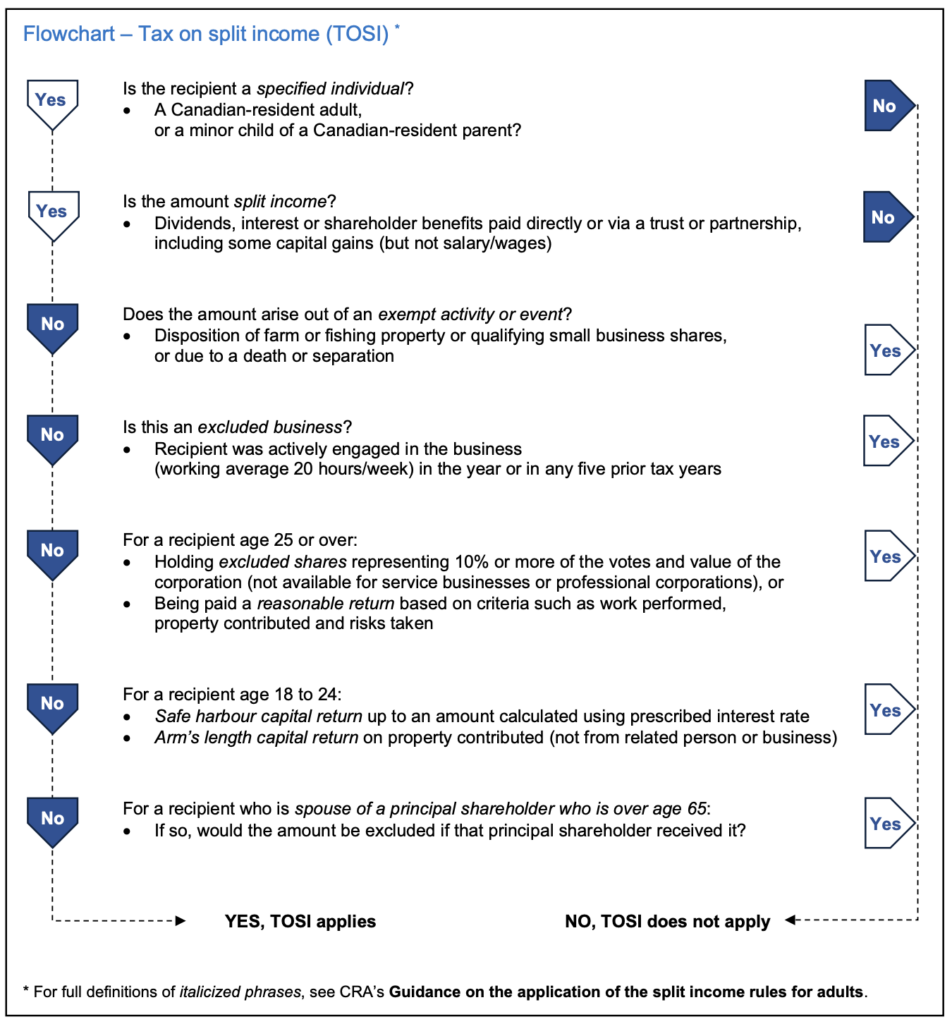
The rules are targeted at circumstances where unintended advantage may be gained. As there remain plenty of reasons and arrangements where family members may hold shares and legitimately be entitled to dividends, the rules allow for several exclusions. For simplicity, we’ll refer to dividends within the following explanations, understanding that split income is in fact broader, as noted above. See the Flowchart on the next page for a graphic representation of the key decisions.

All adult recipients

The recipient has been “actively engaged” in the business in the current year, or in any five years leading up to the year the dividend is paid. The five years do not have to be consecutive. This will generally be met if the person works an average of 20 hours per week. If the business is only active part of the year (eg., seasonal), the working time would be applied to the portion of the year when the business operates. A lesser time commitment may suffice, but that would depend on the facts and circumstances of the case.

Adult recipients age 25 or over

Even if the actively engaged threshold is not met, a dividend may be considered a “reasonable return” based on a combination of factors, including labour contribution, property contribution, risks assumed and historical payments.  Importantly, this exclusion is not available where the business is principally a service business or a professional corporation. 

Adult recipients age 18 to 24

Younger adults may also be able to claim a reasonable return, but based only on property contributed by that individual, and with the size of the return subject to a ceiling prescribed by formula.

Principal shareholder is over 65, recipient is spouse

Many business owners will have planned their retirement on the expectation of being able to share with a spouse in those later years. Accordingly, if the principal shareholder is 65 or over, dividends paid to a spouse will not be subject to TOSI. This is specifically intended to align with the age for pension income splitting.
Spouse and family income splitting

Navigating income attribution rules, including prescribed rate loans

Income splitting has been around for as long as the tax system itself. It’s a shift of income recognition from a high-rate taxpayer to someone at a lower tax rate. Most often it will involve a spouse/common-law partner (CLP), and can also work with children though less often when they are of minor age.

Importantly, income splitting is not illegal. It is however constrained by tax rules that scrutinize gifts and preferential loans between closely connected people. That being so, it’s sensible to review and understand the rules that could undo a planned action, prior to launching into the effort.

The motivation for income splitting

The premise of a progressive tax system is that those more financially capable are asked to bear a larger share of tax. For income tax, a higher rate of tax is imposed on income above each bracket threshold.

Presently there are five federal tax brackets, with rates progressing from 15% up to 33%. Each province has a similar structure, though the rates and number of brackets vary. When combined with federal rates, the top individual marginal tax rate is near or above 50%. Comparatively, the lowest combined rates are roughly in the 20-25% range, and may be close to zero once personal tax credits are applied.

Successful income splitting could cut that portion of a given family’s tax bill in half or better.

Attribution with a spouse/common-law partner

Attribution rules include both general and specific Income Tax Act provisions designed to plug holes where tax may leak. The base rule between an individual and a spouse/CLP is that any income, loss, capital gain or capital loss on loaned or transferred property will be attributed back to the transferor.

The rules don’t affect or change the legality of the transfer, including the legal right to the associated income or gain. Instead, they simply cause the transferor to pay the tax at his/her marginal tax rate.

The rules apply to direct transfers, as well as to indirect transfers and more complex scenarios, including:

    • Transfer to a trust or corporation in which the recipient has a beneficial interest
    • Loans without interest, or at interest below the prescribed rate (discussed further below)
    • Loans through an intermediary to mask underlying routing of funds back to the recipient
    • Third party loans advanced to the recipient, contingent on the guarantee of the high bracket person
    • Re-advancing loans paying off an original loan from the same person to whom attribution applied
    • Non-monetary loans, such as a loan of real estate or personal property
    • Claiming an advantageous split of commingled funds, without any record of respective contributions
    • Pre-relationship transfer or loan, with attribution beginning once a spouse/CLP relationship begins
    • Substituted property acquired with proceeds of sale of original property that was subject to attribution

Attribution with a related minor child

Where a transfer or loan is made to a related minor child, attribution applies on income up to the year the child reaches age 18. Notably, there is no attribution of capital gains or capital losses, whether realized before or after the child reaches age 18, presenting a significant splitting opportunity. For these purposes, child includes a grandchild, sibling, niece or nephew of the individual or of a spouse/CLP.

Strategies that can avoid the attribution rules

The attribution rules can be circumvented with informed planning. The strategies described below refer to a spouse/CLP, but they work just as well when splitting with a child.

Prescribed rate loan

While a transfer to a spouse/CLP by way of gift is a problem, a properly documented and serviced loan that complies with the prescribed interest rate rules will escape attribution. The investment income will be taxed to the lower income borrowing spouse, less a deduction for the interest paid. On the other side, the lending spouse will have to include the interest in income.

While a formal written loan agreement is not mandatory, it’s prudent to have one to buttress the bona fides of the arrangement, should it be questioned in future by tax authorities. Apart from that,

    • Interest payments must actually be made from borrower to lender, paid during the calendar year or no later than 30 days after year-end (January 30th, not ‘end of January’).
    • The lending spouse cannot be the source of the interest for the borrowing spouse, meaning it cannot be simply capitalized to the loan or be part of a revolving loan arrangement.
    • The rate must be commercially reasonable, and be no less than the rate prescribed by tax regulations. That rate is set quarterly, calculated as the average yield of Government of Canada 3-month T-Bills auctioned in the first month of the preceding quarter, rounded up to the next whole percentage.
    • The prescribed rate is 3% in the first quarter of 2026.
    • Failure to comply with any of these rules makes the loan forever offside thereafter.

What makes this strategy particularly appealing is that the loan may remain outstanding indefinitely at the original interest rate, even if the prescribed rate rises in future. And if the prescribed rate falls, the current loan could be paid out, and a new loan established at the lowered prescribed rate.

Fair market value exchange

If a low bracket spouse gives an asset of fair market value (FMV) in exchange, attribution will not apply. However, if the FMV falls short, full attribution still applies. In other words, there is no pro-rata treatment, so the transfer from the high bracket spouse should be no more than the available asset’s FMV.

Examples may be an automobile, antiques or jewelry, as long as the ownership interest did not originate with the high bracket spouse, such as an earlier gift. An interest in a cottage or principal residence may also be possible, but those are more complicated due to land transfer tax (in some provinces), as well as tax on disposition and required tax elections to be made when filing tax returns for that year.

Income-on-income (also known as second/later generation income)

It is only the income on the original gift that is attributable. When that income is reinvested by the receiving spouse, the ongoing income-on-income is taxed to him/her. To prove this distinction if there is an audit (given that the onus is on the taxpayer), it may help to move income on the original investment into a separate account where it can be clearly tracked.

Business income

Generally, the attribution rules are intended to capture passive income from property. If the receiving spouse uses the transferred funds to generate business income, then attribution will not apply.

Business corporation and shareholder taxation

How tax integration protects against double-taxation

As a business owner, you have a few options when choosing the legal structure for providing your goods and services – most commonly a sole proprietorship, partnership or corporation. 

There can tax benefits using a corporation, but there is also more complexity to understand and manage.

Business structures

With a sole proprietorship, you are taxed on the net income from the business after deducting expenses. The net income is taxed to you personally, at progressively higher rates as your income rises, as is the case when you earn other types of income personally. A business loss can be deducted against current income, or be carried to offset business income in past or future years. (The details of loss usage are beyond the scope of this article.)

A partnership does not pay tax. Rather, the partners report their respective share of the partnership’s income or loss as their own.

Unlike a sole proprietorship or partnership, a corporation is clearly distinguished as a separate legal entity from those who own and operate it. It is taxable on the business income, and the distribution of that income to its shareholder/owners is subject to further tax, with rules in place to protect against double-taxation, as discussed below. Losses can be used by a corporation (again with carryback and carryforward rules), but cannot be transferred to shareholders.

Limited liability of corporations

Leaving aside tax for the moment, the fact that a corporation is a separate legal entity from its owner/shareholders means that it can potentially limit the liability of its owners. If a corporation accumulates large debts or is sued, shareholders’ personal exposure is generally capped at – or “limited” – to losing their investment in the corporation. If the corporation’s assets are exhausted, creditor/claimants cannot pursue shareholders personally to satisfy those corporate debts.

Even so, it is not uncommon that shareholders of a new or small corporation will be required to give personal guarantees to obtain financing or trade credit, so limited liability has its own practical limitations.

Incorporated professionals

Incorporation is available to many professionals, including accountants, medical professionals, engineers and lawyers. The provincial governing body for the profession should be consulted to determine its availability and any restrictions.

Professional corporations also limit liability for general business dealings, but there is no such shield against malpractice claims. The professional remains personally responsible for the services and advice given, for which the professional will be required to carry appropriate liability insurance as a condition of the license to practice.

Tax aspects of incorporation

As noted, a corporation is taxed on its business income, then tax is also levied when it distributes its income to its shareholders. To the extent that the net income is not needed for current personal needs, the excess could be left in the corporation, deferring the tax eventually applying to a dividend. If the individual’s marginal tax rate is higher than the applicable corporate rate, more is available to be reinvested in the business.

To give that some context, top personal tax rates are near or beyond the 50% mark, but general corporate rates are in the area of 23% to 31%, and small business corporate rates (on active business income up to $500,000 in most provinces) range roughly from 9% to 12%. The variance depends on the provincial rates where a corporation is resident, with federal rates being consistent across the country.

Our tax system integrates the corporate and personal tax rates to protect against double-taxation. Specifically, it is set up so that about the same amount of tax is paid whether income is earned personally, or through a corporation then paid as a dividend to a shareholder.

There are two main devices used to achieve this integration.

Dividend gross-up

  • When a dividend is paid, it is grossed-up by an arithmetic factor that approximates the original income the corporation earned.
  • This grossed-up amount is added to the shareholder’s other income, essentially emulating the shareholder as being the original earner of the actual corporate income.
  • An initial tax figure is derived by applying the tax rates at that individual’s progressive tax brackets.

Dividend tax credit

  • The shareholder is then given a credit (a reduction in personal tax) based on the estimated tax the corporation paid on the income that fed into the dividend amount.
  • In effect, the shareholder pays the difference or top-up to the tax already collected from the corporation.
  • At very low personal tax brackets it is possible that the tax credit is less than the initially calculated tax due.
    In such situations, the effective tax rate is negative, allowing the excess credit to reduce tax on other income.

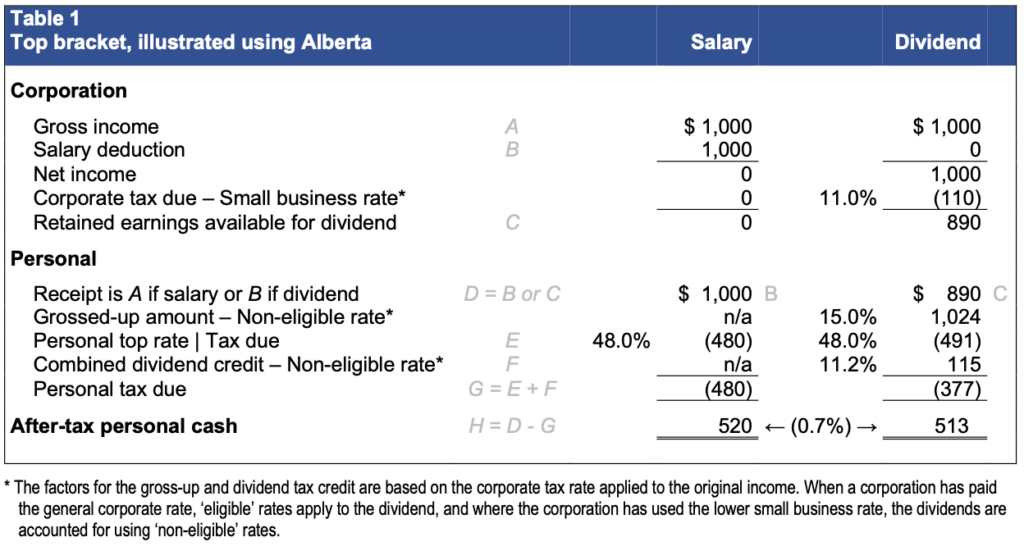
Illustrating integration between corporation and shareholder

Detailed integration comparison

In principle, the process works at all income levels, but it can be most clearly illustrated at top tax bracket. To show this, we’ll use the 2026 Alberta rates.

Net integration summary, all provinces

The gross-up is the same for all provinces, as is the federal tax credit. The provincial tax credit varies by province. Table 2 shows the net after-tax personal cash for all provinces at top bracket, showing for example the final row H from Table 1 as the Alberta column in Table 2.

As Table 2 shows, the net tax difference when earning through a corporation then paying a shareholder dividend is negative 1.7% to positive 0.7% as compared to paying a salary to that same person as an employee. While this is not the whole story, the small difference in result emphasizes that tax alone should not be the determinant whether to incorporate.

Cost considerations before incorporation

As discussed, if not all the income is needed for immediate personal spending, there is a deferral benefit to earning through a corporation. On the other hand, there are higher accounting and legal start-up fees, and ongoing costs to using a corporation. Professional advice should be obtained to get a full picture before deciding how to proceed.
