Building your emergency fund

Getting yours going, and knowing when & how to use it

In the classic sci-fi novel Ender’s Game, gifted children play simulated battle games with aliens at the edge of the universe, until <<spoiler alert>> the title character realizes during an especially intense sequence that he’s in the midst of the real thing, and everything to that point has just been practice.

When you last contemplated your emergency fund, a global pandemic would have been well at the perimeter of possibilities. And yet, that’s what we all just experienced. How comfortable were you with how your finances fared in-the-moment, and how confident are you that you’re ready for a future crunch?

Positioning an emergency fund in relation to regular budgeting

If you had an emergency fund in place, you may still have found yourself asking: Is this the trigger, how much do I take, when and for what? And if you didn’t have one but were fortunate enough not to have been too displaced from your regular earning routine, you were probably jolted into thinking about finally getting one going.

Regular budgeting addresses recurring expenses, plus reserves for periodic capital outlays. Insurance is for the extreme where there are very rare but very costly events. An emergency fund lies between.

This fund allows you to sustain your household in a time of crisis – whether that’s an unexpected injury to you or a family member, job loss or a global pandemic – while expenses continue to pile up.

How and when to use an emergency fund depends on how you define “emergency.” Commit yourself to a clear definition when you start socking money away so that this carefully targeted savings tool is preserved for truly pressing needs, and not depleted on emotional wants.

Guidance for using your emergency fund

Like Ender’s alien battle, those recent crises pushed many of us out of practice mode and into active monitoring and logging of our spending. Whether or not that describes you, we can all learn from these experiences, to help inform how we’ll use our emergency funds in future:

    • The immediate non-negotiable needs are food and safety. You can cut down on these expenses by shopping brand-consciously, reducing cost-per-unit by buying in (sensible) volume, and being extra vigilant about portioning meals, planning leftovers and limiting waste.
    • Shelter costs like rent/mortgage and utilities are next, as interest and penalties on short/skipped payments will quickly compound the emotional and money stress, further impairing your finances in the recovery time to follow. In the case of a widespread disaster, government support may be available, but if it is more localized or specific to your family alone, your financial resources will bear the primary or sole burden.
    • Dispensing with all discretionaries may not be practical as you hunker down for the days and weeks of any extended emergency period, but try to be selective about the prudent pleasures you choose.
    • Suspend luxuries and harbour no regrets. Keep your focus on the present, comforted that yesterday’s conscientious saving actions and today’s prudent spending choices will improve your prospects tomorrow.
    • Log where your money is coming from and where it’s going, so you can manage within your changing means. That’s a good habit in good times, and critical in a crisis. As was the case in the pandemic in particular, you may have a bit more time on your hands (unwanted though it may be) to focus on budgeting, which could be a catalyst to reinforce your good money habits over the long term.
Building a fund for future crises

An emergency fund’s purpose is to have money accessible for a specific number of months to carry you through the emergency. But how many? Start by planning for the most likely emergency: an employment gap.

    1. Based on your industry, geography and individual skills, how long do you think it would take to get re-situated? As you don’t know what the economic conditions will be, choose a figure between the best-case and worst-case scenarios to obtain a reasonable goal for the number of months your emergency fund may be needed.
    2. You may anticipate a payment from your employer on a termination. The amount will depend on the terms of your contract, including your income, length of service and the circumstances of parting. While this should not be ignored, be cautious and conservative in your assumptions. If things are contentious, there may be a delay in reaching a resolution, as well as legal/professional fees you may have to spend before receiving the amount.
    3. While losing income is painful, what matters most in an emergency is spending.
      • Tally up your outlays as shown on your banking and credit card statements over the last year, taking out anything truly extraordinary and deducting recurring items you may be able to defer for a few months.
      • Divide the total above by 12 for a monthly average, and multiply by the chosen number of months you decided upon in step 1 – This is your lower dollar limit.
      • Add back the deferred items to estimate how long until those deferrals will be exhausted, again dividing by 12 and multiplying by your target months from step 1 – This is your upper dollar limit.
      • Choose a number between the lower and upper limits for your target emergency fund. Decide whether and how much this may be reduced by an anticipated terminal payment from step 2, again being prudently cautious in your approach.
    4. Next, decide how much you will make as a weekly deposit to the fund, ideally aligned with your pay cycle. Assign either a percentage or dollar amount you can commit to, even if it’s a small figure.
    5. Now, the gut check:
      • Divide your chosen target from step 3 by your weekly deposit commitment in step 4. This will show how many weeks it will take for you to accumulate your target emergency fund.
      • If that timeline feels exceedingly long and you feel a knot forming in your abdomen, go back and see where you may be able to make some adjustments. Balance that unease against the discomfort from the current budgetary sacrifice in order to arrive at a manageable medium.
Supporting role for a line of credit

As a kicker, an oft-suggested alternative to an emergency fund is a line of credit at the ready with your bank or credit union. But for some people, taking on debt at a time of financial stress may be an uncomfortable proposition.

Even so, establishing a line of credit can be an effective complement to an emergency fund, knowing that it will be there to fill the gap if an emergency hits before the fund reaches its accumulation target.

Registered or non-registered?

Your RRSP is not an appropriate choice as an emergency fund. With withholding tax as much as 30%, you will have to take a higher gross amount to net to what you need. And if the withholding is less than the actual tax due, you’ll be scrambling to come up with cash at tax filing time next year. Withdrawing from an RRSP for an emergency also puts retirement at risk. Keep these two needs separated.

On the other hand, the TFSA is well suited for emergency needs. With no tax to deplete withdrawals, budgeting is much more transparent. Withdrawals are also entitled to the usual TFSA re-contribution credit, which can be both the motivation and target for replenishment once the emergency passes.
When does corporate cash become investible?

Operational efficiency to investible surplus

Apart from pursing a passion, the purpose of running a business is to generate income. To the point, eventually you intend on spending what your hard work produces, and using the excess to invest in yourself and your future.

Sometimes the route from contributed capital to surplus cash is quick, direct and transparent. More often though, invested cash takes on a variety of forms as it travels through the enterprise before emerging as profit. How complex that route is and how long it takes depends on the scope and scale of the business.


That being the case, it can be difficult to determine when, where and how to use portfolio investments in a corporation.

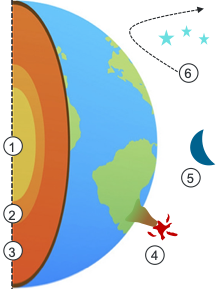
It may help to use the analogy of the earth and its gravitational pull to follow the movement of cash through a corporation.

Operational efficiency – Running the business
1. Inner core

Cash cycles through current assets such as prepaid expenses, inventory, and accounts receivable, and is applied to current liabilities as they come due. Some may be held in physical currency, but its use is more practically facilitated through deposits and short-term credit tools.

2. Outer core

Working capital is the continuous float – the ebb and flow between current assets and liabilities – that keeps a business running. Usually it is supported by a revolving line of credit so that the owner can focus on the business, and not accounting balances.

Working capital is not itself investible, but to the extent that efficiencies are applied (eg., timely use of payment terms, prompt account collections, optimal inventory levels, smart foreign exchange practices, etc.), more cash may be freed up to move up and out of a corporation.

3. Mantle & crust

Long-term assets are the structure within which the business produces its wares. They last for many years, but eventually have to be replaced in order to sustain productive capacity.

The cost of replacement is commonly managed through a combination of asset-backed loans and capital reserves. To assure that reserves are available when needed, safety and liquidity are the top priorities. 

Investible surplus – Breaking the business’ gravitational pull
4. Surface

Retained earnings is the after-tax money of the corporation. The portion of it that is not needed for business operations or capital reserves may be appropriate for passive portfolio investment.

5. Orbiting

A holding company may receive tax-free inter-corporate dividends on shares it holds in an operating company. This puts the extracted funds beyond the reach of operating company creditors, so may be a preferred place for portfolio investments. Where there is more than one business owner, each might establish a holding company so that respective funds and investment portfolios may be isolated.

6. Beyond gravity

Dividends to a shareholder may be placed in a personal non-registered investment account. Such dividends are taxable, meaning the personal investible amount is less than if it remained in a corporation. On the other hand, investment returns are taxed less favourably in a corporation, and sooner or later will have to cross that threshold for shareholder personal use. Tax advice is a must.

Executor of an estate

Naming one, being one

You’ve been asked to be the executor of someone’s estate, and you feel honoured. It’s understandable and appropriate to feel that way, as it shows trust and confidence in you to be asked to take on such an important role. Now, let’s think practical.

Executor means to ‘execute’ the instructions in a Will, though in your province the formal term may be something like personal representative, liquidator, administrator or estate trustee. Whatever the phrasing, it is a large responsibility and significant personal commitment.

This article provides an overview of what executorship entails,

    • For a testator – the person who makes a Will – to determine who best to name, or
    • For a potential executor to decide whether to accept.

The job ahead

Conceptually, there are three stages to the administration of an estate, with some overlap among them:

    1. Identifying and collecting the deceased’s property,
    2. Securing and managing the property (including converting to cash as required), satisfying debts to creditors, corresponding with government departments and fulfilling tax obligations from the assets, and
    3. Distributing property to beneficiaries.

A proposed executor will want to find out whether to anticipate complications. These may relate to the testator personally, characteristics of beneficiaries or the nature of the property.

Whether or not such complications are apparent, it will be helpful to an executor if the testator has kept a summary of key property and important relationships. Forms for this purpose may be obtained from the testator’s estate planning lawyer, financial advisory firm or a trust company.

Candidate characteristics

As that broad range of tasks suggests, it is indeed a job to be an executor, one that can take a lot of time and effort. In simple situations it can run for a year or two, extending out according to the size and complexity of the deceased’s property and scope of people involved.

An executor must be physically available to take care of tasks personally, and/or to meet with professionals who may be hired to provide assistance. It’s not constant, but will be concentrated at times, particularly in the first months after death.

Comfort with financial, legal and tax matters is an asset, at least sufficient to instruct those professionals. And in the arena of non-technical skills, a diplomatic disposition will go a long way, particularly when there are agitated (and agitating?) beneficiaries to deal with.

Legal nature of a fiduciary

With those practical matters in mind, let’s turn to the legal aspect of the role.

The executor is the trustee of the property in the deceased’s estate. A trustee is a legal owner, but must not take or use the property personally. The testator’s Will lays out the beneficiaries to whom the property will eventually pass once the administration of the estate is complete. Often the executor is one of those beneficiaries, which adds a layer of complexity to carrying out the role.

As trustee, the executor has what is known as a fiduciary duty. This includes acting in good faith, personally doing or overseeing the work, and not playing favourites among the beneficiaries. It’s summed up as always acting in the best interests of the beneficiaries as a whole.

Accepting the role

Sometimes a testator may name an executor without having previously discussed it with that person. Just because you were named, you don’t have to accept. The Will is not invalidated if you decline to act as executor, but it does leave it unclear who will be exercising those executor powers. This emphasizes why communication between the testator and the desired executor is so important, without which there could be uncertainty.

If you are unsure, be aware that if you begin acting as executor, you may be compelled to continue the work. If the beneficiaries will not release you from the obligation, a court application may be necessary.

A formal appointment?

It is the Will that gives legal authority to the executor. Even so, those holding the deceased’s property may require proof of the Will’s validity before releasing it to the executor. Historically, this was known as a probate application, though each province now has its own terms for this approval process.

Most provinces charge a tax or fee to process the application, which can run from a few hundred dollars up to about 1½% of the estate property. There are some simple ways to avoid this cost such as making gifts while living, naming insurance & registered plan beneficiaries, and holding real estate in joint ownership. These avoidance steps may lead to other costs and concerns, so it’s best to first consult a lawyer.

Ready to distribute

Once all debts and claims have been settled and taxes filed, the executor is then able to distribute to those beneficiaries. Before doing so, it may be prudent to obtain a clearance certificate from the Canada Revenue Agency confirming there are no further taxes owing. While the tax attaches to the deceased’s property, if that property has been distributed then the executor may be personally liable for the tax.

Once satisfied, the executor may proceed with distribution to the beneficiaries. The order is bequests of specific items first, legacies of specific dollar amounts next, and finally distribution of the residue. Usually, the residue is the bulk of the estate, but a testator may choose to set it up otherwise.

Investing trust funds

Due to the relatively short duration of an estate, an executor’s main priority is to preserve estate assets for distribution to beneficiaries. Appropriate options may be a cash account or guaranteed interest deposit.

However, if a Will directs a beneficiary’s entitlement is to be held in trust for a number of years, inflation could erode that value. A trustee should obtain a lawyer’s opinion as to whether active investing is called for. If so, a recommended next step would be to retain an investment advisor.

Executor compensation

An executor is entitled to compensation, unless the Will explicitly prohibits it. More likely the Will is silent on the issue, or possibly states an amount or formula for determining compensation. If there is no reference to compensation in the Will, the executor may claim compensation when making the final report to the beneficiaries. Since this is a direct reduction of their inheritances, if they approve the amount then that’s the end of it.

If the Will says nothing and there is disagreement about the compensation, a court application may be necessary. The executor will have to provide dockets and records of the work performed. A court officer will evaluate this based on factors such as how much time was required to do the work, the size & complexity of the estate, and whether the executor delivered exceptional results, for example a premium price on selling a business.

Based on case law (or a published fee schedule in some provinces), potential compensation may be as much as 4-6% of the value of the estate, though the court officer may award less based on the specifics of the situation.