TFSA room indexing – Anticipating the acceleration

The compounding frequency of annual increases

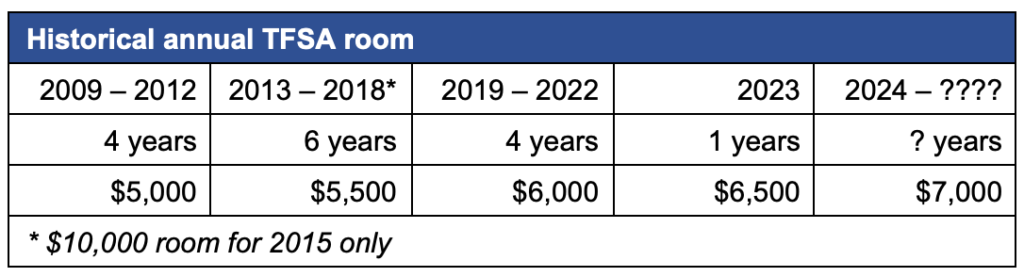
Since inception in 2009, the TFSA has had annual room increases about every five years – that is until the back-to-back bumps in 2023 and 2024 that brought the annual allotment up to its current $7,000 figure.

The annual room of $6,000 in 2022 would have elevated to $6,500 in 2023 with as little as a 1.5% rise in the consumer price index (CPI). As it turned out, 2022’s high inflation pushed the   indexation factor to over 6.3%, contrasting sharply with the sub-2% annual average for the preceding 15 years since the TFSA was launched. That was followed up with a 4.7% CPI for 2023, helping explain why we saw increases in two consecutive years.

This is more than just a walk down economic memory lane. The way that the indexing formula is structured, it’s arithmetically inevitable that we’ll see more frequent annual increases in TFSA room as the years roll forward.

The TFSA indexing formula

One of the distinguishing features of the TFSA is how it is designed to keep up with inflation. Like many other elements of our tax system, it makes use of an indexing formula, but one that operates unlike those others in that changes in annual TFSA room don’t necessarily happen annually.

The indexation factor is in section 117 of the Income Tax Act. For a coming year, it is the average of the CPI for the 12-month period that ended on September 30 of the current year, divided by the average of the CPI for the 12-month period that ended on September 30 of the preceding year.

For things like income tax brackets and RRSP room, that factor applies directly to increase the respective element every year. The same indexation factor is used for the TFSA, but it’s an indirect calculation, such that changes to TFSA room only occur every few years. The factor augments a background reference figure, and only once that figure rounds to the next $500 level does actual TFSA room rise by that amount.

Bear in mind that the first move required just a half-step of $250 for the reference figure to cross $5,250 and force the round-up to $5,500. After that (and leaving aside the one-time doubling to $10,000 in the 2015 election year), the $500 increment was applied two more times to take us from the original $5,000 room in 2009 to $6,500 in 2023. Again, that’s about five years on average, before this one-year quick step in 2024 to $7,000.
A beneficial byproduct of this two-stage process is that TFSA room is always a round figure. While being careful not to overstate the case, this simpler expression may make TFSAs more understandable and accessible for those who may feel intimidated by tax minutia.

Frequency of future increases

Now consider that at the beginning, that $500 increment was 10% of the original $5,000 room. That same $500 is now just 7.1% of the current $7,000 room. With an ever-higher base upon which to apply the indexation factor, the number of years required to reach future levels will continue to compress.

We can observe this with an example that applies a consistent 2% indexation factor, which would match the Bank of Canada’s (BOC) long-term inflation target. Assuming a current reference figure of $6,861 in 2024 (an unofficial approximation based on the CPI rates since 2009), it will take four years to step up to $7,500, and just three years to hit $8,000, with continuing narrowing in following years.

On the other hand, if the recent high CPI foretells a period of sustained higher inflation (hopefully not!), then those jumps could be compressed even further. By my calculation, if CPI hovers around 3% (the high end of the BOC inflation target range), we could soon see TFSA room increasing every other year. As appealing as that may sound for the TFSA, it would be exceedingly disruptive to living expenses, meaning less cash available to take advantage of that increased room.

Accumulated unused room

Though the original $5,000 of annual TFSA room may have seemed modest when the program launched, there is now momentum to its indexed increases. And with the benefit of unlimited carryforward of unused room, the TFSA is likely to become an even more prominent financial tool for many people.

In fact, another way to look at indexing is to consider how the addition of room each year effectively indexes accumulated unused TFSA room. With the $7,000 of annual room credited for 2024, accumulated unused room stands at $95,000. For someone who has not yet taken advantage of their TFSA capacity, that’s an 8% increase to their waiting tax sheltering room.

One cohort for whom this could be especially apropos is couples who were early homeowners when the TFSA was introduced. Mortgage payments will have dominated their monthly budgeting in the intervening years, but now they’re likely seeing light at the end of that tunnel. Through accelerated bi-weekly payments they will have been able to reduce the amortization of a 25-year mortgage by almost eight years. Give it a couple more years and that extra household cash flow will align nicely with the combined $200,000+ TFSA room waiting to be exploited.

IPP suitability scorecard – Business owners and professionals

Expanded retirement tax-sheltering using defined benefit pension rules

Registered Retirement Savings Plan (RRSP) contribution room is calculated based on a percentage of an employee’s annual income. Comparatively, a defined benefit registered pension plan (your own RPP) combines income with actuarial factors such as an individual’s age and the plan’s features to open the way toward significantly larger tax-deductible deposits.

Qualified business owners and incorporated professionals may establish a plan for one person, or up to three pension members – including spouse and family employees.

Check the boxes here to see if it is suitable for you:

  Is the business owned by and run through a corporation? Or if it is a professional practice, is it operated through a corporation?

  Does the owner draw annual income of at least $70,000 to $100,000, either as employment income alone, or combined with dividends? 

  Is the business owner or professional at least 38 years of age, but no older than age 72?  

  Has the owner maximized RRSP contributions, but is still seeking more CRA-approved tax-sheltering opportunities? 

  Is there surplus corporate cash that is exposed to the punitive corporate tax rates on passive income? 

If you have at least three checks so far, then this could be your route to expanded tax-sheltered savings, and here’s more to consider.

  Would it be appealing to increase the amount for annual spousal income splitting, and make it available before age 65?

  Are there any concerns that business creditors may get access to corporate assets meant to fund the owner’s retirement? 

  Are there family employees for whom the owner would like to arrange a tax-deferred estate transfer, bypassing creditors and probate? 

  Is there an anticipated or pending business sale where excess assets may threaten the owner’s claim to the lifetime capital gains exemption?

  If planning to retire abroad, would the owner like allow for greater tax-deferral by limiting emigration tax on deemed dispositions? 

The ideal candidate for this kind of retirement pension will have at least six checks.

To learn more about how this can work for you, see the article IPPs – Individual pension plans.

Spousal rollover … or not?

To defer, or prefer to incur

After a good long run, dad died midway through his 99th year. Mom and we kids will miss him dearly – they actually called each other “dear” – but it was his time.

Mom is nearing the mid-90s herself. Customarily, everything would roll to her to get around the tax on deemed dispositions at death that would otherwise erode dad’s estate, of which mom is the sole beneficiary – But could we do better for her?

It’s one of those mantras of financial planning to arrange beneficiary designations and joint accounts to allow streamlined continuity to a spouse. Even so, it’s equally important to pause and consider whether to opt out, particularly for deaths early in the year. Dad died in January, so with only a couple weeks of income, there remains plenty of room to make use of his basic personal credit and low bracket tax rates.

Following are some steps we undertook, along with the odd snag along the way.

Pension rollover

To begin, notice was given to the administrator of the defined benefit pension that was their primary income source. As surviving spouse, mom will continue with a reduced pension, emphasizing the need to be tax-conscious with her other income sources. There won’t be any residual value when she dies, but with the two of them living well into their nineties, they got their fair actuarial share out of the deal.

RRIF on death

Mom handled the house when we were youngsters, followed by a lengthy run as a school trustee. Dad took early retirement at 60, then kept busy with teaching and consulting gigs into his 70s. Thus, despite having a dependable pension, both had moderate accumulation in registered retirement income funds (RRIFs), each naming the other as beneficiary. Their financial advisor (a friend to us all) readied the paperwork to roll dad’s RRIF to mom.

Acting under power of attorney (POA), we instead declined the receipt of the RRIF on mom’s behalf. Accordingly, the amount will be included in dad’s final year income, soaking up the remainder of his basic personal credit
(i.e., at zero tax), with the rest tagged with the lowest bracket rate.

RRIF minimums

In their later years, we have been managing their finances under POA. This included instructing on taking the minimum RRIF withdrawal early in the year. That meeting was still in the upcoming calendar when dad died.

The RRIF minimum, based on the preceding year-end value, is required to be paid in the following calendar year. Per CRA and the administrator’s practice, as it had not been paid before dad’s death, that portion had to be paid and taxed to mom as the named beneficiary (though again as noted above, the bulk had been declined, to be taxed in dad’s final year).

TFSA rollover

One great thing about a TFSA rolling to a spouse is that it continues to be a TFSA, without requiring or using up the receiving spouse’s TFSA room. Notably, unused TFSA room does not roll to a spouse, nor to anyone else for that matter. Fortunately, mom and dad were consistent TFSA contributors, with the combined amounts now being with mom, except for the lost room for dad’s final year due to the contributions not having yet been made.

(Not) naming beneficiaries under POA

For registered accounts in Ontario (and most common law provinces), attorneys under POA cannot initiate or change beneficiary designations. However, many financial institutions will carry over an existing designation on an incoming registered plan, which was helpful as we were consolidating their financial holdings when their faculties had significantly declined.

Unfortunately, dad had one small TFSA without a designation. As we could do nothing about it, probate was inevitable for dad’s estate. On the bright side, it bolstered our decision to allow the RRIF to fall into the estate, with the projected income tax savings well exceeding the nominal bump in probate tax.

Joint non-registered account

The proceeds from their home sale years ago went into mom and dad’s joint non-registered investment account. That’s helped service their later accommodations, while also appreciating nicely. Probate was bypassed at dad’s death, with mom continuing as sole legal and beneficial owner by right of survivorship.

By default, capital property rolls at adjusted cost base (ACB) to a spouse on death. This applies when held through a joint account as in this case, or if dad had an account under his name alone that was then migrated to mom as estate beneficiary (as long as the individual securities in the account were not sold in the process).

Alternatively, dad’s estate can elect out of the automatic rollover, on a per-property basis. This will allow us to optimize for mom’s future needs by choosing which securities to rollover, and which to have taxed in dad’s final return. As mom could conceivably blow right past dad, the century mark and beyond … that extra financial flexibility will be welcome comfort for her as she moves into this next chapter.