RESP – Registered Education Savings Plan

A tax-sheltering tool to help with post-secondary education

The Registered Education Savings Plans (RESPs) assist subscribers (usually parents) to save for post-secondary education for beneficiaries (usually their children). RESPs provide three main financial benefits:

    • Government money is added to the subscriber’s personal contributions
    • Tax-sheltered growth of both the personal and government money in the plan
    • Tax is usually borne later by the student-beneficiary, who will typically be at a lower tax bracket than contributors

How are RESPs set up?

To set up an RESP, a subscriber contracts with an RESP promoter (an offering financial institution) to save for the education of a beneficiary. The subscriber may then make contributions to the plan or invite anyone else to contribute.

A beneficiary must be a Canadian resident with a social insurance number (SIN) when the plan is opened. Any person may be a subscriber, but usually it is the beneficiary’s parent. The SIN of the subscriber must also be provided to register the plan in the tax system.

Most plans are set up as an individual plan with one beneficiary, or a family plan where the beneficiaries are related siblings or cousins. There are also group plans administered based on age-determined groups.

There’s no minimum or maximum beneficiary age to open an individual plan. You can even set one up for yourself. Contributions may be made for up to 30 years, and the plan may stay open for up to 35 years. If the beneficiary qualifies for the disability tax credit, these timelines are extended by 5 years.

What is the maximum allowable contribution and what is the tax treatment?

In terms of personal contributions, there is no maximum annual contribution limit, as long as the lifetime personal contribution does not exceed $50,000 per beneficiary. There are however annual limits to the amount of government assistance (see below), which could influence personal contribution timing.

Tax treatment depends on source of the money and timing:

    • Personal contributions are after-tax, meaning there is no tax deduction at that time.
    • Government assistance is not taxable when credited to a plan.
    • While in the plan, there is no tax on income earned on either personal or government contributions.
    • When taken out, all income and government assistance are taxable to the beneficiary when paid as education assistance, but withdrawal of personal contributions is not taxable.

How much government assistance can subscribers receive?

There are three main sources of federal government support (and some provinces also have programs):

Canada Education Savings Grant (CESG)

Basic CESG is a 20% matching grant of up to $500 annually, to a lifetime maximum of $7,200. Carryforward room must be claimed before the beneficiary turns 18 years of age. In theory, if cash is available, the full lifetime $50,000 contribution could be made in one year, but then only a single year’s CESG would be collected, leaving thousands of government support money unused.

Additional CESG

On the first $500 of annual contributions, extra support is provided to low- and middle-income families. Family income thresholds are indexed annually, with figures for 2024 being:

    • Additional 20% grant, up to $100, if family income is up to $55,867, or
    • Additional 10% grant, up to $50, if family income is up to $111,733.

Canada Learning Bond (CLB)

For a child in a low-income family, the CLB provides $500 in the first year, then $100 annually to age 15, for up to $2,000 total. No personal contributions are required. The CLB is in addition to CESG benefits. The family income threshold begins at $55,867 in 2024 if there is one child in the family, increasing with more children.

How are funds withdrawn from the plan? What is the tax treatment for withdrawals?

The subscriber may choose how much and what type of draw is to be taken from the RESP:

Education Assistance Payment (EAP)

An EAP can be paid to assist a beneficiary who is attending qualified education, training or an apprenticeship program – either in Canada or abroad. As a distribution of the plan’s government assistance and accumulated income, the full amount is taxable to the beneficiary.

The EAP limit during the first 13 consecutive weeks of enrollment is $8,000 for full-time studies, or $4,000 if part-time. Thereafter, there is technically no annual limit, but the plan administrator must obtain more detailed documentation for amounts over a set annual amount, which is $28,122 in 2024.

Refund of contributions

Personal contributions can be returned to the subscriber at any time without tax consequences, as long as the beneficiary is enrolled in a qualifying program at the time. If not, the withdrawal of personal contributions may trigger repayment of recent years’ government assistance, according to a formula based on the timing of the original contributions.

Accumulated Income Payment (AIP)

This is a taxable payment of any remaining income in the plan to the subscriber, generally only if the beneficiary will not be attending school. An extra 20% tax applies, which may be avoided by rolling the AIP amount into an RRSP (assuming the subscriber has at least that amount of room in their RRSP). The plan must then be closed by the year following the AIP.
When to begin your CPP retirement pension

The case for taking Canada Pension Plan at age 70

While playing charades over the holidays, my youngest son stumbled with “a bird in the hand is worth two in the bush.” Eventually we guessed it, and then explained to him that it means accepting a sure thing now rather than holding out for something potentially bigger later.

Coincidentally, that adage also featured prominently in an item on my holiday reading list — a research paper about delaying Canada Pension Plan (CPP) retirement benefits, released by the National Institute on Ageing and the FP Canada Foundation.

My long-held opinion has been to take CPP no earlier than age 65, unless there are compelling personal characteristics or surrounding circumstances that support starting at a younger age. After reading this paper, I’m now leaning toward 70 as the default position.

When we’re starting CPP, and why

The majority of Canadians — seven out of 10 — take their CPP retirement pension at either age 60 or 65. Less than 5% take it after age 65, and only 1% wait until age 70. The research paper’s author, Bonnie-Jeanne MacDonald, attributes this pattern of early uptake to a combination of lack of advice, bad advice, and “bad-good” advice.

The bad advice includes the emotional pull of the bird-in-the-hand: If you die early (so the argument goes), you’ll leave money on the table, so you should take CPP as soon as you can. However, the only guarantee here is that your payments will start sooner, not that you will receive more. And ironically, the early uptake may in fact increase the likelihood that you will receive less, as we will see further down.

The “bad-good” advice is the mainstream practice of using a breakeven age. It compares two starting ages, for example 60 and 65, focusing attention on whether you will reach the age when the cumulative payment receipts are the same. This speaks to our behavioural tendency to favour the near-term (from first age to second age to breakeven age), thereby undervaluing the lifetime income security that CPP offers. On top of that, academic research shows we tend to underestimate our life expectancy, making it even more likely to choose the earlier start.

According to Canada’s chief actuary, life expectancy at age 60 is 85.9 for men and 88.5 for women. In my own experience, I’ve never seen a suggested breakeven/crossover age much over 80. This has long been my discomfort with this approach, as you are betting on being in the “dies-before” half of the cohort population. You lose (statistically) simply by being average, and it gets worse the longer you live.

Measuring the dollar difference

Early uptake would not be a concern if it leads to a better financial outcome. To test this, MacDonald departs from the breakeven approach, favouring a calculation of the current dollar value of the expected loss, or “lifetime loss.”

The model incorporates the annual drawdown of RRSP/RRIF savings equal to the foregone CPP pension each year, until the pension actually begins. Though taking CPP earlier may allow RRSP/RRIF savings to last longer, the model shows that most people will maximize lifetime income from the two combined sources by deferring CPP to age 70.

Notably, among the scenarios canvassed in the paper, for someone entitled to the maximum CPP pension who lives close to age 100 (a 25% probability from age 60 according to the dataset used), the current dollar loss can exceed a quarter of a million dollars.

Sorting through contributing factors and fielding options

To be clear, lifetime loss is not intended to be applied without consideration of individual circumstances. There are many situations where it would make sense to begin early, such as when there is a known life-limiting health condition, or when someone is trying to preserve income-tested benefits or shield against the Old Age Security clawback.

For most people, it’s a challenge just to identify all the contributing factors in making such a decision, let alone evaluate the trade-offs among them. It’s both technically complicated and emotionally charged, which together can be overwhelming.

In addition to being a dependable information source, financial advisors can offer guidance on how to apply some of the lessons of behavioural finance:

    • Loss aversion holds that we feel the pain of loss twice as much as the joy of gain, which is what lifetime loss illustrates in concrete terms.
    • It also frames the discussion on the more-likely scenario of longevity, as opposed to early death.
    • Lastly, by anchoring the thinking on age 70 as the default option, the ultimate decision is more likely to end up near that age, to one’s own benefit.

Ultimately, the decision should be informed by individual particulars and reliable evidence as part of the conversations between advisors and clients.

RRIF – Registered retirement income fund

What happens when you are ready to draw down your RRSP?

A registered retirement savings plan (RRSP) allows you to deposit and accumulate tax-sheltered savings. Once you are ready to use those funds for your retirement, there are three options available – individually or in combination – for you to ‘mature’ your RRSP:

    • Cash-in your RRSP — The entire cashed-in amount will be taxable that year, which could push you into higher tax brackets, so this is not usually desirable except to close out a small RRSP.
    • Purchase an annuity — Annuities pay a guaranteed fixed amount for life or a set number of years. Payments are often made monthly, with the total annual receipts taxable each year.
    • Transfer to registered retirement income fund (RRIF) — You must take a minimum amount out of a RRIF each year (except the first/transfer year), though you can take more. Amounts taken are taxable each year.

When can you start a RRIF?

You can start a RRIF at any age, not just when you are retired from working. Still, since the required withdrawals are taxable, you generally wouldn’t do so until you need the funds for living expenses – but you can’t wait forever. By the end of the year you turn 71, your RRSP must be matured by one or more of cashing-out, annuitizing or transferring to a RRIF.

Investing with continued tax sheltering

Unlike an RRSP, you cannot contribute anything more into a RRIF. To be clear though, you aren’t required to mature all your RRSPs at the same time. You may decide to keep some money in RRSP form, to be used to set up another RRIF (or annuity, or cash-out) at some time in the future, bearing in mind the age 71 outer limit.

Apart from what you take out of a RRIF, whatever remains within it will continue to grow tax-sheltered.  As to investments, you are able to choose among essentially the same options available to you in your RRSP.

How are RRIF minimum annual withdrawals calculated?

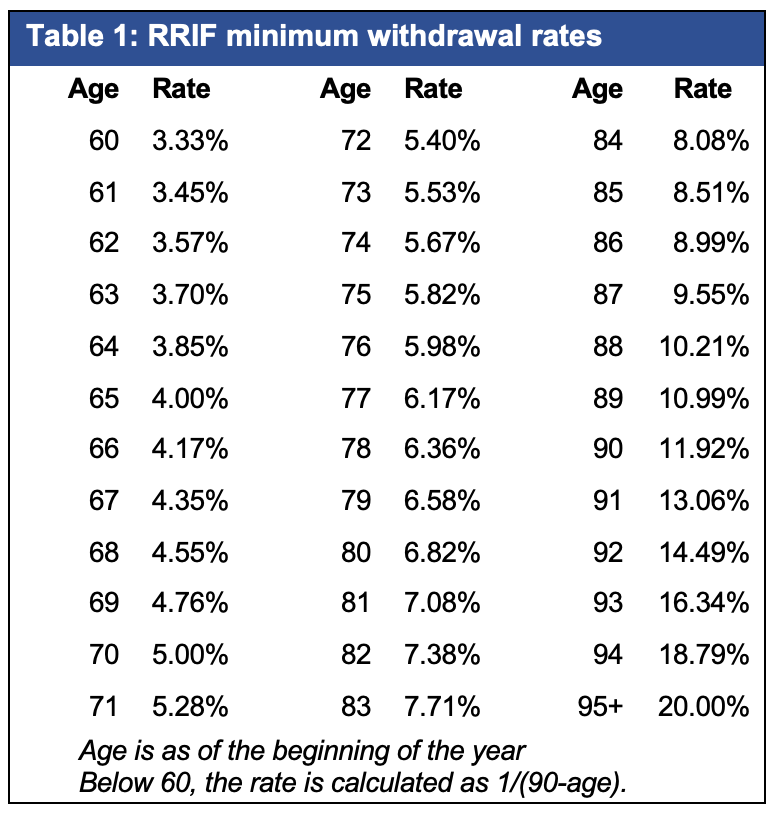
A minimum must come out of a RRIF each year, based on your age as the ‘annuitant’ at the beginning of the year. Minimum withdrawal rates are on Table 1 following. The shown rate at each age is multiplied by the RRIF value at the beginning of the year to obtain the required minimum withdrawal. Once again, there is no minimum the year the RRIF is set up.

If you wish, you may use the age of your spouse/common law partner (CLP) as annuitant, which would reduce the minimum if he/she is younger. If you do this, the payments are still made to you and taxed to you, even though the rate is based your spouse/CLP’s age. When you file your annual tax return, you may be able to elect for some of that RRIF income to be split with and taxed to your spouse/CLP, as discussed further below.

Withholding tax

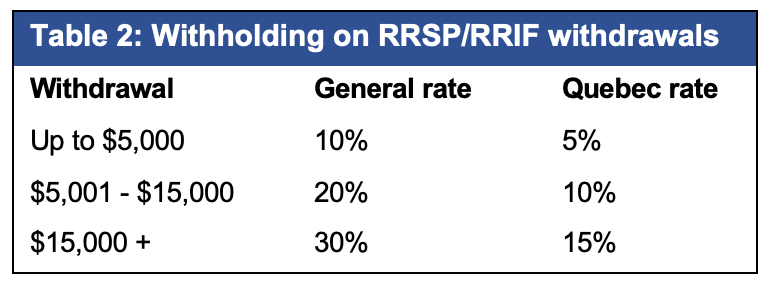
The RRIF administrator must withhold tax on withdrawals to remit to the Canada Revenue Agency (CRA), but only on any amounts over the minimum. See Table 2 below. Understand though that all RRIF withdrawals are taxable.

When you calculate your actual tax due on your income tax return, you receive a credit for the withheld taxes. This may lead to a tax refund if more was withheld than necessary, but if the withheld amount is insufficient then you will owe the difference.

Quarterly instalments

When you file your return, if the difference between tax payable and withheld tax is over $3,000 ($1,800 in Quebec) for the current year and either of the two preceding years, you may have to pay future taxes in quarterly instalments. This can happen for example if the RRIF is large, and the annuitant is taking only minimums without any withholding. CRA will send you an Instalment Notice if this is the case, outlining the payment due dates, amounts required and process for making payments.

Annual splitting, and transfers at death

If you are over 65, you are entitled to split up to 50% of RRIF income with a spouse/CLP, which could reduce your household tax bill if your spouse/CLP is at a lower tax bracket. You make the election on your annual tax return. Each year, you may choose to split whatever amount suits your needs, again up to the 50% maximum.

On death, the full RRIF amount is normally brought into a deceased person’s terminal year income (January 1st to date of death). However, a tax-deferred rollover is allowed to a spouse/CLP who is named as RRIF beneficiary or who is an estate beneficiary with a financial entitlement at least as much as the value of the RRIF. It is also possible to roll to a minor child or a financially dependent disabled adult child in qualified circumstances.