Demystifying family trusts

How to use trusts in estate planning

We say the word ‘trust’ regularly in our day-to-day language. When it comes to its legal use in estate planning however, the trust is likely a mystery to most people.

For centuries, trusts have been used to control, preserve and transfer property. While they may have been used more often by the affluent in the past, today the topic of trusts should be discussed in all estate planning conversations.

What they are is a form of property ownership. Even more important is what they do, which is to allow for that ownership to be carefully catered to individual needs – by breaking the ownership apart.

What is a trust?

A trust is a way of separating legal ownership of property from the beneficial entitlement to that property. The legal owner holds the title, controls and manages the property, while beneficial ownership refers to the use, enjoyment, income and growth of the property.

The base structure of a trust is easily represented in the familiar shape of a triangle. The initial property owner, the settlor, names a trustee as the new legal owner of the property, who holds onto and manages it with the obligation to do so in the best interests of the beneficiary. This is called ‘settling’ a trust.
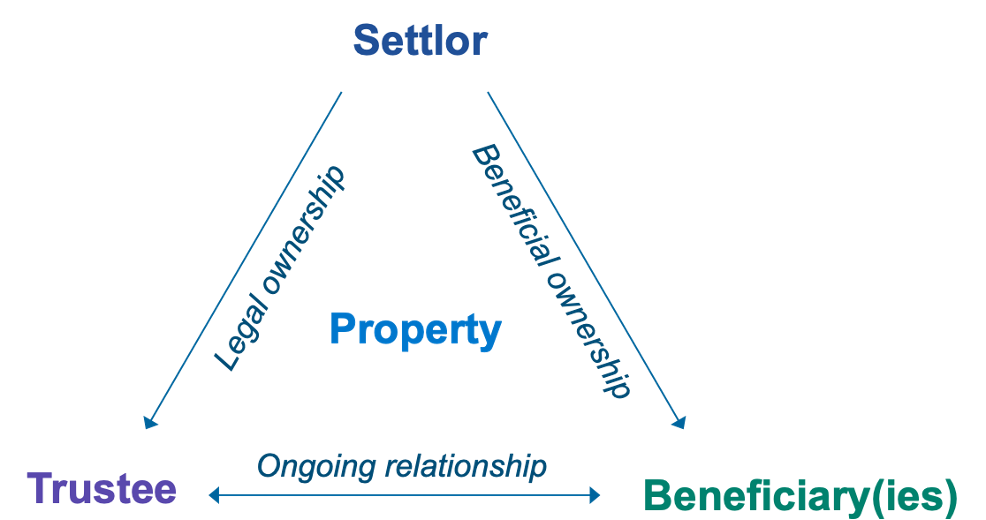
Commonly there is just one settlor, but it’s not unusual to have 2 or 3 trustees, and as many beneficiaries as circumstances require. In some situations, the settlor may also be a trustee, a beneficiary or all three.

In summary, a trust is the description of a property relationship. Specifically, it is not a legal entity, but it is however a taxable entity, and it is the trustee (as legal owner of the property) who is obligated to file tax returns on behalf of the trust.

Why would you want one?

A trust may be used when someone cannot or should not come into full ownership of property. With a trustee as legal owner, the property will still be available to the beneficiary, however it will be subject to instructions you give the trustee. Common uses include:

    • Overseeing the inheritance of a minor child who can’t legally own property
    • Insulating against creditors who may otherwise seize the person’s directly-owned property
    • Preserving family wealth from claims arising on a marital breakdown
    • Optimizing public support for a disabled person who may be subject to asset or income limits
    • Keeping someone with an addiction from wasting their possessions
    • Managing and monitoring charitable gifts
    • Staging the distribution of inheritances down generations, or across blended families
    • Tax planning between spouses, as well as for succession of businesses

Beneficiary breakdowns

Sometimes a trust has one beneficiary who has all beneficial rights to the property. Alternatively, just as there are many situations where a trust may be used, there are many ways that beneficiary rights may be broken down.

For example, under a Will you may be a primary beneficiary, or it may be contingent on someone else like a parent having predeceased. You could be entitled to a specific item, a set dollar figure or the residue that is left over. Your rights may immediately vest or may be deferred to a certain date or until some event occurs. If there are investments or real estate, you may get the income, the capital when it’s sold, or both. As well, that income may continue for a set period of time, up to a set amount, or for life.

How is one created?

Now that you have an idea of the ‘what, who and why’ of a trust, let’s look at the legal requirements for how one comes into being. These are called the ‘three certainties’:

    1. Subject matter: Can you identify the property that is to be held in trust? (either by directly naming or listing the property – or by providing instructions on how this will be done in the future)
    2. Objects: Are the beneficiaries known, or is there a way to conclusively determine who they will be?
    3. Intention: Is it clear that the settlor wanted to separate legal ownership from beneficial ownership?

A trust can be oral, written or both, but these certainties are clearest where there is a single written trust document. If the trust is created while you are alive, also called an inter vivos trust, the technical name of this document is an ‘indenture’. Alternatively, your Will passes your property at death to your executor as trustee of your estate. In this case we call you a testator, not a settlor, but your estate is a trust all the same.

Navigating taxes

Until 2015, trusts created by a Will, called testamentary trusts, were commonly drafted into Wills for the purpose of tax planning. Until that time, testamentary trusts were taxed at graduated bracket rates that progress from low to high income, similar to individual tax treatment. Now, they are taxed at top bracket, just like inter vivos trusts, those created during your lifetime.

Graduated treatment is however still allowed for the first three years of an estate (called a “graduated rate estate”) and for testamentary trusts for a beneficiary who qualifies as disabled under the tax rules. Trusts can also still be used in a variety of ways to defer taxes when transferring property between spouses.

Lastly, business succession planning is often driven by tax issues. In such cases, trusts don’t provide a direct tax benefit, but instead have the primary purpose of maintaining control without interfering with the tax planning.

Historically, a trust was not required to file a tax return if it had nominal income, had no tax due and had not disposed of capital property. As of 2023, all trusts (with limited exceptions) must now file an annual T3 Return, and include with it a Schedule 15 Beneficial Ownership Information of a Trust. These obligations now apply to bare trusts (where the trustee cannot act without instruction/permission of the beneficiary/ies), though bare trusts are exempt from the filing requirements for the 2023 tax year, unless CRA makes a direct request to a taxpayer. Further guidance from CRA is expected with respect to filing obligations in years after 2023.

Choosing a trustee

Fundamentally a trustee’s role is to own and manage property. For a professional trustee, that’s the business proposition being offered.

If instead a family member or friend is contemplated as trustee, their qualifications should also be evaluated. This includes organizational skills, financial experience and diplomatic aptitude, as well as the person’s age in relation to the expected time that the trust will continue.

Finally, as noted earlier, the trustee is required to always act in the best interests of the beneficiaries. This is known as a fiduciary, requiring both integrity and conscientiousness to steer clear of conflicts of interest. Put another way, it is critically important that the trustee be trustworthy, in the everyday sense of the word.
Intestacy? For those you love, make a Will

Complications and costs of an un-planned estate

Recently, I was invited by a financial advisor to meet with a young mother of two whose husband had, in a matter of weeks, gone from diagnosis to death – and there was no Will. I’ve had that same meeting a half dozen times over my working life.

You may find it shocking for me to be so blunt in saying so, but that falls well short of the emotional pain of becoming a widowed parent of toddlers, trying to keep the household together financially, and plodding your way through an intestacy. It’s devastating enough to deal with a close death, without that added uncertainty, paperwork and excess stress.

So, to the question of when someone should have a Will, my unhesitant response is that if you ARE an adult then BE one – and make a Will. If not, here’s what may be ahead for your family.

Purpose of a Will, and effect of intestacy

A Will allows you to say who will receive what you own at the date of your death, in what proportions and with appropriate strings attached if you wish.

Without a Will, the provincial/territorial rules of intestacy – meaning the absence of a valid Will – will dictate who among your family (or more distant relations) will receive your property, and in what proportions. Unfortunately, that distribution would be without the benefit of your legally binding wishes, let alone any final thoughts or moral guidance you may have wanted to impart. The exact rules vary by jurisdiction, but generally:

    • Spouse and no children – Entire estate passes to the spouse
    • Spouse and child or children – Spouse commonly receives a legislated minimum amount, and the rest is distributed between the spouse and child/children, with the spouse getting the largest portion
    • Child or children – Each will get an equal share
    • No spouse or children – The rules expand outward to parents, siblings and other blood relations
    • No blood relations – The estate will likely end up with the provincial government

Note that intestacy does not supersede property passing by right of survivorship when held jointly (with anyone, not just a spouse), nor does it affect beneficiary designations on registered plans and insurance policies.

Extra stress for common law spouses

Depending on province/territory, a common law spouse may be excluded from estate distribution if there is no Will, or require a prior registered notice to qualify for a share of the estate. For the purposes of entitlement to intestate distribution, the term “spouse” applies to:

    • Only legally married persons in Ontario, Quebec, New Brunswick, Newfoundland & Labrador, and Yukon.
      (In Yukon, a common law spouse may apply for a court order for support and maintenance from the estate.)
    • Both legally married and common law spouses in British Columbia, Alberta, Saskatchewan, Manitoba, Prince Edward Island, Nova Scotia, Northwest Territories and Nunavut. (In Nova Scotia and Nunavut, registration of common law status and/or filing of a domestic contract may be required.)

Adjusting unintended or unexpected distributions

Even when people are legally married, an intestacy invariably puts the surviving spouse in a difficult position. Rather than the entire estate passing to the survivor (as is most often the expectation), the children may gain property rights alongside their parent. If the children are adults and all get along, that may be manageable. If there are minors and/or past conflict, then further complications and anguish may be ahead. The age of majority is 18 in six provinces: Alberta, Manitoba, Ontario, Prince Edward Island, Quebec, and Saskatchewan. The age of majority is 19 in four provinces and the three territories: British Columbia, New Brunswick, Newfoundland, Northwest Territories, Nova Scotia, Nunavut, and Yukon.

Possibly, the spouse could take steps to force a different distribution, for example by electing under the jurisdiction’s family law to treat the death as a legal separation. Though this may be a practical and arithmetically justified step, it can be emotionally tough to come to this decision (in addition to possible social and cultural discomfort the survivor may feel), and even then it will seldom result in all the assets being back with the spouse.

And as challenging as things may be where the surviving spouse is the parent of the children in an intestacy, any conflicts of interest could elevate to conflicts in reality in second marriage and mixed family households.

Supporting your children in vulnerable circumstances

Beyond the matter of transferring property between you as spouses, as parents you also have to think the unthinkable of what happens if you both die, whether at once or in short succession.

Transferring property to children can be complicated. A trustee will be legally required for minors – which you could have done by Will, but which instead will probably require a court order in an intestacy – and even young adult children can use support and guidance. It requires careful thought to decide how best to structure a trust, what powers to give the trustee, how things will be accounted for, and ultimately who is best suited to the job. You missed out on your opportunity to give those instructions if you didn’t make out a Will.

Equally important, such a traumatic time is when children need a stable family structure. You want them to have an emotionally supportive home, surrounded by extended family and a social setting that allows them to build fulfilling lives. To the point, your Will is the last word you can offer on guardianship, so its contents and the conversations leading up to its execution are fundamental to your role as a parent.

Having ‘enough stuff’ is not the criterion

You may feel you don’t own enough to be bothered, but eventually you will (often without you noticing), and sometimes rights and claims arise as a result of an untimely or accidental death. And really, it’s not so much about the things you own, as it is about properly caring for the people you love, particularly those who are financially dependent on you.

Even if you’re young and penniless, think of the parents and the family from which you came. When a child dies first, it can be crushing to parents, whether that child is under their roof or has set out into the world. Such a ‘death out of order’ can be emotionally, socially and even physically paralyzing for parents. A minor child can’t do anything to provide relief in such tragedy, but as an adult you can make a Will to assure that the estate can be managed as efficiently as possible, helping your parents to begin dealing with their grief.

Donating RRSP/RRIF to charity

Re-directing final tax dollars to your chosen causes

As a regular supporter of your favourite charity, you’re pleased that your annual donations help keep the lights on. Ideally though, you’d also like to contribute in a way that sustains the organization over the longer-term.

One way to do this – without reducing what you need to live on – is to direct some or all of the remaining value of your RRSP or RRIF on death to your chosen charity. Not only will that make for a substantial gift in and of itself, but you’ll also be pleased to know that it comes
‘at the expense’ of some of the tax that would otherwise have been paid at your death. 

Indeed, after the tax break, the donation may only cost you half of what the charity receives. 

Tax imposed on registered plans at death

For many Canadians, registered retirement savings plans (RRSPs) are the primary tool used to accumulate retirement savings. Contributions are tax-deductible, with income and growth tax-sheltered while in the plan. 

Commonly on retirement, an RRSP is converted into a registered retirement income fund (RRIF), which continues to enjoy tax-sheltered income and growth. Withdrawals from the plan are taxable income, but usually spread over multiple years at graduated tax bracket rates. 

Still, the entire value of a RRSP/RRIF is eventually taxable. 

On death, the remaining balance is treated as income that year, though that can be deferred by rolling over to a registered plan of a spouse or financially dependent child or grandchild. Otherwise, the full amount is taxed in a single year, pushing up through those graduated brackets toward the top bracket, which is within a couple percentage points of 50% or more, varying by province. 

Tax relief on charitable donations

When someone donates to charity, the person may claim a credit to reduce annual taxes. The tax credit is at the lowest bracket rate on the first $200 of donations claimed in a year, being 15% federally, and ranging by province from about 5% to 20% depending on where the donor resides. 

Above $200 of annual donations claimed, the tax credit jumps to a higher rate. The high rate applied against federal tax is the 4th bracket 29% rate, or the top/5th bracket rate of 33% if income is over that level. Those brackets are $181,440 and $258,482 in 2026. For provincial tax, Quebec and BC use the federal approach, with the other provinces applying a single high credit rate that is near or equal to their top bracket rate. This puts the combined federal-provincial credit rate near or above 50%, varying by province.

The maximum annual donation that can be claimed is equal to 75% of a taxpayer’s net income. That limit is increased to 100% in the year of death, and if the donation is larger than that final year’s net income, the excess can be used to recover tax from the preceding year’s tax bill, also based on up to 100% of net income

Donating registered plans to charity at death

The owner of a RRSP/RRIF may designate one or more beneficiaries to receive the proceeds of a plan upon the person’s death. The plan administrator will provide a form to make that direct designation, or alternatively most provinces allow for a person’s Will to direct the proceeds of such a plan. (Note that direct designations are not available to Quebec residents, whether on the plan directly or by Will.)

A named beneficiary may be another person, or it may be an organization, such as a charity. When a charity is named, by either method, the donation is deemed to have been made immediately before the person’s death. This then qualifies the donation for that 100% threshold for both the year of death, and excess carryback to the preceding year.

Spousal flexibility

A spouse could be designated as primary beneficiary, with the charity named as contingent beneficiary. This assures that a living survivor would continue to have full use of the couple’s savings on a first death through the usual tax-deferred rollover. Meanwhile that contingent designation serves as a backup plan if the survivor forgets to name the charity as beneficiary after the first spouse’s death, or if there is an unfortunate common disaster. 

Note that once a RRSP/RRIF has rolled to a spouse, the original owner’s instructions will have no further control over the proceeds. When carried out by beneficiary designation, the past plan ceases to exist, as does any contingent designation. When the transfer to the spouse is as successor annuitant on a RRIF, the plan and contingent designation may remain intact, but the surviving spouse has full legal control over the plan, including the right to change any designation.

Providing a legacy through the Will

Sometimes a person may be uncertain whether their estate will have enough liquidity to fund desired legacies, or even to commence administration of the estate. For example, some provinces require that the probate fee/tax is paid before the executor is granted legal authority to deal with estate property. Potentially a RRSP/RRIF could be made available for this purpose, either by foregoing the naming of a beneficiary for the plan, or by making a direct designation to the estate (on the plan or by Will).

Once the estate liquidity need has been satisfied, the net remaining funds could then be paid as a legacy to the charity. So long as the donation occurs within 36 months of the date of death, it may be claimed in the estate year when it is made or in an earlier estate year (in either case up to 75% of net income), or in the year of death or preceding year (once again, up to the 100% threshold).

Probate and estate creditors

The trade-off in allowing the RRSP/RRIF to come into the estate is that it will be subject to probate fee/tax in provinces where such applies, and estate creditor/claimants may latch onto those plan proceeds. 

Comparatively, a direct beneficiary designation (other than to the estate) bypasses probate and creditors. This bypass generally applies even when the Will is the instrument used to make the designation, though this should be verified with the drafting lawyer, as probate has been levied in some provinces based on the facts in a few court cases.

Illustrating donation of RRSP/RRIF on death

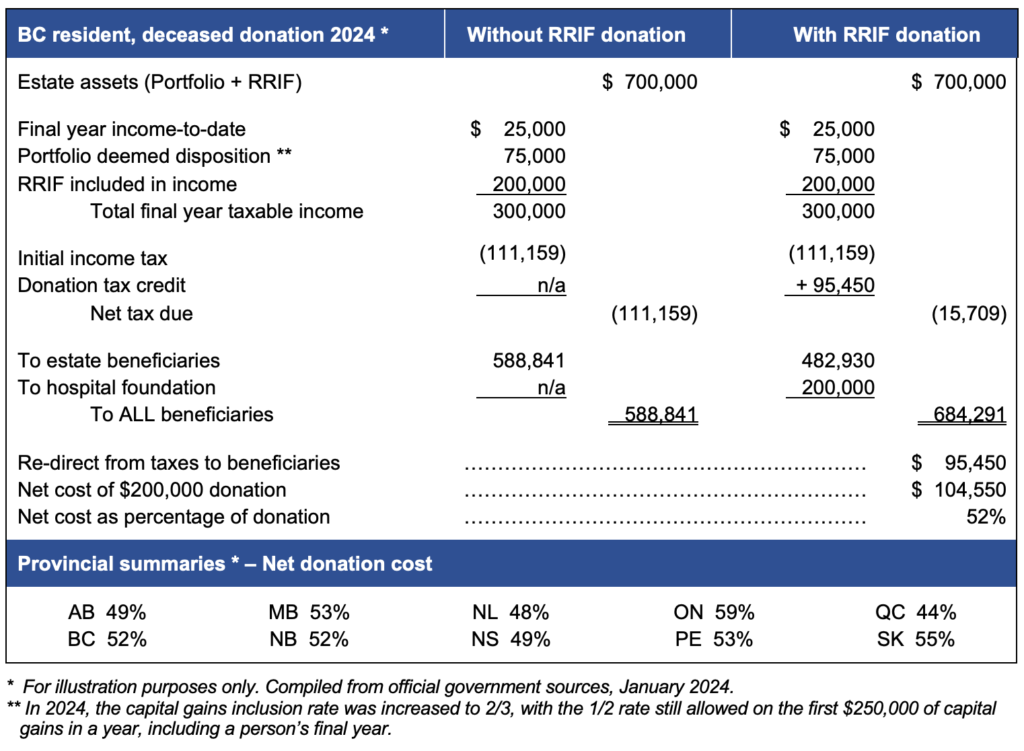
To illustrate how this can work, meet Greg who lives in British Columbia. He wants to give back to the local hospital that provided such compassionate support when his spouse Jean went through palliative care. He confirms the legal name of the hospital foundation, and names it as beneficiary on his RRIF administrator’s form. 

Greg understands this will reduce how much will go to their children – all financially secure adults – but expects it will also reduce the estate tax bill, making it an efficient way to donate. On his death, Greg was living in long-term care, which consumed his $25,000 income to-date that year. On death, there was a $500,000 non-registered portfolio with a $150,000 capital gain (resulting in a taxable capital gain of $75,000, based on the 1/2 inclusion rate), and a $200,000 RRIF.