Is it time to revise your Will?

Three prompts to keep your estate planning current

For some people, even the thought of creating a Will casts a pall over their mood. Yes, a Will deals with a person’s death, but the broader process of estate planning is about caring for the most important people in your life. Having an up-to-date Will is central to that process.

But how do you know if you are really “up-to-date”? Realistically, it isn’t feasible for you to constantly adjust your Will, but the three prompts discussed in this article will help you keep on top of any necessary changes.

The purpose of a Will

Estate planning is about taking care of yourself now and in the future. It is also about taking care of the people around you – now, in the future and when you are no longer there.

As much as the phrase “taking care” expresses your values and emotional commitment, it has an equally important practical purpose. With a clear picture of who is the focus of your planning, you’re in position to manage your property to fulfill your intentions during your lifetime, and to prepare for the eventuality of your death – that being when your Will takes effect.

With the benefit of good legal guidance, your Will will be drafted within the boundaries of the law, while anticipating reasonable contingencies. Still, there is nothing more constant than change itself, and that also applies to the people, the property and the law of estate planning.

When to review your Will – The 3 P’s

What then may prompt the review of a Will and thus require a discussion with your lawyer? The potential changes to your circumstances can be grouped into the following three categories, which are listed in order of priority:

1.     People changes

This includes you, a dependent, a Will beneficiary, an immediate family member (whether or not a beneficiary), an executor, or a trustee or guardian.

    • Beginning or end of a close personal relationship, whether or not legally married
    • A birth, adoption, death, mental capacity concern or significant health event
    • Immigration, emigration or change in citizenship, and even a permanent move to or from the province
    • A change in liability exposure, such as a bankruptcy, being joined in a lawsuit, signing a guarantee or starting a business

2.     Property changes

Your Will is used to direct who will receive the property out of your estate, which in turn is the property you own when you die. Changes in the nature, legal title and dollar value of property could affect proportions among beneficiaries, and at the extreme could effectively disinherit one or more of them, intended or not.

    • Sale of a large asset, especially if it is the subject of a specific Will bequest
    • A windfall, such as an inheritance, court award or lottery prize
    • A theft, loss or consumption, including a marked decline in or withdrawal from an investment account, especially for an RRSP/RRIF plan where a beneficiary designation is in place that was designed to coordinate with inclusion or exclusion of beneficiaries in a Will
    • Ownership change or transfer, including loans or gifts to Will beneficiaries, a change to bank signing authority, or the addition of a joint owner on investments or real estate
    • New life insurance, or cancellation or loss of insurance (for example, on retirement from employment) where the plan proceeds or a beneficiary designation were factored into Will planning

3.     Passage of time

Even if you and the property have remained effectively the same, the legal landscape may have shifted beneath you. The principal sources of law are the courts, provincial legislatures and the federal Parliament.

    • Case law – A judge may have ruled in a court case where the strategies, circumstances and or facts are similar to your situation and planning decisions.
    • Provincial law – Changes may be made to legal entitlements or processes. For example, in 2020 Manitoba eliminated its probate fees, and as of 2021 Ontario no longer treats a marriage as revoking a pre-existing Will.
    • Federal law – Changes are regularly made in tax legislation, so there could be developments that could have an impact on Wills, or the administration of estates and trusts.

It is difficult to say exactly how often you should review your Will, but it is commonly suggested that you review it at least every five years. Though the timing of court judgments is somewhat random, political change is more predictable. A sitting provincial or federal government must call an election within five years, and there could possibly be two elections in that time.

Testamentary trust tax changes

Indeed, one of the most significant estate tax changes came about just over five years ago. For decades, testamentary trusts – those created through a Will – were entitled to preferred tax treatment. As of 2016 they are now taxed at the top tax bracket, near or exceeding 50% in most provinces, with two key exceptions:

    • Graduated rate estate – For the first 36 months of an estate, graduated tax brackets apply. However, the rules are complex, and if not carefully navigated, the preferential treatment may be lost.
    • Qualified disability trust – Ongoing graduated-tax-bracket treatment may be available to a testamentary trust with a beneficiary who is qualified for the disability tax credit.

Wills drafted and executed before this development may have included one or more testamentary trusts to take advantage of the tax rules in place at the time. Today, those trusts will have little or no tax benefit and may turn out to be an impediment to efficient estate administration. For those who have benefited from what was good planning in the past, it may be time to call the lawyer and discuss appropriate planning in this new environment.
Who gets the family cottage … and how?

Holding onto memories while letting go of ownership

Some of the hardest estate planning decisions are not about dollar values, but about personal values. A prime example is the family cottage, where the memories are many, and the mere mention of letting-go can be painful.

Unfortunately, it’s not much easier on parents who intend to keep it in family hands rather than sell to strangers. Among those you love, it can be even more emotionally troubling to decide when, how and to whom ownership will pass.

To prepare for these tough choices, it’s helpful to have a clear understanding of tax and legal rules so that you can anticipate hurdles and consider options.

Tax liability for parent as seller/transferor

Apart from spousal transfers, a change in beneficial ownership is a taxable disposition. Half the increase in value from the adjusted cost base (ACB) to the fair market value (FMV) is added to the seller/ transferor’s income for that year. The ACB is generally the acquisition price plus capital improvements.

The tax bill could be reduced by claiming the principal residence exemption (PRE), though that would limit use of the PRE on a future disposition of other concurrently owned residential properties.

Options for passing ownership to one or more adult children

In an arm’s-length sale, a seller transfers ownership without control or concern as to how that arm’s length purchaser holds title. In family situations, there are more options that parents may consider:

Direct transfer to one child

Even if little or nothing is paid in return, a full disposition is deemed to occur at FMV for purposes of calculating the capital gain. Thereafter, the child has all rights of ownership.

Adding joint owners

A proportionate disposition is deemed for each added owner. For example, a widowed mother who adds 2 sons is deemed to dispose of 2/3 of the value. The later death of any joint owner is a disposition of that person’s share, with the survivors continuing to own the property together.

Using tenancy-in-common

A parent could direct a specified percentage to transfer to one or more children, to be held as a tenant-in-common. Like joint tenancy, there is a disposition on initial transfer and on an owner’s death, but the deceased’s rights pass to his/her estate, not to the surviving owners.

Tax-deferred trust transfer

Parents over age 65 could transfer the cottage into an alter ego or joint partner trust for their current benefit, with the children as contingent beneficiaries. The property is not deemed disposed until both spouses die, at which time capital gains would be calculated and tax due.

Transfer to a lifetime trust

The parents may be content to trigger a taxable disposition to a trust now.  They could maintain legal control as trustees, with future gains accruing to the children as beneficiaries.

Estate distribution possibilities

If the cottage is held to the second spouse’s death, the capital gain arises at that time. The cottage could then be transferred to the children (tenants-in-common or joint owners, as desired) or continue to be held in trust according terms as outlined in the last deceased’s Will.

Funding the tax liability

Allowing that the PRE may be claimed in some situations, tax on the capital gain is usually inevitable. And if it’s large, the decision may be to delay triggering it until death. Parents could buy joint last-to-die life insurance to pay the tax, or allow that other estate assets will have to be sold to raise the needed cash.

Deducting mutual fund investment counsel fees

How tax results can hinge on how fees are paid

There is a longstanding debate whether an investor is better off paying through a mutual fund’s management expense ratio (MER), or by direct fee to an advisor in a fee-based account.

The direct fee is favoured by some advisors and investors as it is more transparent than MERs, and can show the total fees on a portfolio in one place. In turn, the investor can clearly see the after-tax cost of such fees when claiming the deduction on his or her annual income tax return. 

Still, the question remains whether a direct fee allows for a larger tax deduction, is neutral, or may be more costly in some cases – all issues being addressed in this bulletin. 

Criteria for deductibility

As a tax principle, deductibility generally requires that a particular outlay is related to earning taxable income. The further removed from that core purpose, the less likely the outlay is to qualify.

For investment counsel fees, the financial advisor must be advising on the buying or selling of individual shares or securities, or pooled securities like mutual funds. This may include administration or management services related to those securities. Such advice or services must be the advisor’s principal business.

Non-registered accounts

Comparison using fully taxable income

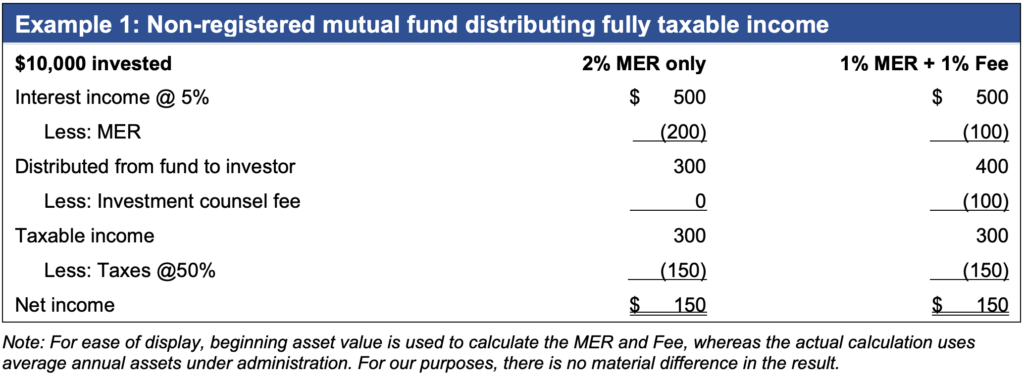
To illustrate the tax effect, we’ll keep the advisor’s advice and compensation the same, whether payment is by MER or direct fee (“Fee”). Either way, the total cost to the investor will be 2% of the assets under management. 

Our investor has $10,000 to place in either an A-series mutual fund with a 2% MER, or a 1% F-series version that leaves room for the advisor to charge a direct fee of 1%. To simplify the arithmetic, we’ll assume our investor is at a 50% marginal tax rate, and that the fund’s only income for the year is a 5% interest return.


In both columns, the MER reduces the initial investment return, thereby reducing the amount of income available for distribution to the investor. Once the direct fee is charged by the advisor to the investor at the second step as shown in the right column, the investor is left with the same taxable income and net income under either method.

As illustrated, there is no difference when the amount of fully taxable income – interest and foreign dividends – is at least as much as the MER of the A-series mutual fund.

Preferred income distributions

Of course, not all investment income is fully taxable. Capital gains are not taxed until disposed/realized, and even then the current inclusion rate for the taxation of such gains is just 1/2. As well, Canadian dividends benefit from the gross-up and tax credit procedure that reduces the tax for a Canadian resident investor, based on the tax the government has already collected from a Canadian corporation that paid those dividends. So, if the fund has preferred income, does this lead to a preference for either MER or direct fee? The answer is “no”. 

A mutual fund is subject to very high tax rates, near or beyond 50% depending on the province where it is headquartered. It would be costly for investors as a whole – and particularly for those below top bracket – if the mutual fund was to pay income tax, especially if applied against preferred income. Accordingly, once MERs are applied against income, a mutual fund will always distribute any remaining income to investors.

Under either method/column in Example 1, this will be an additional distribution of the same amount of preferred income to the investor. Whatever the investor’s tax bracket, the net income will be the same either way. 

Registered investments

Recall from earlier that deductibility depends on whether an investment is able to produce taxable income. Accordingly, there is no deductibility when an investor pays a direct fee to an advisor for advice on RRSPs, RRIFs or TFSAs, all of which produce tax-exempt income. This is so even though withdrawals from the first two retirement account types will eventually be fully taxable.

RRSP or RRIF holding mutual fund

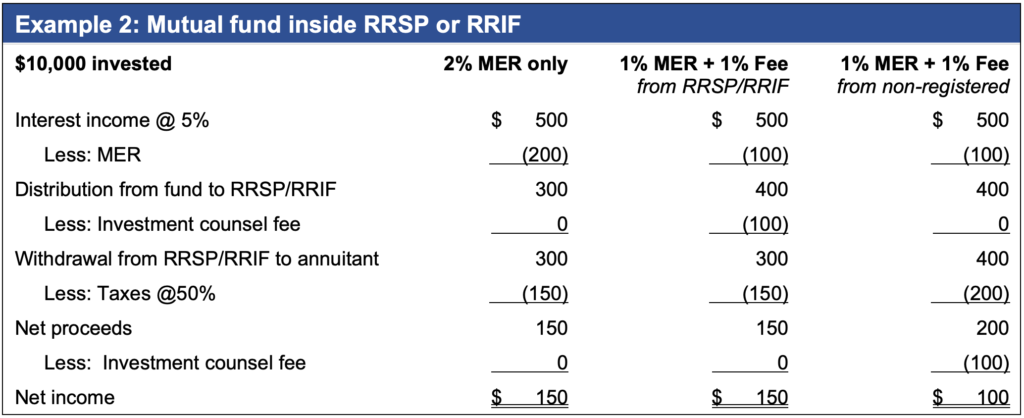
When a MER is charged within a mutual fund in a RRSP/RRIF, it reduces the fund’s investment return, just as it does for a mutual fund in a non-registered account. However, if a fund series with a reduced MER is used to allow a direct fee to be charged, the net tax result to the plan annuitant depends on the source used to pay that fee. 

All money within a RRSP/RRIF is yet to be taxed, whether in a mutual fund or in the form of cash. A direct fee may be paid by a RRSP/RRIF trust using pre-tax cash held inside the account, effectively achieving the same result as when a MER is charged within a mutual fund. On the other hand, if the RRSP/RRIF annuitant pays a direct fee using non-registered/after-tax money, no deduction is allowed.

To illustrate the distinction, we’ll add a column in Example 2. The left column charges full MER, while the middle and right columns have a reduced MER plus a direct fee, respectively paid from within the RRSP/RRIF or out of non-registered/after-tax money. To show the final after-tax result, the income will be immediately withdrawn by the RRSP/RRIF annuitant. Though the amount available for withdrawal is highest in the right column, once the non-deductible direct fee is paid, the net income is $100 compared to $150 under either of the other two methods. 

It should be noted that in order to show the after-tax comparison on the bottom line of Example 2, the non-registered money is actually sourced out of the RRSP/RRIF. 

Instead, what if there were no distributions, and the direct fee in the right column was paid using a (non-registered) $100 bill you already had in your pocket? That would preserve $400 of RRSP/RRIF in the right column, which is $100 better than the $300 in the other two columns. More tax-sheltering room must be better, right?!

As appealing as that first appears, it’s an illusion until the tax is reconciled. If you cash out the $400 in the right column, you’re left with $200 after-tax. For the other two columns, your $300 nets to $150 after-tax, to which you can add the $100 bill in your pocket to total up to $250, still $50 better than paying a non-deductible direct fee.

TFSA holding mutual fund

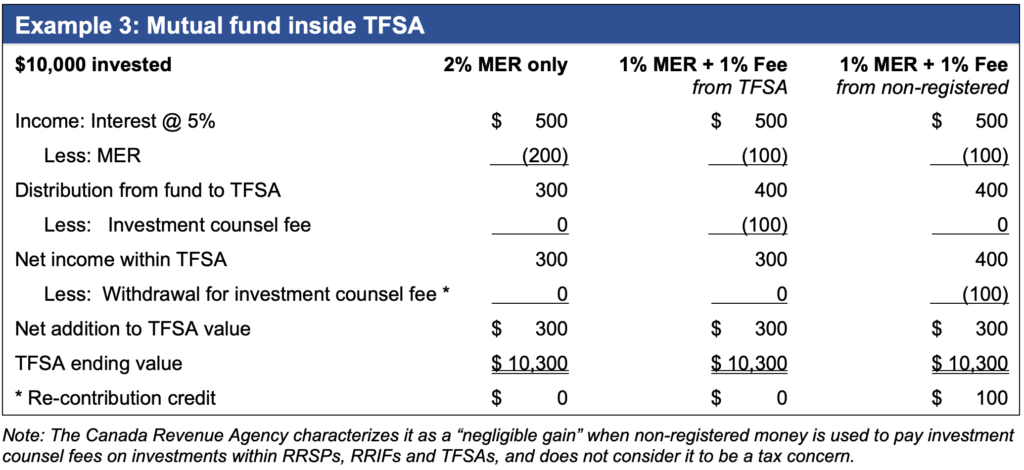
As mentioned above, TFSA income is tax-exempt, so direct fees are not deductible. The net income of a mutual fund inside a TFSA will be the same whether fees are paid by MER, by direct fee from within the TFSA or by direct fee via a non-registered account.

But what about this idea of preserving tax-sheltering room by paying a direct fee from a non-registered source? As we just saw, that didn’t work out with RRSP/RRIFs, owing to the fact that later withdrawals from that type of registered account are taxable. By contrast, when a direct fee is paid from outside a TFSA, the preserved tax-sheltering room will ultimately be delivered through to the planholder as a tax-free TFSA withdrawal.

An alternative way to illustrate this is to assume that the TFSA itself is the cash source for the direct fee, as shown in Example 3. By any of the three column/methods, the net increase for the TFSA is $300. In the first two columns, all the money remains within the TFSA, but in the right column the planholder makes a $100 withdrawal to pay the direct fee, giving the planholder a $100 re-contribution credit the following January 1st. 


Related considerations

Financial planning

Financial planning addresses a person’s overall financial needs, including budgeting, saving strategies, credit/debt education, and tax and estate planning. To provide context and foundation for investment recommendations, financial advisors may engage in financial planning discussions and prepare formal plans. 

As important as these services are in providing the personal context for investment advice, they are not directly related to earning income, and therefore any fees charged for financial planning are not deductible. 

Tax preparation

Personal income tax return preparation fees are generally not deductible, regardless who is preparing the return. But if part of the preparation fee relates to calculating and reporting the details of business income and/or investment income, that portion may be deductible. For those whose income is derived principally through business income and non-registered investments, this could arguably amount to almost the full preparation fee.

It’s helpful if the fee’s components are itemized—or better yet, if the preparer renders a separate invoice for the business and investment-related fees.

Not applicable to segregated funds

Segregated funds are sometimes described as the insurance industry’s version of mutual funds. Despite the similarities to mutual funds, segregated funds are legally structured as annuity contracts (a form of life insurance) whose value fluctuates with a pool of investments that the insurer ‘segregates’ from its other assets. 

The current position of the Canada Revenue Agency (CRA) is that a segregated fund is not a share or security, and therefore no deduction is allowed for investment advice related to the purchase or sale of segregated funds.

Reasonableness

There is a general requirement under the Income Tax Act that in order to claim a deduction, the outlay or expense must be reasonable in the circumstances. Reasonableness could be an issue if:

  • A combined fee is levied for financial planning, tax preparation and investment counseling, allowing the client to choose how to allocate that among the services
  • A single investment counsel fee is charged, covering RRSP/RRIF, TFSA and non-registered accounts, allowing the investor to determine how much is related to each account type
  • Investment fees are pooled for multiple family members and charged disproportionately to one of them
  • A higher fee is charged on non-registered assets compared to registered assets, even though the advice and/or service is otherwise indistinguishable

In all these situations, the investor’s deduction claim could be questioned as to reasonableness, bearing in mind that the legal onus lies with the taxpayer to prove entitlement to a tax benefit, not upon the CRA to disprove it.