Charities’ investment portfolios

Maintaining charitable status by complying with the disbursement quota

To maintain charitable status under tax rules, a charity is required to spend an annual minimum dollar amount on its programs or on gifts to other qualified donees, generally other registered charities. This is the disbursement quota (DQ).

The DQ applies to property not used in charitable activities or administration of the organization, and for about two decades leading up to the end of 2022 it was 3.5%. Effective January 1, 2023, the DQ is 5% on the portion of a charity’s property over $1 million, with the 3.5% rate continuing to apply below that level .

Threshold for application of the disbursement quota

The DQ only applies once non-active property exceeds a certain level, but then it is calculated on all property not used in charitable activities or administration of the organization:

    • For operating charities, the DQ applies once non-active property exceeds $100,000; or,
    • For charitable foundations (those funding operating charities or other qualified donees), the threshold is $25,000.

Purpose of the DQ

Registered charities are allowed to issue receipts to donors, who in turn may claim a tax credit for their donations. For the charity, the full amount of the donation is available to use (i.e., it pays no tax on the donation), and there is no tax on income generated by the charity on invested funds.

The DQ is the device used by the Canada Revenue Agency (CRA) to assure that the charity consistently applies a portion of its funds to its charitable purposes on a current basis, while allowing it to grow its remaining principal so that it may continue to act on its mandate into the future. To be clear, the DQ is a mandatory minimum, leaving it to the charity’s discretion to spend more if desired.

While adhering to its primary responsibility to deliver on its charitable purposes, commonly a charity will then try to keep as close as it can to the DQ. This will allow it to meet its CRA regulatory obligation, while maximizing the amount that can be invested to produce income and growth that will fund future operational needs and capital projects.

Example before and after the change

Consider a charity that has $1.5 million of property not used in charitable activities or administration.

We’ll look at the scope of property in that calculation a little further on, but for now let’s assume it’s the same amount to begin each
year in 2022 and 2023. 

DQ comparison: 2022 2023
First $1,000,000 $35,000 $35,000
Next $500,000 $17,500 $25,000
Total $52,500 $60,000
Required extra spending resulting from 5% DQ $7,500

Scope of affected property

For the DQ calculation, property includes real estate not used in charitable activities or administration, and passive investments such as chequing and savings accounts, inventory, stocks, bonds, mutual funds, term deposits, land and buildings.

To distinguish the treatment of real estate, take a charity operating a drop-in centre for at-risk youth on the first floor of a plaza, with rental units on the second floor and its own office in the basement. The value of the rented space would be part of the DQ calculation, but the rest of the property fits its charitable activities or administration.

Of course, investment and real estate values can fluctuate, which can then affect a charity’s spending requirements. Fortunately, valuation is not at one point in time, but instead is based on average property value over the 24 months before the beginning of each fiscal year. This smooths out the impact of short-term market movements, leading to more predictable and confident planning for the charity, and for the community it serves.

Impact on investment practices

It’s important to reiterate that the DQ change will only affect charities with property over $1 million. As well, if a charity already grants 5% or more annually, then the new rate will have no practical impact.

Still, it’s a wake-up call that CRA and other government bodies are more actively scrutinizing the activities of Canadian charities. It presents an opportunity for all charities to review, and possibly revise, one or more parts of their governance, investment management or operations. Some discussion points follow.

Spending/gifting

Where might more gifting have the greatest effect? For example, are there any worthy projects of existing grantees that could be expanded, or can you identify other/prospective grantees who are presently underserved?

Investment policy

Review the investment policy statement (IPS) to determine whether a re-draft may be in order. Should a higher priority be given to preservation of capital and consistency of returns?

Asset mix

Are there asset classes that better align with this new regulatory regime?

Alignment with values

Would an environmental, social and governance (ESG) investment approach make sense, to make a measurable impact on society generally and to better serve the charity’s own purposes specifically?

Communications

Will endowed gifts be able to keep pace in this new regime? Will donors need to be contacted? What should the message be?

Donations

Will fundraising efforts need to ramp up to help narrow any shortfall in years to come?
CPP – Canada Pension Plan

Public pensions for retired & disabled workers

CPP is a social insurance plan providing income replacement to contributors and their families in the event of retirement, disability or death. It is government-run, but funded by mandatory employee and employer premiums. 

Premiums are invested by CPP Investments, a body independent of government politics or CPP administration. While CPP is the largest long-term disability plan in Canada, serving both contributors and dependents, the largest component of CPP payments is the retirement pension.

Guiding principles

Historically, CPP was designed to replace 1/4 of a worker’s average earnings, up to the year’s maximum pensionable earnings (YMPE), an annually-indexed dollar ceiling approximating the average national wage. In 2016, enhancements were introduced to eventually move the replacement target to 1/3 of qualifying earnings.

    • Phase one of the enhancements began in 2019 with the premium rate moving from 4.95% in roughly equal annual increments through to its target 5.95% level in 2023.
    • Phase two began in 2024, with a 4% premium being levied on income above the YMPE up to the year’s additional maximum pensionable earnings (YAMPE). The YAMPE is set at 7% above the YMPE in 2024, then rises to 14% above YMPE for 2025 and thereafter.

Premium payments

Employers withhold employee premiums in their payroll process, adding an equal amount as its own premium, and remit the total to the Canada Revenue Agency. Employers claim a deduction for their premiums. Comparatively, employees claim a tax credit for premiums on income up to the YMPE, and a deduction for the additional premium up the YAMPE. Self-employed individuals pay both the employee and employer portions.

For 2026 the employee premium rate of 5.95% applies above the $3,500 exempt income level up to the YMPE of $74,600, for a maximum premium cost of $4,230. The 4% for the addition applies from the YMPE up to the YAMPE for 2024 of $85,000 (a range of $4,700), for a potential maximum additional premium of $416.

The connection between premiums paid and your potential retirement pension

Contributors earn credits for premiums paid during working years, from age 18 until the age when the pension begins. In concept, credits are spread across the number of working years to arrive at an average.
In practice, there are adjustments for presumed and actual absences from work, mainly:

General dropout

Takes out the equivalent of up to eight years, to acknowledge schooling, unemployment or other reasons

Child rearing provision

For actual time away from the workforce spent caring for children up to age seven

Disability exclusion

Periods during which a person is disabled, per CPP definitions

Over-65 dropout

May replace relatively low earnings before age 65 with higher earnings after age 65

Your actual retirement pension depends on the age when you begin

For 2026, the maximum annual pension is $18,092 at age 65. Age 65 is what CPP considers to be the standard age, but it’s not a legal requirement. A retirement pension may begin as early as age 60 or as late as age 70:

    • The pension is reduced 0.6% for every month taken before age 65, which is a 36% reduction at age 60. For 2024, this works out to a maximum of $11,579.
    • The pension is increased 0.7% for every month taken after age 65, which is a 42% increase at age 70. For 2024, this works out to a maximum of $25,690.

Complementary components of the CPP, outside of the core retirement pension

Disability pension

Unable to work at any job on a regular basis due to severe & prolonged disability

Survivor’s pension

Spouse or common-law partner of a deceased CPP contributor

Children’s benefit

Dependent of a disabled/deceased contributor, to age 18, or age 25 if full-time student

Post-retirement benefit

Augments pension of CPP retiree who continues to work and pay premiums

Post-retirement disability benefit

When a disability arises after starting retirement pension

Death benefit

A one-time $2,500 payment to the estate or dependent of a deceased CPP contributor

Joint ownership

Prudence, perks & pitfalls in property transfer

Joint ownership is often the way that spouse/common-law partners (CLP) will own their matrimonial home, a recreational property and maybe other real estate held for investment. But when other owners are contemplated to be involved – for example, adult children – another arrangement may be more appropriate, including just leaving well enough alone.

Compared to tenancy-in-common

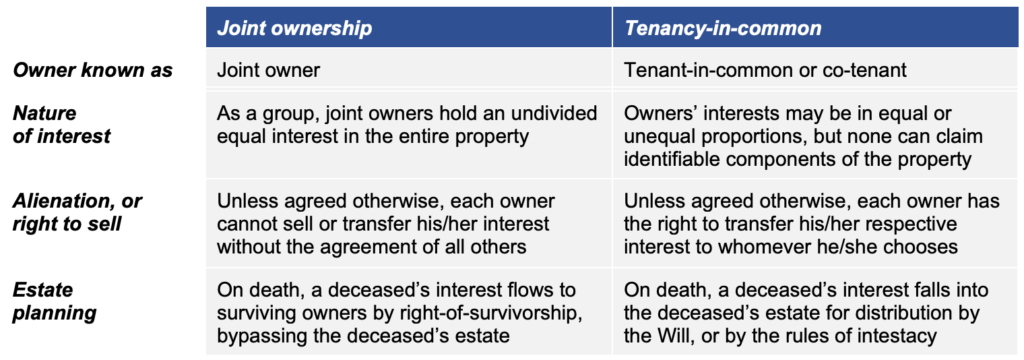
There are two common ways that property is owned by more than one person, joint ownership and tenancy-in-common, with a few key features distinguishing them:


Probate avoidance

Probate is the tax or fee charged by a court for confirming that a submitted Will is valid for the named executor to deal with a deceased person’s estate. The formal name varies by province. Some provinces just charge a flat filing fee of a few hundred dollars, and in others it can be up to about 1.5% of the value of the estate property.

The choice between the types of property ownership is often influenced by a desire to avoid probate. Specifically, the right of survivorship under joint ownership allows for the interest/rights of a deceased owner to bypass his/her formal estate, thereby avoiding probate.

While probate could total up to a significant dollar figure when viewed in isolation, it is usually a relatively small proportion of the cost of administering an estate, and there are trade-offs to consider before deciding to proceed.

Couples’ preference for joint ownership

Spouse/CLPs usually intend the other to be the primary or only beneficiary of their estate. Joint ownership can therefore simplify the estate by passing selected property outside the Will. This can put things beyond the reach of a Will challenge, insulate against estate creditors, and again escape any probate fee/tax.

In addition, appreciated property can pass between spouse/CLPs at its cost base, allowing couples to add one another to title without triggering a tax bill on the capital gain.

Involving adult children – Tread carefully

As children are usually the next stage of beneficiaries after a spouse, it may at first seem a good idea to add one or more as joint owners with the parents, or after one parent dies. While this may indeed streamline the legal transfer, it is an action that should be balanced with other legal, financial and practical considerations.

Income tax effect of transfer to joint ownership

Unless it is clear that the parent retains the beneficial rights to the property, tax will generally be triggered when a non-spouse is added. For example, if two parents add their adult child as a joint owner on an investment property, they are deemed to dispose of 1/3 of the property, thereby triggering tax on 1/3 of the current capital gain. A tax professional can advise the parents on appropriate steps and recordkeeping if they wish to avoid this result.

Relief and risk if it is a principal residence

A variation of the example above would be to put a child on title of the parents’ principal residence. While their principal residence exemption (PRE) may protect against capital gains tax when the child is added, if the property is not also the child’s own principal residence, future capital gains on the child’s portion may very well be taxable.

Legal and registration cost

Costs of transfer should be balanced with expected probate tax savings. According to province (and even regions within), taxes or fees on land transfers may be flat charges or be based on a percentage of the property value. Transfers to a spouse/CLP are often exempt, extending in some provinces to certain intra-family transfers.

Exposure to creditors of other joint owner(s)

If an added child runs into debt problems, creditors may decide to take legal action against the property. While the creditors’ claim will be limited to that child’s interest, if neither parents nor child have other assets to satisfy the claim, the creditors could force sale of the property to collect the amount due.

Matrimonial law implications

Adding a child as a joint owner may expose their interest to a property equalization claim on a later relationship breakdown. In most provinces if it is a gift to the child, then in principle it is not exposed, but this could be affected by how the property is used thereafter. In Ontario for example, a recreational property that is regularly used by a married couple may be considered a matrimonial home, making the value of the ownership interest equalizable.

Legal or beneficial transfer, and estate complications

When an adult child is gratuitously added as a joint owner, that is presumed not to be a beneficial transfer. On the parent’s death, the child holds the property as trustee for the estate beneficiaries. The presumption can be rebutted if the parent expressed otherwise at the time of the transfer, ideally in writing. This would be particularly important if there are other siblings not on title, especially if there is any existing family tension. Otherwise, the onus is on the child to prove to a judge that the parent intended that that child personally succeed to the property.

Application to financial accounts and other personal property

Property means something that can be owned, whether that’s real property (or real estate) or personal property. Personal property covers moveable things, including financial instruments like chequing and savings accounts, and non-registered accounts holding GIC/term deposits, individual marketable securities or mutual funds.

Joint ownership can also be used with personal property. As with real property, this can simplify and streamline estate transfers between spouse/CLPs, and where others are involved the cautions above again apply.