Downsizing in retirement

Planning where you will live in your later years

People often talk about eventually downsizing their home when they get to retirement.  Practically, it doesn’t make sense to clean and maintain unused space once the kids have flown the coop.

Financially, this may be intended as a way to release tied-up capital to help supplement retirement income, but just how much becomes available – if any – depends on where and what kind of destination you have in mind.

Whether you are driven by the finances, or just see it as a byproduct of a lifestyle choice, you need to carefully think through and plan how to proceed. A misstep could be costly in either respect, so here are some things to mull over.

Are you assuming downsizing will be a financial windfall?

All else being equal, it costs less to maintain a smaller property. But between here and there is the matter of moving. Maybe you’re leaving a house in the big city for a humbler abode further away. However, if you’re moving within the same geographic market, the financial effect may be neutral at best, despite reducing the physical footprint.

Between the real estate commission on selling the old place and the land transfer tax on buying the new one, you’re likely well past 5% of your sale price before you even hire the movers.

Add to that some updated appliances, new/smaller furniture, window coverings and other settling-in costs, and your physical downsize could be more of a lateral move financially. That’s not necessarily a bad thing, but thinking through the finer details can give you a clearer view of the full picture.

How will the new digs fit your relationships and lifestyle?

Having reviewed your finances, you may consider looking beyond the local area or at a different kind of housing.

How far are you going?

A more distant move could affect the frequency and amount of time you are able to spend with family and friends. Maybe you’re moving closer, but if not then you could face challenges logistically, emotionally and financially. Consider too the impact on church/community connections, and professional/personal relationships like your doctor, dentist, hairdresser/barber, and massage therapist.

Cozying up to neighbours, or too close for comfort?

If you are moving to a different kind of accommodation, say from a detached home to a townhouse or condo, have you thought about how that will feel? Some people are comforted being in closer proximity to others, whereas some may feel crowded. Elevators and underground parking are great conveniences, but to some they are a personal security concern. Being in the city with a balcony view can be invigorating or intimidating.

Decisions on a lifetime of stuff?

In terms of your physical surroundings, how much do you want to hold onto and how much do you want to leave behind? It’s safer and less physically demanding not having to navigate stairs and maintain an outdoor space. But what if gardening is your thing? And with less space to maintain, you also have less room to host holiday family gatherings, or even just have the grandkids for a sleepover. What matters to you?

How about taking a test-run?

If things don’t work out with the new place then you may want or need to move again. Clearly that can be disruptive and inconvenient, and if you become a serial mover then financial strain could mount.

One way to test it out, whether before or after you sell, is to use a service like airbnb to live for a couple of weeks or a month (or a year, like a friend I know) in a place near and similar to what you’re considering.  Discuss it with your real estate professional and your financial advisor to make sure you have the right information about both the market and yourself before making a more permanent commitment.

Powers of attorney

Your capacity, care and continuity

When it comes to estate planning, most people are familiar with Wills, which are used to distribute property after death. But it’s equally important to address lifetime decision-making, should your mental capacity be diminished by an accident, illness or age-related decline. This complements your Will by taking care of yourself first, before you take care of others.

The naming of substitute decision-makers has been a recommended part of estate planning for decades, though rules vary somewhat among provinces. In this article, we’ll outline common principles and planning considerations, using the traditional term “power of attorney” (POA) which is still used in many provinces.

Readers are encouraged to consult an estate planning lawyer in their province to learn the appropriate terminology, and to discuss how the principles in this article apply in their situation.

Legal effect

Powers of attorney allow you to share decision-making power over your property and/or personal affairs with someone else. It is important to note that by doing so, you DO NOT lose your own ability to make those decisions. As the giver of the power, you are known as the grantor, donor or principal.

The person to whom you grant the power is called your attorney. Though that term can be a synonym for lawyer (mostly in American law), in this usage it simply means decision-maker. Other terms include representative, proxy, designate or agent. Whatever the official term, understand that you are giving that person significant legal powers, so your decision to grant a POA and your choice of attorney must be carefully thought through.

A brief history

The law of power of attorney has been around for centuries, with its origins in the judge-made common law. Those early POAs dealt exclusively with property (and related financial matters), and historically would cease to be effective if the person granting the power became mentally incapable of making such decisions him/herself.

Provincial legislation now supersedes most common law rules, including the option for an attorney to continue to act after a grantor’s incapacity, in which case it is known as a continuing, enduring or durable power of attorney.

These modern POAs still deal with property decisions, and may also extend to authority over the individual personally. Written authority is required, with some provinces allowing a single document for both purposes, and others requiring a separate document for each role, even if the same attorney is named for both purposes. For distinction in this article, we’ll call these the POA-Property and POA-Personal.

Capacity to execute the document

For POA-Property, the grantor must generally be at least age of majority, which is 18 or 19 according to province. As well, the grantor must know the extent and approximate value of his/her property, any legal or moral obligations to dependants, the nature of the power that is being granted, and the potential for its misuse or abuse.

For POA-Personal, some provinces allow the grantor to be as young as 16. Generally, the grantor must understand the kind of decisions covered, which may include medical consent, general health care, nutrition, shelter, clothing, hygiene and safety. In addition, some provinces require an acknowledgement that the grantor believes that the named attorney has a genuine concern for the individual’s personal care.

Coming into force

Each province has rules on the format, content and witnessing requirements for the execution of POAs.

It is possible to require that a POA-Property only takes effect once the grantor is incapacitated, but that would require a mental assessment of some sort, which could delay its use when time may be critical. Alternatively, a common practice is to have it effective on execution, with the stated intention on its face that it is expected to be used on a later incapacity. The document should remain in safekeeping, possibly in the lawyer’s office vault, which provides a degree of protection against its premature use.

A POA-Personal attorney will normally only act when the grantor is incapable, or otherwise unable to respond.

Scope of authority

A POA-Property attorney can generally do anything that the grantor can do, with the exception of making a Will or doing things that would alter testamentary/estate distributions. For example, the attorney can’t change the beneficiary of an RRSP, though some provinces allow continuation of a past designation to a new RRSP or RRIF.

A grantor may place restrictions on an attorney’s powers if desired, such as narrowing from all property to some specific property or stating a time limit. Instructions may also be given to an attorney, though this is most often in general terms. Absent that, an attorney’s first responsibility is to take care of the interests of the grantor, then any dependants, and possibly provide gifts, loans or donations, so long as it reflects the grantor’s habitual practice.

For a POA-Personal attorney, there may be a separate ‘living will’ or advance care directive stating the grantor’s wishes about medical treatment. This may not be legally binding (depending on province), but the attorney must consider any wishes expressed by the grantor while capable, whether in a POA, oral or in writing elsewhere.

Legal duties on incapacity

Acting as an attorney is a big responsibility, especially once a grantor becomes incapacitated. At all times, but especially at this point, an attorney must act diligently and in good faith. The attorney must explain decisions to the grantor and involve the grantor in making those decisions to the extent possible. As well, the attorney should consult with family, friends and caregivers as appropriate, and assist the grantor in maintaining contact with them.

For a POA-Personal attorney, there is a particular requirement to help the grantor live as independently as the person may wish. And when treatment or intervention is needed, it should be the least restrictive course of action.

Who to name as attorney, and how

An attorney must be mentally capable, and generally at least age of majority, though some provinces allow a younger age for a POA-Personal attorney. An attending health care worker or someone providing paid personal care services cannot usually be a POA-Personal attorney, unless it is a family member.

The same person could be attorney under both POAs, as is common with spouses, or separate attorneys could be named for each POA role. There could be a primary attorney, with an alternate if that first-named person cannot serve or continue in the role. Two or more people may be concurrent attorneys for either POA, though it can get logistically and emotionally challenging the more who are involved. If it is intended that multiple attorneys be able to act independently of one another, the POA document must state this as “joint-and-several”. Otherwise every decision, instruction and permission, for example signing a cheque, must involve all attorneys “jointly”.

In evaluating candidates, a grantor should think about the length and depth of their relationship, as the attorney will be making intimate decisions as if in the grantor’s shoes. Knowledge and capability with financial matters are important, as well as practically whether they can devote the time and are physically near enough to do the job. And don’t forget organizational and communication skills, diplomacy, confidentiality and general trustworthiness – all of which might be soft skills in other situations, but are at the core of what is needed in this sensitive role.

—————

APPENDIX – Provincial reference material

Below are provincial government websites or resources referenced from those sites. Underlined text in the PDF version of this article are hyperlinks. Full text of the links are on the next page. This is intended as a starting point for resources in each province. Consult an estate planning lawyer in the province for further information.

British Columbia

Alberta

Saskatchewan

Manitoba

Ontario

Québec

New Brunswick

Nova Scotia

Prince Edward Island

Newfoundland and Labrador
Donating securities ‘in-kind’ to charity

Tax-optimizing your philanthropy

When it comes to charitable donations, the most likely type of donation that comes to mind for most of is cash. However, there are a variety of ways to support your favourite charitable causes, one of which is to donate publicly traded securities in-kind.

The Canada Revenue Agency (CRA) defines a publicly traded security to include a share, debt obligation or right listed on a designated stock exchange, a share of the capital stock of a mutual fund corporation, a unit of a mutual fund trust, an interest in a related segregated fund trust or a prescribed debt obligation. 

When such securities are donated in-kind from a non-registered account, a tax receipt is issued for their fair market value (FMV) on the donation date. As with cash donations, a tax credit can then be claimed to reduce your income tax bill. In addition, in-kind donations can cost you less, and there is no reduction in what the charity receives.   

How the donation tax credit works

When you make charitable donations, both the federal and provincial governments allow you to claim a credit against the income tax you owe. The tax credit is based on the total dollar value of all donations in the year, no matter how many individual donations you make. The value of the credit varies by province, with the credit rate ranging from 20% to 25% on your first $200 of annual donations, and 40% to 54% on the amount over $200.

You can claim donations up to 75% of your net income in a year. Donations not claimed in the current year can be carried forward to be used in any of the next five years. This assures that a large single donation can be fully utilized, even if it exceeds the net income threshold. As well, this gives you flexibility if it is more beneficial to forego claiming the entire credit in the current year, and instead strategically spread it across multiple years.

For more on the principles of the donation tax credit, see the article “Four tax strategies to get more bang for your charitable donation buck”.

Donating cash or selling appreciated securities?

Most people make periodic charitable donations in cash, but that may not be optimal when you own securities that have appreciated in value. Cash is worth what you have in your hands, but appreciated securities carry a waiting tax bill. That appreciation is known as a capital gain, and while there is no tax on unrealized gains during the time one is holding investments, tax does apply in a year when there is a disposition/realization. The current income inclusion rate brings 1/2 of the capital gain into income, which is what is used in the examples in this article.

Let’s say you want to contribute to a local charity’s capital fund, and you have equal balances in your chequing account and your (appreciated) securities account. If you write a cheque, you still have your securities, but with their pending tax liability. If you sell the securities to make the donation, there is less money available for the donation due to the tax, which means that either the charity gets less, or you need to top up the donation from your chequing account.

One way or another, you or the charity will bear the brunt of the tax in these two scenarios. The question is whether there is a way for you to keep your fully spendable chequing balance, while making the maximum donation to the charity using your securities? This is where in-kind donations come in. 

Donating securities in-kind to eliminate tax on capital gains

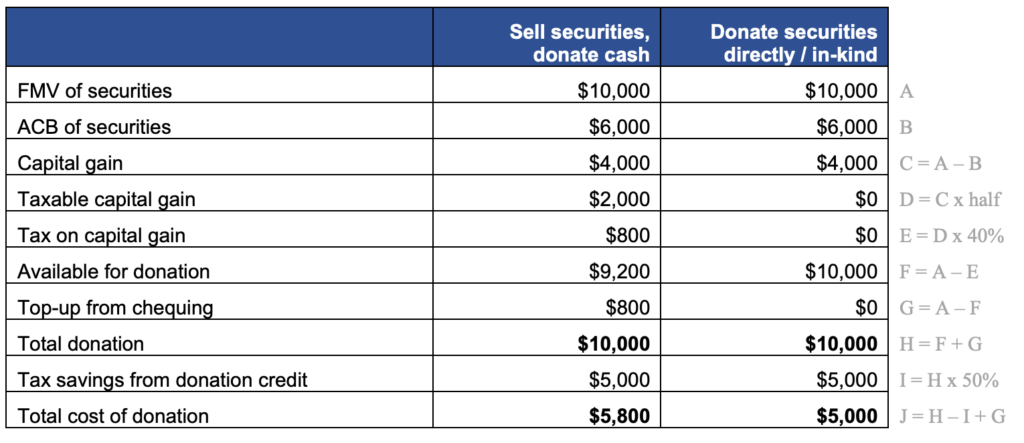
Typically, when there is a change of ownership of a security, a disposition is deemed to occur, and a capital gain or capital loss is triggered. However, when a security is transferred directly to a registered charity as a donation, the tax on any capital gain is reduced to zero. We can illustrate this with the following example:

  • Donor is in a 40% combined federal-provincial tax bracket in a province with a top donation credit rate of 50% 
  • $10,000 donation, using a security with $10,000 FMV and $6,000 adjusted cost base (ACB)
  • There has already been $200 in charitable donations made elsewhere this year

Donating securities in-kind to trigger a capital loss

The donation of appreciated securities is attractive, as we have just outlined. However, donating depreciated securities can also be a viable option, especially when it comes to your year-end tax planning. 

When you donate depreciated securities, you trigger a capital loss that will be applied against capital gains realized in that same tax year. You can then carry back any remaining capital loss to offset capital gains in the three previous tax years or carry those losses forward indefinitely. So not only will you receive a tax credit for the FMV of the donated securities, you will also be reducing your tax bill if you have realized capital gains elsewhere.